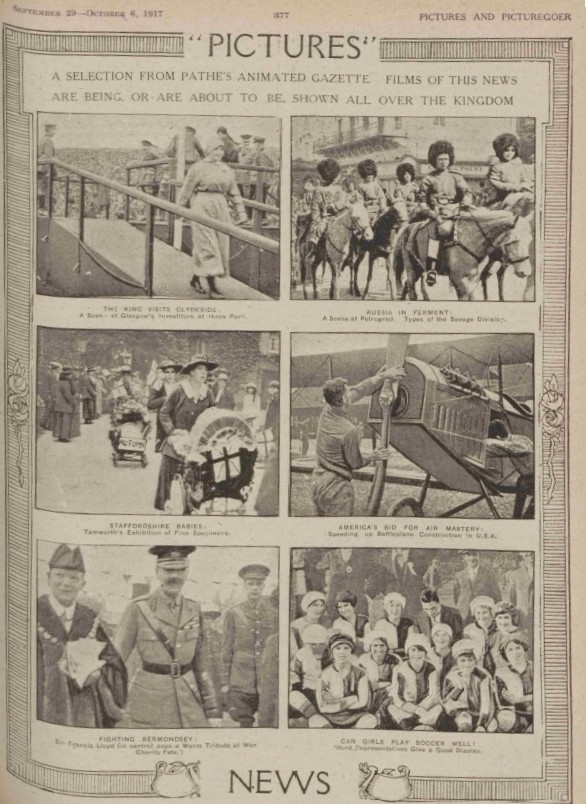
CAN GIRLS PLAY SOCCER WELL?
Ilford Representatives give a good display
(Source: BNA Picturegoer Saturday 6 October 1917 p17)
Saturday 1 September 1917 – First Public Filming of Women Football Superstars
The first ever game of the newly formed Sterling Ladies FC was filmed in September 1917 and shown in cinemas across the country by British Pathe as part of the Topical Budget Series. The Sterling Ladies FC defeated Burton Vowles (Shirtmakers) by 6 goals to 1 on the ‘Gordon Fields’ of Ilford FC. Newspaper reporters commented that the 1902 ‘Prohibition’ of women’s football by the English FA had been (through its emergency committee of three) suspended for the time being. Four of their remarkable undefeated 36 games (including their penultimate and 35th game) over the two great ‘war seasons’ were filmed and shown up and down the land in the first ‘Golden Era’ of women’s football.
England had women football media superstars in 1917…
Sterling Ladies FC – The Dagenham Invincibles
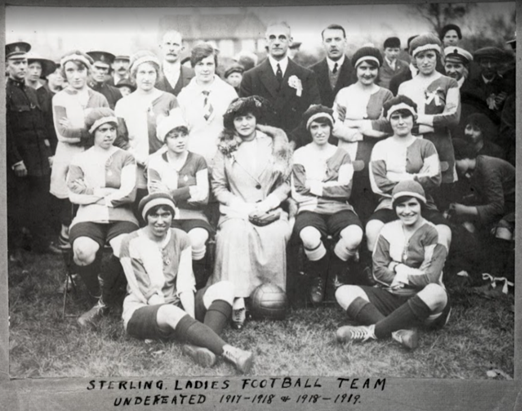
LtoR: Vic Hale, Trixie Peters, Alan Bott, Gladys Fairman, Guy Burney, W. Reynolds Vernon, Violet Foster, Maud Billet
Seated: Ada Fairman, Maud Smith, Ada Burney, Edie Mullet (cap), A Tennyson
On Grass: Maud Reader, Alice Saggers
Sterling Ladies Football Team
Undefeated 1917-1918 + 1918-1919
(Courtesy Valence House Archives, Dagenham)
Maud Smith – Superstar Footballers in the Time of Total War
The Sterling Telephone & Electrical Company of Dagenham with their communications technology experience and expertise was one of the most important factories in the country during WW1. Their story is a beautiful story of women and men coming together in a time of great need. Old Victorian ideas about society were cast aside (temporarily). If men could sacrifice their bodies, minds and lives in the trenches then women, especially young working class women, could sacrifice their femininity and potentially their fertility by playing the dangerous, men’s impact sport of football. Women in the factories took to the previously male only rite of passage known as association football in droves and by the end of the 1918-1919 ‘war season’ over 250 teams had played over 1,000 games to raise a fortune for the war effort. These games were often played after a 12 hour shift. Weaker sex indeed…
This is also the story of a beautiful, gentle and kind man. Guy Burney was a genius, easily on the same level as Marconi. He was the factory founder, owner and managing director and in order to tempt the best to rural Dagenham he created a unique sporting environment a century ahead of its time.
Maud Smith, the superstar centre forward, scored 38 goals out of 103 in the first season.
Sterling Ladies FC Fame Spreads Across the Atlantic
As early as January 1918 a picture of the Sterlings in action appeared in an American newspaper. The Tampa Times, Florida, ran an article entitled: “Women Take Up All Forms of Sport”. The American Newspapers often cut two photos together and the top part shows American women skaters knitting Red Cross Items for soldiers, whilst the bottom half shows a forward menacing a goalkeeper who has fallen on the ball to make a save with the words “good save”.
The article starts with:
“Woman in the war is going to do much toward changing the sports of the feminine world. They’ll indulge in rougher, more strenuous games than their pre-war sisters did.”
The article continues: “In the accompanying picture are some English girls playing “soccer” and that one fair player has made a “good save”. In plain United States language, she has dashed out from behind the goal and fallen on the ball. Both girls are members of famous football team of the Sterling munitions works, which recently won the woman’s championship* in a warmly contested game with the workers of the Vickers munition plant.
*There was no championship, that is just journalistic hyperbole. The Vickers reference refers to two games in the previous October and November 1917. On Saturday 6 October the Sterlings defeated Vickers Dartford in a home match in Dagenham by 4 goals to nil. However, in an extremely tight return game at the Dartford ground on Saturday 10 November the Sterlings just about managed a 2 v 1 win. The Sterlings were losing 1 v 0 with 10 minutes to go when star forward Ada Fairman scored two late goals.
It is a constant source of amazement to me that the Sterlings managed to go through two whole seasons undefeated. They had some very close calls!
Maud Smith – Dagenham’s Superstar Centre Forward
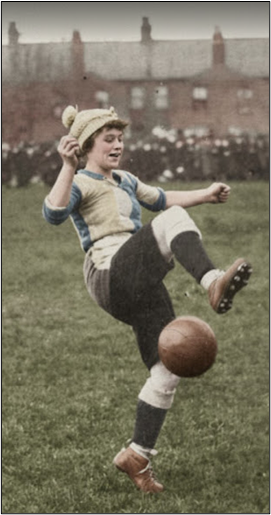
Maud Smith – Chief Goalscorer for ‘The Blues’ – Season 1
(Source: BNA Daily Mirror – colourised by author)
Maud Smith – 38 out of 103 Goals in One Season.
The biggest WW1 Museum in the world is in Kansas City. The National WW1 Museum and Memorial has been dedicated by the US Congress as the Country’s official museum dedicated to WW1. In 2026 Kansas is one of the host cities for the male football world cup with six games scheduled. To celebrate, the museum is running a significant exhibition from April to November entitled ‘The Beautiful Game’. Several rare and valuable items from the #SteveBoltonCollection are going to feature, thanks to my good friend and top historian Clive Harris. The exhibition is to feature a small recreated football pitch with several mannequins dressed for the central powers e.g. Germany, Bulgaria, Ottomans and the allies.
Maud Smith in the iconic blue quartered football kit and bobble hat has her own mannequin.
She will be carrying the torch for the women footballers of WW1 over 100 years after their supreme contribution to the war effort. The fact that this is in an American City with the world’s first dedicated stadium built for women’s football is, to quote my American friends, awesome.
The Media Superstars of Dagenham in 1917
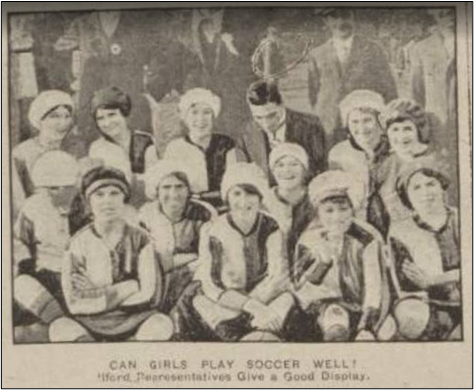
Sterling Ladies FC – The Legendary Dagenham Invincibles
Featuring in Picturegoer Magazine in October 1917
An Incredible Four Games Filmed
1917-1918 Season
Filmed Game No1 – Saturday 1 September 1917
Sterling Ladies FC 6 v 1 Burton Vowles Ladies – Played at Ilford
https://www.britishpathe.com/asset/77335/
(1st game of Season 1)
Filmed Game No2 – Saturday 20 April 1918
Sterling Ladies FC 2 v 2 Vickers Crayford Athletic Club – Played at Southend
https://www.dailymotion.com/video/x89yzur
https://www.youtube.com/watch?v=ri_xYzWdFRE (with sound + colour)
(19th game of the Season 1)
Filmed Game No3 – Saturday 4 May 1918
Sterling Ladies FC 11 v 0 London General Omnibus Co Ladies – Played at Ilford
https://www.britishpathe.com/asset/77396/
(20th and final game of Season 1)
1918-1919 Season
Filmed Game No4 – Saturday 12 April 1919
Sterling Ladies FC 2 v 0 Handley Page Ladies FC at Ilford
https://www.britishpathe.com/asset/77840/
(Penultimate game of the Season 2 + Penultimate Ever Game)
Filmed Game No 1 – Sterlings 6 v 1 Burton Vowles – Sat 1 Sep 1917
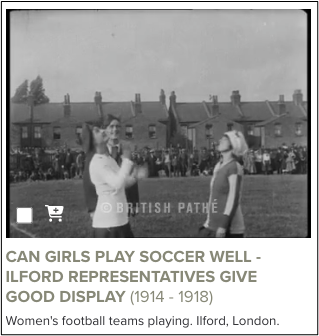
CAN GIRLS PLAY SOCCER WELL
ILFORD REPRESENTATIVES GIVE GOOD DISPLAY (1914-1918)
British Pathe ID: 1890.45 https://www.britishpathe.com/asset/77335/
(This film is identical to Film ID: 1884.16)
29 Second Clip at Ilford Football Club
The game was played to raise funds for the Cowlin Memorial Fund to remember local hero Horace Cowlin. The football match was part of a much bigger fete. There was an athletics competition including the ‘Canadians’ and the famous Surrey Athletic Club which included 48 prizes. The 1st Essex Volunteer Regiment and 3rd Cadet Battalion, Essex Regiment bands provided musical entertainment. The management of the Hippodrome had arranged for a number of eminent professional artistes to entertain the crowd. The referee was George Shalders (ECFA) and the local MP, Sir Peter Griggs and Lady Griggs were there to distribute prizes.
The film starts with the two captains, Edie Mullet of the Sterlings and Ms Williams of BV tossing the coin with referee Shalders. The Assistant Honorary Treasurer of the Sterling Amateur Athletics and Social Club, Mr E. T. Shalders can then be seen kicking off the game. There then follows footage of general play with Burton Vowles, who were playing their first game, trying hard in white tops and black skirts. The final shot is of the Sterling team relaxing after the game with George Shalders.
The Sterlings were leading 2 v 1 at half-time thanks to Ada Fairman and a reply from F. Parish. After half-time Violet Foster added a third and then the Dagenham team’s “dashing centre forward”, Maud Smith, added two. Edie Mullet finished off the sixth goal with a “ripping shot”.
Mr. E. F. Vowles – Surrey Athletics Legend
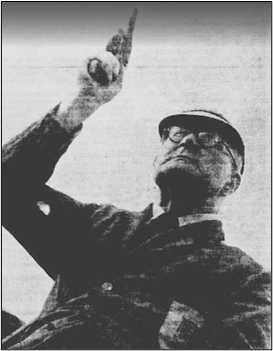
Mr E. F. Vowles Officiating at an Athletics Meet aged 85
(Source: BNA Surrey Advertiser Wednesday 4 June 1952 p1)
August 1917 – Two Cricket Matches
On Saturday 18 August 1917 Barking Hospital held a huge fundraising fete in Barking Park with around 2,000 attendees. Justice of Peace and soon to be Ilford M.P. Sir Peter Griggs attended and spoke about the great need for local councils to build and support hospitals, referencing the ‘deplorable calamity which happened so recently at the Ajax Chemical Works’. (The disaster in question led to the deaths of 73 people when a fire ignited 50 tonnes of TNT in the Silvertown area on the Isle of Dogs, initially suppressed by the Government of the day.) The fete included a mother and baby show, a band contest, beauty contests for girls (aged 6-8, 8-14, 14-25, 25+) and boys (aged 6-8, 8-14 and 14-25), a mock rescue of boy scouts by the St John Ambulance Brigade and local Nurses, a display of scouting activities and a sports contest. Mr W. R.Reynolds Vernon, General Secretary of the Sterling Athletic and Social Club, organised the sports at short notice. ‘An item that was closely watched and applauded’ was the women’s cricket match where Sterling beat Burton Vowles.
One week later, a number of wounded soldiers were guests at the Burton Vowles and Co Sports Day at the Spotted Dog sports ground in Forest Gate, which is now run by fan-owned Clapton Community FC. The Sterlings were their guests and as well as the usual walking and running races there was also a women’s cricket match, easily won by the Sterlings. Football stars Edie Mullet and Alice Saggers bowled well and Maud Reader showed ‘capital form with the bat’. (The Sterlings had a star cricketer in their captain Miss Lazarus who scored 49 and took 6 wickets). Maud Reader won the 100 yards scratch race and Maud Smith led the winning relay team. I have no doubt that these two events led to the invitation to Mr Vowles to constitute a women’s football team for the Sterling’s first ever game.
Mr E. F. Vowles was for his entire life a passionate and much loved supporter of amateur athletics. The remarkable picture above is accompanied by the following text:
RUNNERS EYE VIEW of the starter at the Whit-Monday sports meeting at Guildford. Mr. E. F. Vowles, who is 85, is one of the best-known of track officials and was himself a leading athlete 60 years ago, winning over 300 prizes. He has been starting races at Guildford and other meetings since 1915.
The Cowlin Memorial
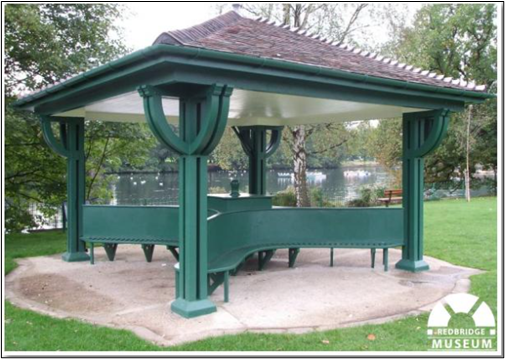
The Cowlin Memorial
Valentines Park, Ilford
(Source: Courtesy Redbridge Museum)
Horace Cowlin – A Brave Man
Horace Cowlin was the proprietor of a jewellery shop in Ilford High Road and was killed on the first day of the battle of the Somme in July 1916. Horace ‘was in the act of throwing a bomb at the Germans when he was shot in the wrist and dropped the bomb, thus setting the fuse going… ’ With only a few seconds before the grenade exploded, Horace threw himself upon the grenade, thereby shielding his fellow comrades from the explosion. In August 1916, Horace’s fellow members of the Ilford Chamber of Commerce met to discuss proposals to erect a memorial in his honour and fundraising started apace. It was decided that a wooden shelter, something both ornamental and useful, would be gifted to Ilford Council. The shelter and a stone memorial plaque were unveiled on 6 December 1917.
The Sterlings first football match was to raise funds for this beautiful memorial.
In 2006, the memorial was refurbished and the original commemorative plaque was cleaned, re-gilded and re-sited between the shelter and the lake. In July 2016, the memorial shelter and stone tablet were restored by Vision Redbridge Culture & Leisure, with funding from the London Borough of Redbridge, to commemorate the centenary of both Horace’s death and the Battle of the Somme.
It was hoped that Horace would be awarded a Victoria Cross. Unfortunately, it needed an officer to have witnessed his act of bravery and this wasn’t the case.
Information taken from Redbridge Museum website, with thanks. If you do happen to be in the area, perhaps take some flowers…
Filmed Game No 2 – Sterlings 2 v 2 Vickers Crayford* – Sat 20 April 1918
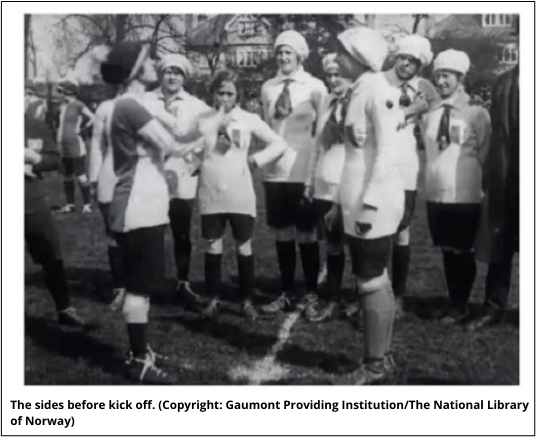
Vickers Crayford Athletic Club Players with Sterling Captain A. Dixie
(Note the Crayford cravats and badges marked VCAC)
40 Second Clip at Chalkwell Park, Southend
This was the penultimate and 19th game of the season for the Sterlings. It was a huge charity fundraiser for the three Southend war hospitals. This was a very challenging game for the Sterlings who were taking on the mighty undefeated Vickers Crayford Ladies. The Sterlings can be seen in their blue kits and Vickers Crayford can be seen wearing black shorts and white tops with natty cravats. If you look carefully you can just make out VCAC (Vickers Crayford Athletic Club) on their badges. There were claims printed in the papers afterwards that some Vickers Dartford players were involved, but the Sterlings had already played against Vickers Dartford, both home and away, earlier in the Season. None of the listed names match the Dartford team lists, so on balance I think that this should be recorded as Vickers Crayford.
Superstar centre forward Maud Smith is easy to spot as she is the only Sterling player sporting an all-white bobble hat, which needs frequent readjustment! The game was kicked off at 3pm by the Chief of Police, Mr Henry Kerslake and the women were entertained to tea afterwards by Commandant Henry Walker of the V.A.D hospital, the Mayor of Southend being indisposed.
Three pictures of this game appeared in the Daily Mirror.
*This clip was heralded as the ‘first known footage of a women’s football match’ and as a combined Vickers Crayford and Vickers Dartford team. I don’t think that either of these apply now.
Filmed Game No 3 – Sterlings 11 v 0 LGOCo – Sat 4 May 1918
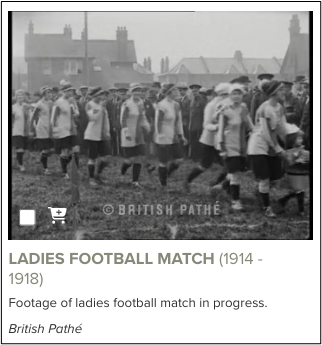
LADIES FOOTBALL MATCH (1914-1918)
British Pathe ID: 1892.45
https://www.britishpathe.com/asset/77396/
38 Second Clip at Ilford Football Club
This was the last ever game for star centre forward Maud Smith. She retired in style from football after this game to marry the Sterling’s Tennis Captain. The newly formed ladies football team of the London General Omnibus Company (Forest Gate), also known as ‘The Clippies’ played the mighty Sterlings to raise money for the Ilford Emergency Hospital. The two teams can be seen walking through the crowd onto the pitch. The Sterlings in their iconic blue kit are seen leading 3 year old Mascot Maisie Smith (no relation) onto the pitch. They are followed by the ‘greens’, who had filled the role of bus conductors, an occupation previously reserved for men. The ‘greens’ were essentially an early West Ham Women’s team and both teams were given the great honour of starting the following season at Upton Park. West Ham United is therefore a pioneer of women’s football. Ada Burney, wife of managing director Guy Burney is seen kicking off the game, with Alan Bott refereeing. Some game play then ensues with Maud Smith again noticeable in her white bobble hat.
Media Superstars
The Daily Mirror featured two pictures of this game, the first picture showing the captains with Maisie Smith and the second depicting the legendary Maud Smith in action. Picturegoer newspaper showed a picture of Ada Burney kicking off in her posh shoes with a toe poke. The Winnipeg Tribune featured two pictures with the headline: “Winnipeg Girls Should Follow English Maidens and Get Into Football Game”. One picture is an action shot with the ‘Bus girls’ defending their goal. The other is the team picture with all the men edited out, including Guy Burney, which I feel is a trifle unfair. The team picture (men not edited out) appeared in the New York Herald with the line:
“This group is the Sterling Ladies Football Club, the unbeaten women champions of the country”
“PICTURES” WEEKLY NEWS
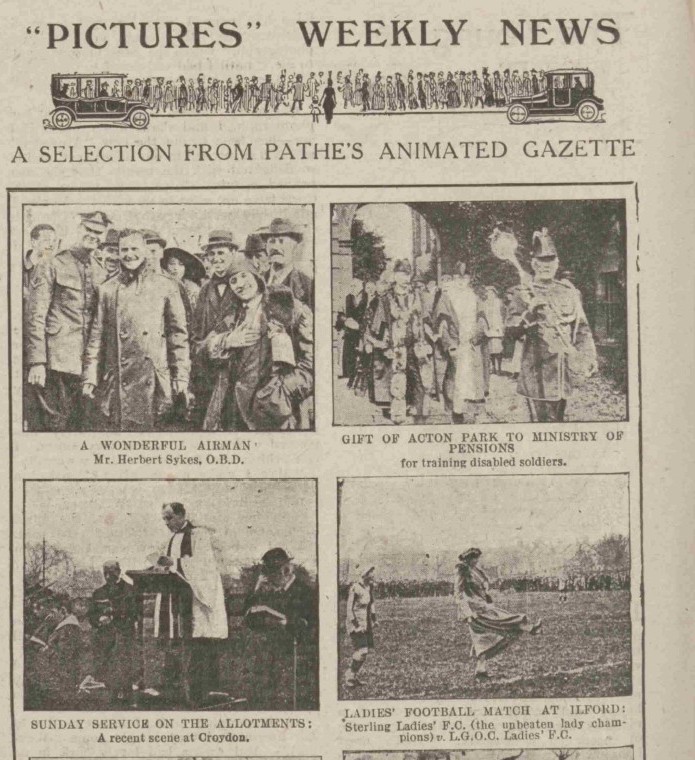
LADIES FOOTBALL MATCH AT ILFORD
Sterling Ladies’ F.C. (the unbeaten lady champions)
L.G.O.C. Ladies F.C.
(Source: BNA Picturegoer Saturday 18 May 1918)
Ada Burney Kick’s Off
One aspect that I would like to emphasise is the mixing of classes. Most, if not all of the Sterling Ladies FC were from very humble origins in the area around rural Dagenham. Within a few short months they were mixing with the very top of society and the ‘establishment’ e.g. Members of Parliament, top Church officials and top Military officials, etc. I can only imagine what the buzz must have been like back at the factory when all their family and friends had seen them on Pathe news in the local cinema. This sort of ‘My Fair Lady’ journey was extremely rare in this era.
Pathe Gazette in Kinematograph Weekly (Bottom Left)
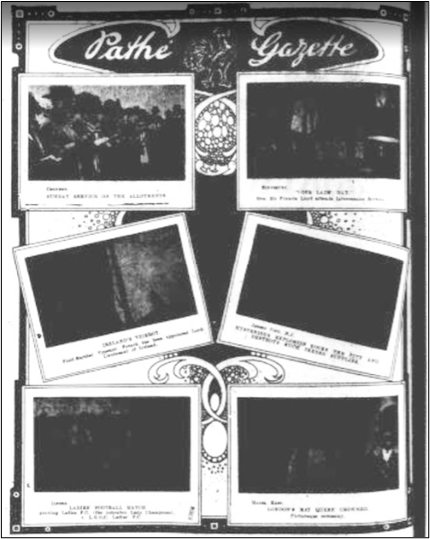
Note from Editor: This is the best image of this newspaper sheet there is and is only included as reference
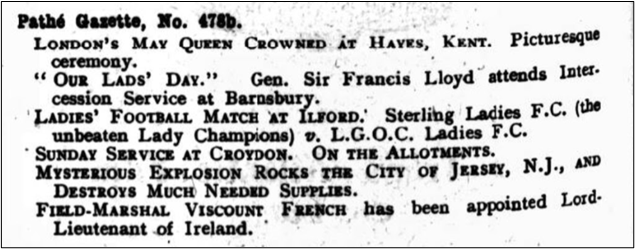
ILFORD, LADIES FOOTBALL MATCH STERLING LADIES F.C.
(the unbeaten Lady Champions),v. L.G.O.C. Ladies’ F.C.
(Source: BNA Kinematograph Weekly Thurs 16 May 1918 – Bottom Left)
Filmed Game No 4 – Sterlings 2 v 0 Handley Page – Sat 12 April 1919
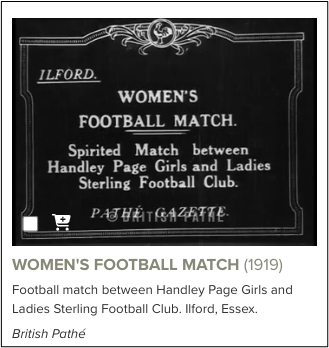
Ilford. Women’s football match. Spirited match between Handley Page Girls and Ladies Sterling Football Club
British Pathe ID: 1910.45
https://www.britishpathe.com/asset/77840/
2 Minutes and 43 Seconds Clip at Ilford Football Club
This is remarkable footage at nearly 3 minutes in length and was part of Pathe Gazette No 555. A crowd of 4,000 were there to see the ‘famous’ Sterling Ladies take on the only recently formed ‘Aircraft Girls’ from Cricklewood. The Sterlings had played them earlier on in January and thrashed them 6 v 0 at their home ground in Dagenham (now the home ground of the current West Ham women). This was a much closer affair. Again, Mascot 4 year old Maisie Smith, relative of Mr D. J. F. Campbell, one of the organisers, was present. Regular referee Mr Alan Bott helped organise and also took the whistle.
The footage starts with the two teams lined up in the goals, the Sterlings in blue and Handley Page in their tunics with large, floppy, tam o’shanter style hats. Much loved local MP Sir Peter Griggs is shown in the centre circle where Lady Griggs consented to kick off. The Handley Page defence and goalkeeper (white top) are kept very busy with waves of Sterling attacks. I absolutely love the bit at half time where a couple of the Handley Page players notice the camera whilst trooping out for the second half and touch their hair whilst coyly glancing at the camera. More game footage ensues of further waves of Sterling attacks. The media savvy Sterlings are then seen walking out followed by Sir Peter and Lady Griggs.
Topical Budget
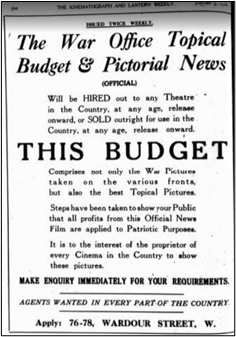
(Source: BNA Kinematograph Weekly Thursday 3 January 1918)
Newsreels at the Local Cinema
The Topical Budget was a silent newsreel first issued in September 1911. During the First World War, the British Government took control, which led to a confusing variety of names, including the War Office Official Topical Budget from May 1917, and the Pictorial News (Official) from February 1918. In May 1919, the reel reverted to the name Topical Budget and by then had been sold to the newspaper magnate Edward Hulton.
Several Cinemas in Each Town
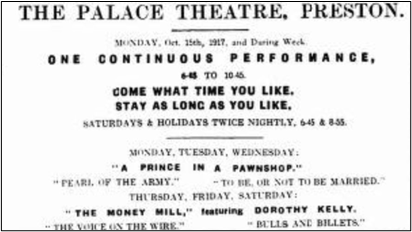
(Source: BNA Preston Herald Saturday 13 October 1917)
One Continuous Performance
Here is a typical example from one town. In Preston, as well as the Palace Theatre, you could also visit the Empire Theatre, Preston Royal Hippodrome, Theatre Royal, Princes Theatre or the Palace and Picturedome. The Pathe newsreels were a popular way of filling the bill with interesting items.
Valence House Museum and Archives
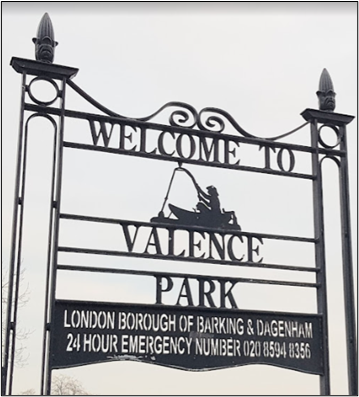
(Source: #SteveBoltonCollection)
An Architectural Treasure
The London Borough of Barking and Dagenham has a fantastic resource on the edge of Valence Park in Dagenham. Valence House is the only surviving manor house in Dagenham and it is home to the borough’s collections and archives. The archives hold a treasure trove of evidence from the Sterling Telephone and Electrical Company archives. (Please note, the Sterling Engineering Company which was established on the same site with the same name in 1940 and made the famous sub-machine gun had no other connection to the long departed Telephone and Electrical Company, they simply built on the same site and took the same name.) The archives are housed in a modern building with a lovely cafe. Valence House is a Grade II listed building and houses the fantastic museum. The House was surrounded by a rare Medieval hand-dug moat which was first documented in 1650. In late 2025 it was announced that the remaining North moat would be repaired and restored. Both museum and archives are well worth a visit.
Sir Alfred Ramsey – ‘The Heath’ and Dagenham Boy
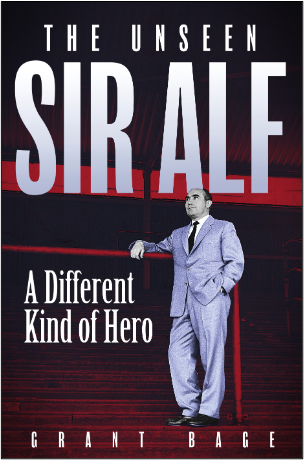
Sir Alf – Neighbour of the Sterlings
A large part of the history of Dagenham is about the Becontree Estate which dominates Dagenham and was built between 1921 and 1935. My good friend, Grant Bage has produced the most astonishing re-write of the history of the archetypal Englishman and football legend, Sir Alfred Ramsey. He was a Dagenham boy. He grew up by ‘the Heath’ and members of his family seemed to some on the new Becontree Estate to have Gypsy, Roma, Traveller (GRT) heritage. He suffered racist epithets due to that, and whispered rumours about Alf’s ancestry surface even during and beyond his 1963-1974 year spell as England Manager. I won’t say anymore, other than please read this fantastic book.
Maud Reader – Star Centre Midfield
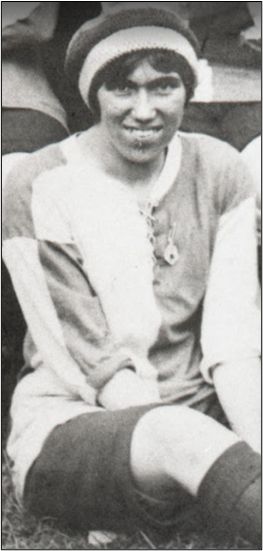
Maud Reader
(Courtesy Valence House Archives, Dagenham)
Maud Reader – Gypsy, Roma, Traveller Heritage?
Maud Reader was an important regular in the team. She played in the very first game and she played in the very last game. Sterling’s last game took place in April 1919. It was an away game in Chelmsford in the pouring rain against the mighty Hoffmanns (vast ball bearing and tank rollers factory, bigger than Marconi). She scored the two winning goals in their 2 v 0 win, thus sealing Sterling’s place in history as the Dagenham Invincibles.
Extensive research by a descendant of the Reader family has been very kindly shared with me. Author Grant Bage has also very kindly shared his research and knowledge with me. Maud and her family grew up by ‘the Heath’ as close neighbours of the Ramsey family. Whatever Maud’s heritage and background we can see from the evidence so far that she was a much cherished, skilled and valued member of one of the most important football teams in the history of women’s football, if not football history as a whole. This will be the subject of a further article.
My thanks to Kathryn and Grant.
“The Invincibles Play” by Amanda Whittington

Book of the Play by Amanda Whittington
Celebrated in Culture
1917: World War One is raging in Europe. In Britain, Sterling Ladies – known as the Dagenham Invincibles – are playing to win. For two whirlwind seasons, they never lose a game. Yet once peace is restored, the factory girls must hang up their boots and see triumph fade into obscurity.
2023: Injured footballer Maya follows England’s progress through the Women’s World Cup. The world has changed, yet the roar of the Lionesses echoes the Invincibles’ war-cry. Watching at home, Maya fears she’ll never play again – but as she loses herself in the present, she hears the call of the past and finds fresh hope for the future.
Amanda Whittington’s play The Invincibles celebrates two generations of inspirational women, and their adventures on the football pitch a century apart. It premiered at Queen’s Theatre Hornchurch in 2023, and offers rich opportunities for other theatre companies looking to score a hit with their audiences.
I was the historical consultant for this amazing play by Amanda. I urge everyone to buy the book (less than £10) and go and see it if you get the chance. See if you can spot the Brian Clough quote that lifelong Nottingham Forest fan Amanda sneaks into the dialogue!!
(Text courtesy of Nick Hern Books)
Headgate Theatre, Colchester

“The Invincibles” – Headgate Theatre – April 2026
(Image courtesy Headgate Theatre)
Support Local Theatre
Amanda’s amazing play has featured all over the world since its inaugural run in September 2023 at the Queens Theatre in Hornchurch and The New Wolsey Theatre in Ipswich. The rights for an amateur production are available through Nick Hern Books and casting can run from 7-10 female and 2-5 male plus ensemble cast. Staging can be as simple or as complicated as the Director chooses. The play has been performed so far (to my knowledge) by:
- LAMDA
- Broughton Players at the Preston Playhouse (I went to school in Broughton!!)
- Tudor Players in the Library Theatre in Sheffield
- First Act Arts in the Brindley Theatre, Runcorn
- Aschcam Middle School, Sydney, Australia
The Headgate Theatre is a small, vibrant theatre in the middle of Britain’s first city Colchester, famous for its Roman heritage with the original name of Camulodunum. The theatre itself is an architectural gem, originally a 19th century Chapel. Director Paul T Davies states that he has had an astonishing amount of support from the community, including Colchester United Football Club. The play has been one of the easiest to cast and crew. On Thursday 5 March 2026 ‘Creative in Colchester’ are supporting a talk and exhibition about the Invincibles to mark International Women’s Day and raise money for #HerGameToo at the theater. I am often asked in media interviews what my famous international footballing granny would have thought of women’s football today. I find myself wondering what those ordinary working class Dagenham women would have thought about inspiring today’s footballers and football fans and being celebrated in culture? This sort of fabulous community art must continue to be supported and thrive.
The Misogynistic Conspiracy Theory Myth
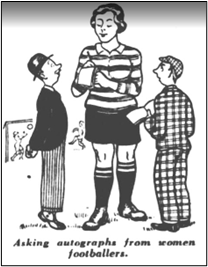
Fear of ‘Amazons’
(Source: BNA)
Some Inconvenient Truths
“A bunch of nasty men got together in 1921 and banned women’s football. It disappeared completely and then started up again in 1971, when the men allowed it.”
This is how the history of women’s football is usually presented and I now believe that this is wrong. More than that, it is unhelpful to future development. The fixation with the 1921 ban assumes that there were no women of influence for 50 years and ignores the inconvenient truth that they were generally of the middle class establishment and were vigorously opposed to women playing football. The purpose of this article is to celebrate the first Media Superstars of women’s football, the Dagenham Invincibles. Here follows some context. I am simply going to state my views and a more in depth argument with research back-up can wait for an article dedicated to that purpose.
My view is that English society was not ‘ready’ for a large expansion of ‘working class’ women playing football until post the 1966 men’s world cup. That is not to say that there were not significant challenges and barriers. Importantly though, this is when we see a number of leagues forming, particularly in the Midlands. It is my view that there were two ‘golden eras’ of women’s football:
- 1st Golden Era – World War 1 – Particularly the 1917-1918 and 1918-1919 ‘war seasons’.
- 2nd Golden Era – 1920-1921 Season
This presents the question: Why did we have these golden eras, some 50-ish years before we were ready as a society?
We had a total war which turned societal norms on their head, temporarily. If it was necessary for men to sacrifice their bodies and their health fighting on the front line then women wearing skimpy clothing and playing the male impact game of football, possibly damaging their bodies for future motherhood was likewise an outcome of the country fighting for its future. My impression is that most women footballers from this era accepted the ending of this peculiar situation with alacrity. In many ways, my thought is that they probably felt that the ending of the war and the return of the menfolk was a way to ‘get on with their lives’. I haven’t performed a thorough analysis but I have found evidence that several of the Sterlings married very shortly after the war, or in Maud Smith’s case, during the war. The 1921 ban came 3 years after the end of the war and had nothing to do with it.
Conclusion
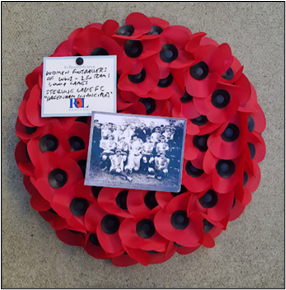
11th Hour, 11th Day, 11th Month
(Source: #SteveBoltonCollection)
#MadeInDagenham and #MadeInStHelens
This is a very personal story for me. My granny Lizzy Ashcroft’s magnificent career with the St Helens Ladies only started in April 1921 and had basically come to an end a few months later thanks to the October and December 1921 F.A. Resolutions. It was only the fact that St Helens thrashed the Dick Kerr Ladies 5 v 1 in 1923 that she was able to continue her amazing career until retirement in 1935.
I want to make it quite clear that I think the 1921 ban was wrong.
I am, however, absolutely convinced that the F.A. of the time were honourable ‘Victorian gentlemen’, who felt that they were doing the right thing and protecting women. As a historian I have amassed quite an amount of evidence to support this point of view. I would urge anyone who is interested, as a starting point, to read Sir Frederick Wall’s 1935 autobiography. One of things that surprised me in my research was the barriers put in the way of women’s football by influential women during the 1920s and 1930s. Again, I have amassed a lot of evidence and it wasn’t just football that was regarded as not suitable for girls and women. I have found prohibitions against rugby, boxing, distance running and rowing. My friend Amanda Whittington, who it a top historian herself, has a great phrase for this: ‘bigger wheels were in motion’. Suzy Wrack’s book ‘A woman’s Game’ does a great job at looking at the laws and diktats post WW2 which tried to force women back into domestic roles. If asked, I would rather have tried to run a women’s football team in 1935 than in 1955.
There are two main points that I would like the reader to take from this article. The first is that women’s football enjoyed its first golden era due to a cataclysmic event, total war. After the war and particularly in the calendar year 1919 women’s football almost entirely disappeared. I have found no evidence to alter my view that the vast majority of women footballers accepted this fact and got on with their lives. As more and more institutions get interested in this history they seem preoccupied with ‘the ban’. The 1921 ban had nothing to do with this amazing era of women’s football. To the end of the 1918-1919 war season over 250 teams played over 1000 games to raise a fortune for the war effort. This is a beautiful thing in very dark times and should, I think, be positively celebrated. The second golden era came about for very different reasons. Yes it was due to the war, but it was long after the war had finished and it was because we had a completely broken country. Families starved to death in our major cities and riots took place all over the country due to poverty and unemployment. Two distinct categories of women’s football took place, ‘pea soup football’ and what I term the ‘high profile charity model’. ‘Pea soup football’ is the term typically used to describe local community football in areas of industrial dispute where wives, girlfriends and female relatives would play whilst tins were rattled to collect money to keep people in food. This type of football had a resurgence in 1926 and I thoroughly recommend the work of Professor Alethea Melling and Patrick Brennan.
The second point that I would like to emphasise is just how special the media coverage of the Sterlings was in this first golden era. Apart from the Portsmouth ladies nearly all football in this era is only covered locally. I am aware of some counter examples but statistically I don’t think they disprove my point. The nearest that I can find to this media interest is two years later when the second golden era begins due to the visit of the French national team for a four game tour against the Preston team the Dick Kerr Ladies. The evidence that I have for this is significant. During WW1 the Dick Kerr Ladies played 30 games and lost 4* of them (*possibly 5). Nearly all articles about these games are featured in the Preston Herald or the other Preston newspaper the Lancashire Evening Post (the LEP despite its name is actually a Preston paper). There are a couple of games towards the end of the 1918-1919 season where a combined Preston/Bolton team takes on a Tyneside munitions team called ‘Newcastle’ where obviously there is some coverage in Newcastle as well. Rather tellingly, I think, is the gap between the Dick Kerr Ladies last game of the 1918-1919 season which was played on 31st May 1919 to their first game of the 1919-1920 season. Their next game was not until 7th February 1920, over 8 months later. Prior to the first French game nearly 3 months later on 30th April they managed 5 games against ‘Liverpool Ladies’ which is basically the ex-munitionettes of the area. So, in 8 ‘football months’ they have managed 5 games, and they lost 2. This is not giving manager Alfred Frankland much chance to brand his team the ‘unbeaten lady champions’ and I am not surprised that no more games were arranged against ‘Liverpool’. The French tour was one of the most important tours in the history of women’s football. It ‘lit the spark’ for the second golden era. This golden era came to an end thanks largely to the actions and influence of the F.A. in October and December 1921.
I want to make it quite clear that in my view the Dick Kerr Ladies are the greatest women’s football team of all time and I am so proud of my granny’s 13 years with them. However, out of historical accuracy I think it should be recognised that they did not become famous until April/May 1920. This was long after the end of WW1.
As well as the Pathe clips photographs of the Sterlings featured in the Daily Mirror, the Illustrated Sporting and Dramatic News, Picturegoer Magazine, Kinematograph Weekly, Glasgow Daily Record, The Tatler, Birmingham Daily Gazette, Sheffield Independent, The Daily Herald, The Tampa Times, The Winnipeg Tribune, The New York Herald and probably others that I haven’t located. They were media superstars.
Any history of women’s football should start with the Sterlings front and centre.
I have had the great honour for the last three years of laying a wreath at the Cenotaph in London 11th November to remember the contribution of the women munitionette footballers of WW1, as part of the footballers contingent. This is thanks to the amazing folk at the charity the Western Front Association which promotes the memory of the great war. The ‘golden team’ of the first ‘golden era’ was the Sterlings, with 34 wins and 2 draws. The Invincibles…
The Sterlings shone briefly, but ever so brightly and we should remember them.
Article copyright of Steve Bolton – January 2026