
It’s nearly 50 years since the hot summer of 1976. It was the warmest on record and to be alive that summer was an extraordinary thing because for 15 consecutive days between 23rd June and the 7th July, the temperature reached 32.2C somewhere in the UK.
The long hot summer not surprisingly, impacted significantly on professional cricket in England and Wales, through intense heat, water shortages and rock-hard playing surfaces, which just so happened to coincide with a visit from The West Indies cricket team.
Embed from Getty Images
The Sizzling summer of ’76 brought widespread drought to the UK and coincided with a tour from the West Indies Cricket team.
The intense heat caused county cricket grounds to turn brown and it was challenging to maintain pitches and the combination of intense heat and severe drought meant that pitches were baked hard turning them into treacherous surfaces that sadly accelerated the decline of English cricket’s standing against a dominant touring West Indies side.
Following England captain Tony Greig’s mis-guided statement that he intended to make the tourists ‘Grovel’, the West Indies furious at his comments, used the hot, hard conditions to unleash a barrage of bowling, winning the 5- match Test series 3-0 and also the ‘One -Day’ series 3-0, transforming Test cricket from a game of skill and technique into a battle of survival, which fundamentally convinced other nations to prioritise pace.
Embed from Getty Images
England captain Tong Greig got into hot water when he said he would make the West Indies ‘Grovel!’
‘None of the West Indies players ever confronted me about my comments’ wrote Tony Greig in the’ foreword’ of David Tossell’s book about the series called ‘’Grovel’’, published in 2007, ‘They were just faster and nastier, whenever I came to the crease to bat. Their actions did the talking and in the end we were beaten by a magnificent team playing some fantastic cricket and I was quite happy to do the grovelling.’
‘Greig’s ‘South African-ness’ wrote Sankran Krishna in 2016, ‘undoubtedly played a huge part in the animosity that his comment evoked’.
The South African born Greig qualified for England through his Scottish father and aimed for an international career that was impossible with South Africa during its ‘apartheid -era ‘ sporting isolation.
However, after the first two Tests ended in draws, it initially appeared that England had a chance of winning the series, but that was before things took a sharp turn for the worst.
The baked pitches were proving ideal for the West Indies’ four -pronged attack comprising of Michael Holding, Andy Roberts, Wayne Daniel and Vanburn Holder, who exploited the uneven bounce to their advantage and the conditions allowed the bowlers to target English batsmen with a relentless barrage of ‘bouncers’, most notably against Brian Close(45) and John Edrich(39), who were subjected to a brutal physical battering without helmets, during the 3rd Test at Old Trafford; Holding would take 14 wickets for 149 runs.
Embed from Getty Images
3rd Test match between England and West Indies at Old Trafford, Manchester, 9th July 1976.
Close and Edrich ( dubbed as ‘Dad’s Army’ by many), acting as openers in Manchester endured what can only be described as ’75 minutes of hell’, facing the West Indies attack on a fast, cracked pitch; Close, who had been recalled( his first Test had been as far back as 1949 and he hadn’t opened for England since 1955), was severely bruised from taking numerous blows to his body, chest and arms, prompting him two years later to write his autobiography ‘I Don’t Bruise Easily’, which highlighted his reputation for courage and the book covers the infamous series and the immense pain and bravery he showed against a relentless attack in what was his final defiant stand in Test cricket.
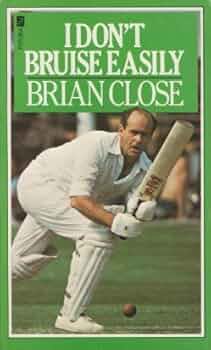
‘I don’t bruise easily!’ Brian Close’s autobiography, explains what he went through in the 3rd test at Old Trafford in 1976.
Close told the Daily Mirror that he felt ‘like he was on the wrong end of a coconut shy’ and should have been receiving ‘blood money.’
Richard L Williams in ‘Heatwave: The Summer of 1976-Britain at Boiling Point’ (2025), recounts his thoughts on watching back the duel between Holding and Close:
I’m seeing’, says Williams, ‘Rorke’s Drift, Custer’s Last Stand, the plucky old white man locked in hopeless defence against the youthful violence of the oppressed and now watching it in my sixties, it’s Close I feel for, as I can only imagine how much nerve you would have needed to face that bowling at 45 years of age.
The quick, sun-baked surfaces also allowed massive totals to be amassed, with the visitors scoring over 400 in three innings and 687 in the final Test at The Oval, where Viv Richards scored 291.
‘They were in their pomp’, says Williams, ‘Thrilling batting matched by awe-inspiring bowling.’
Both Close and Edrich were dropped for good after the 3rd test, even though they had actually performed better than many of their younger team mates in dealing with the West Indian onslaught in the second innings ; the pair put on 54 for the first wicket with Close scoring 24 and Edrich 20.
However, it is easy to forget that there were some impressive performances by England’s players too, with centuries for David Steele in the 1st and Tony Greig and Alan Knott in the 4th Test, a ‘double century’ from Dennis Amiss at The Oval and the consistently strong bowling of Bob Willis, Jon Snow, Mike Selvey and Derek Underwood.
In a sign of how the heat affected the game, MCC allowed members to remove their jackets inside the Lord’s pavilion for the first time in 189 years, although they were still required to wear ties.
‘The 1976 Grovel series’, says Colin Babb writing for’ Caribbean Intelligence’, ‘helped to further cement the relationship between West Indies cricket and the ‘Caribbean diaspora’ in Britain and the ‘76 series remains one of the significant and eventful West Indies cricket achievements in their history.’
It acted as the foundation for twenty years of world dominance for the West Indies and it saw the establishment of the ‘four fast- bowler’ strategy, which became the corner-stone of their two decades of success; it is widely regarded as a turning point, which transformed the team into an unstoppable force, (later featuring Joel Garner, Colin Croft, Collis King, Courteney Walsh and Malcolm Marshall ), that dominated world cricket until the early 1990’s.
While the scorching summer provided ideal conditions for the bowlers from the Caribbean, many believe that they would still have been highly effective , though perhaps not as overwhelmingly dominant, in a normal British summer because while the pitches were ideal, the West Indies bowlers also demonstrated that their pace ‘through the air’ mattered most; even on less-lively pitches their sheer speed, combined with a lack of helmets for batsmen, was a lethal weapon.
As a footnote, it is also important to note that the tour undoubtedly accelerated the introduction and adoption of protective helmets in Test cricket, marking the end of the ‘unprotected era’; although prototypes existed, the first modern -style helmet with a visor was introduced by England’s Dennis Amiss in 1977, directly in response to the terrorising pace of the ’76 West Indies tour and the first batsman to wear a helmet in a Test was the Australian Graham Yallop in 1978 against, you guessed it…the West Indians.
Embed from Getty Images
Graham Yallop was the first to use a protective helmet with a visor in 1978
Article copyright of Bill Williams