
In April 1891, the following acrimonious exchange of letters took place in The Era, a weekly paper noted for its sports coverage and theatrical content, on the subject of who had initiated the use of glass tanks in music halls and theatres to produce dramatic aquatic scenes. John Douglass acknowledged that ‘from time immemorial’ professors of natation had exhibited in tanks, but he maintained that he had been the first to utilise a tank for scenic effects in 1886, a claim rejected by Professor Frederick Beckwith who said he had produced a dramatic piece twenty years earlier.
Letters to the Editor. A QUESTION OF TANKS. Era, Saturday 11 April 1891, 17.
Sir, I have read Mr Beckwith’s letter, and whilst having every respect for the gentleman when in the water, must object to the vagueness of his assertions out of it. In the first place, I never said I was the first man to travel with a tank (I know from time immemorial professors of natation have exhibited in tanks). I said, and maintain, I was first to bring into practical use, i.e., the first to put a large tank of real water above the level of the stage for producing scenic effects, and the sensation the novelty created in October 1886, was shown by the extraordinary unanimity of press opinions, and the enormous business, unprecedented, in the history of the theatre.
How is it, if, twenty years ago, Mr Beckwith filled his mythical tank in Paris that at the present time the Parisian managers have arranged for mine, as, according to Mr Beckwith, it can be no novelty there. Again, ‘Over twenty years ago,’ Mr Beckwith says, ‘he placed a large tank on the stage of the Pavilion Theatre, East London, and played a sailor in the piece, and had to rescue injured innocence by diving from a bridge into the said tank.’ Mr Beckwith doesn’t give the name of the piece; he forgets the author’s name; he forgets the name of the proprietor of the theatre; he only remembers the treasury was very uncertain at the time through bad business. I can supply some of the missing links. There is no record of any piece having been played, or advertised to be played, at the time mentioned—but there is an announcement of a swimming entertainment and a dog and monkey show. My late father, Mr John Douglass, had the Pavilion Theatre, I think, at the time (he was lessee for fourteen years), and I challenge anyone in the profession to say treasury was ever uncertain under his rule.
I am, Sir, yours faithfully, JOHN DOUGLASS, Green Room Club, April 7th, 1891.
Letters to the Editor. A QUESTION OF TANKS. Era, Saturday, April 18, 1891, 16.
Sir, I am very sorry to ask space for a reply to Mr Douglass’s rather rude letter. I do not think my truthful letter deserved the answer sent. I again assert that I put a tank on and took the small part of a sailor in a piece at the Pavilion, East London, over twenty years ago. I can easily trace the date, but am busy, and did not dream Mr Douglass would doubt my statement. He sneers at my forgetfulness of the date; he must recollect how I have travelled about all over the United Kingdom at theatres and music halls, as I was the first that ever travelled with a tank, and therefore one engagement is not impressed on my memory, Mr Douglass also doubts my putting a tank on a stage in Paris; he calls it Beckwith’s mythical Paris tank. I never said the Paris tank was for playing a piece, The one I had in Paris was for the usual tank performance, the first that was ever there (Paris), some six months after peace was proclaimed in the Franco-German war.
In reading Mr Douglass’s letter of his troubles with his tank, I sympathised with him, which was the reason, of my mentioning my Paris visit, as I also had great trouble. At the time of my engagement in Paris, I was teaching the Rothschild family at Gunnersbury Park, and Mr Leopold kindly translated the French agreement, and gave his opinion as to its not being a very good engagement, as everything was so dear in Paris, and I found it so to my cost. If Mr Douglass doubts my first and this second letter, I will stake any amount against his that I prove the truthfulness of both my letters. Yours respectfully, F. E. BECKWITH.
Letters to the Editor. A QUESTION OF TANKS. Era, Saturday 25 April 1891, 12.
Sir, Will you kindly allow me to say my last words in reference to Mr Beckwith’s letter. He certainly led me to believe he was in Paris to put a tank on the stage for dramatic performances, or rather for a performance similar to which he claims as having done at the Pavilion Theatre years ago.
Mr Beckwith does not consider it rudeness to (by inference) cast a slur upon the memory of a dead manager, but it is the height of rudeness on the part of that manager’s son to refute the charge. I spoke from the information supplied by day bills of the period and the books of the theatre, Mr Beckwith prefers to trust to his memory. I leave it to your readers to say which authority would be most likely to prove treacherous.
Yours, &c., JOHN DOUGLASS. Green Room Club. April 22nd, 1891.
Whoever was in the right here, and it is always difficult to get to the truth since aquatic showmen and women inevitably ‘puffed themselves up’, this exchange of letters points to the enormous popularity of natational performances in glass tanks during the second half of the nineteenth century, a fascination that continued well into the twentieth century. Media reports suggest that the touchpaper was lit by the installing of a plate-glass tank filled with six feet of water at Cremorne Gardens in 1867 in which Natator, a twenty-year-old man called Cooper, gave aquatic performances. His show was described in some detail that year by Frank Buckland in Land and Water, an article that was widely reproduced in regional newspapers. He noted that the ‘huge human aquarium’ measuring nine feet by five feet was made of iron with a plate-glass front and that it contained four tons of water, normally kept at 62 degrees, although warmer water made the performances easier. Natator firstly stood on his head with his head on the bottom, a feat called the ‘minute trick’ that was designed to show the length of time he could stay underwater. Then he swam up to twenty lengths of the tank underwater, taking up to 45 seconds, before sitting down cross legged and grinning at the spectators while opening and shutting his eyes and mouth, just to demonstrate that this could be done. After submerging again, he ate a ‘sponge-cake or a bun’ underwater, opening his mouth afterwards to show that he had really swallowed it. Ascending to collect a soda-water bottle he then dived to the bottom and drank a ‘halfpenny-worth of milk’, chosen so that the audience could see it being drunk. He then took a few ‘whiffs’ of a lighted pipe above water before descending to smoke it and then returning to the surface to show that it was still alight. After demonstrating some ‘poses plastiques’ the piano struck up the tune ‘Froggy would a wooing go’ and he danced to the music underwater while singing the song, the volume of his bubbles matching the content of the song. He finished by performing acrobatics and his ‘porpoise trick’, the twenty-four head over heels taking 50 seconds to complete.
After the show Buckland, a medical man, examined Cooper, describing him as 5 feet 7½ inches in height and lightly built being 9 stone and 6 pound in weight although ‘exceedingly well made’ and muscular. His pulse on coming out of the water was 148 beats per minute and 20 minutes after it was 92. He listened to his heart and lungs detecting several ‘strange phenomena’, which he attributed to Natator’s body having adapted to the aquatic environment without interfering with his health, which he described as excellent. The longest he had ever remained underwater was 69 seconds and his tricks required between 10 and 30 seconds under water. While he had suffered from headaches in the early days of practicing long stays underwater these had disappeared and he had no rheumatism or aches and pains despite performing at 10.30 every night and sometimes twice a day.[1]
The following month another report observed that it was generally believed that Natator had a peculiar physical development that enabled him to remain submerged for long periods but that he had appeared the previous week with a pupil who was not as skilled as his master, but who was far more ‘amphibious than ordinary mortals’. While their performances astonished spectators and the reporter acknowledged that their abilities were beyond dispute, he questioned whether it was really healthful. He went on to say that British law, while not sanctioning suicide, ‘wisely allows people to run the risk of killing themselves in extraordinary acrobatic and other performances’.[2]
A contributor to the Penny Illustrated Paper in 1869 argued that a ‘more rational exhibition’ of tank swimming occurred at Cremorne with the appearance of the Beckwith family. Spectators were attracted by a procession headed by a band and an illuminated transparency indicating the way to the ‘Beckwith Frogs’ who were performing in a huge aquarium on the Marionette theatre stage.
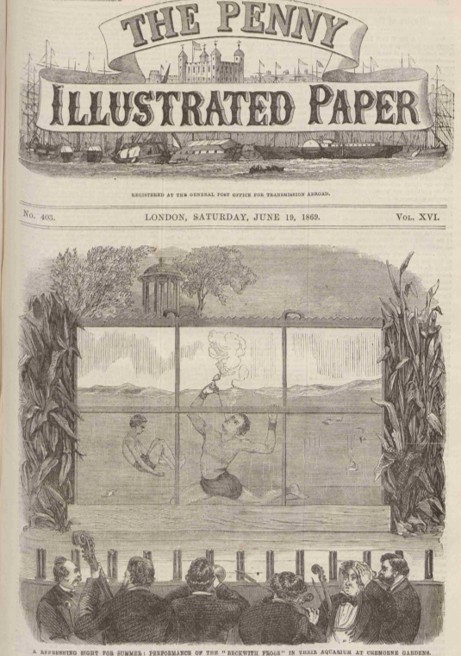
Source: Penny Illustrated Paper, Saturday 19 June 1869, 1.
The report gave an extensive description of a typical Beckwith family performance.
Master Willie Beckwith went through a series of acrobatic gyrations under water. Like a perch among minnows, he darts past the startled goldfish, and dives from one end of the tank to the other, until it is a relief to see him rise to the surface to regain breath. He plunges to the bottom again and walks on his hands; and, still immersed, gracefully performs a number of somersaults. The expert tricks of this young ‘Beckwith Frog’ are excelled by Professor Beckwith’s assistant teacher of swimming, a skilful young exponent of the art named Thomas Attwood. Easy and graceful in his sub-aqueous movements – quite finished in style, in point of fact – this lithe young swimmer is also as agile as an otter. To eat, drink, and smoke even under water appears, however, to come quite naturally to Attwood. As he sinks, he is seen to place a portion of a roll in his mouth and to eat the whole of the bread before emerging. Down into his seemingly native element he glides once more, this time with a lemonade bottle full of milk, which be drains to the last drop before rising. Like Old King Cole, he now calls for his pipe. Taking a whiff or so above water first, Merman Attwood rejoins the goldfish and enjoys a smoke in the attitude depicted by our Artist for an unconscionably long time, the blue vapour rolling up from his mouth in small volumes, which can be plainly seen, while the bowl of the ‘churchwarden’ of course remains above the surface. Capping this clever feat by remaining recumbent at the bottom of the aquarium for seventy seconds (too long a time for even you to be submerged without risk, Mr. Attwood), the elder ‘Beckwith Frog’ brought his performance to a close amid a well-merited burst of applause, which was shared by Master Willie Beckwith. Clad in fleshings and drawers, after the fashion of acrobats, these adroit young divers flash about the aquarium with a fishlike facility that is extraordinary enough to draw all London Cremorne-wards to see them. It may be added, for the benefit of those who many wish to witness the performances of the ‘Beckwith Frogs’ at an earlier hour than eleven that on Saturday afternoons there is a children festival at Cremorne, when all the amusements of the gardens may be enjoyed at a reduced rate. Another opportunity of seeing these marine acrobats at a convenient time will be offered on Monday evening, the 28th inst., when they are to appear at an aquatic entertainment to be given by Professor Beckwith at the Lambeth Swimming-Bath. Champion swimmer of England for several years, the Professor is, necessarily, sadly, also a famous Performer in the water; and the natatory skill of himself and family causes his swimming fetes to be deservedly popular.[3]
Tanks
Entrepreneurs like the Beckwiths further developed their shows by constructing travelling tanks that could be used in theatres and music halls at home and abroad. Victorian aquatic performances depended on advances in technology that enabled tanks to withstand immense water pressure, provide visibility for audiences, and remain entirely portable. Tanks were engineered with heavy-held architectural support frameworks, iron skeletons consisting of a modular cast-iron or wrought-iron frame that locked together to form a rigid cage. To reduce weight and maintain stability, only the front wall (and sometimes parts of the sides) was made of glass while the back and bottom plates were constructed from thick, interlocking iron or steel panels sealed with rubber gaskets or lead putty. The increasing popularity of these shows in the second half of the nineteenth century relied on significant developments in glass technology since the standard glass of the early-to-mid 1800s was too brittle and filled with optical distortions. Industrial polished plate glass became significantly cheaper and more durable after the repeal of the UK Glass Duties Act in 1845, and the glass fronts were normally 1 to 1.5 inches thick, while the outward pressure was distributed by engineering a series of smaller, thick glass panels divided by reinforced iron mullions. Tanks were designed to be completely flat packed for transportation, which involved unbolting the iron framework, sliding out the heavy glass panels, and packing them securely into custom, heavily padded wooden crates. The heavy components travelled via train between major cities and then flatbed horse-drawn wagons carried the iron and glass from the station to the music halls. Because these glass sheets were incredibly heavy and fragile, they were packed and moved vertically on edge to prevent them from snapping under their own weight during transit. At the theatre a reinforced timber platform would be built over the stage floor to support the immense weight, the tank would be bolted together, the joints would be sealed with waterproof cement, and the tank filled using the theatre’s water mains or local water pumps.
A trade in swimming tanks was a feature of the natational business and both individual owners and theatres that had provided their own tanks for performances sold them on as circumstances changed. In 1892, Professor Oakes was advertising his small swimming tank, ‘Adapted for railway travelling, with all the latest improvements’, for sale because of his ‘declining health’.[4] In 1912 an exhibition swimming tank, complete and ready for use on stage, pier, or as a side show, was being offered for sale at a ‘sacrifice price’ and in 1917 a ‘Glass Swimming Tank, wheels on and off stage, complete with every accessory’ was for sale for at least £60. Potential purchasers could send 6d. for a photograph.[5] In 1923, Professor Beaumont ‘having given up the business’ was offering for sale two swimming tanks (for Music Hall or Circus) in good condition, one of which had 4 glasses 1 in. thick and one of which was on wheels. He was asking £50 for the lot, and they could be viewed at the Grundy Arms in Poplar, London.[6] As late as 1954, a stage swimming tank with a Perspex front and complete with trailer, was on sale for £145 or near offer in Harrow.[7]
The Beckwiths in Tanks
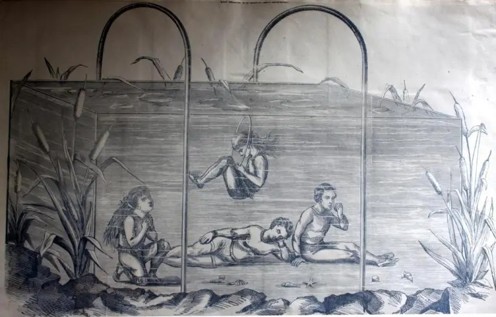
The Beckwiths in Tanks
Source: https://rbkclocalstudies.wordpress.com/2016/03/24/wonders-of-cremorne-acrobats-and-angels/
Beckwith quickly adapted his Cremorne performances into something that could be exhibited in any venue. In fact, he had already begun that process before 1869. In March 1868, the proprietor of the Birmingham Concert Hall had engaged the Beckwith amphibious family ‘at great expense’. The troupe performed in a huge tank made of iron with the exception of the front, which was made of very thick glass capable of bearing the pressure of the 4 tons of water. Each of the 3 members of the family took turns in entering the tank and executed a ‘number of surprising evolutions’ while a powerful ‘lime light’ was focused on the water so that spectators could see every movement. The junior members of the family appeared first and went through a series of ‘clever exploits in diving and swimming with the youngest performer, ‘a mere child’, showing surprising agility. The professor then exhibited a number of ‘incredible’ performances. He swam, dived, ate, drank, smoked, and conducted a tune played by the band to demonstrate that he could still hear despite being submerged, all of which done with the same apparent ease as if he were in a ‘comfortable room’. The professor’s eldest son was a skillful swimmer and he went gracefully through several aquatic evolutions, his ‘crowning feat’ being to dive to the bottom of the tank and lie down as if asleep for what appears to be a considerable time to the audience. He had on occasions remained in this position for 1 minute and 45 seconds and his stay under water had sometimes been so prolonged that some of the ‘fair spectators’ (presumably meaning the women in the audience) had become alarmed. This fears were dispelled when he rose to the surface with such grace and ease to make his bow amid loud and well-deserved rounds of applause.[8]
Over the course of the next forty years female members of the Beckwith family became even more central to the attraction of these shows. In October 1887 Agnes Beckwith and her sister Lizzie were appearing in a ‘handsome crystal tank’ at the Canterbury Music Hall. Agnes’s power was a ‘proverb’ and while the dimensions of the tank did not allow her ‘unlimited scope’ she convinced all the spectators of her’ capableness and her right to rank as one of the foremost exponents of the art of natation’.[9]
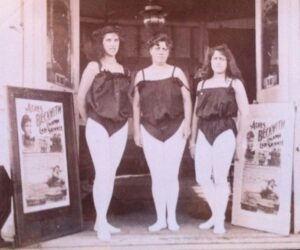
Source: Author’s Private Photographic Collection.
In September 1898, Lizzie Beckwith was regularly performing on the Promenade Pier in Ramsgate.
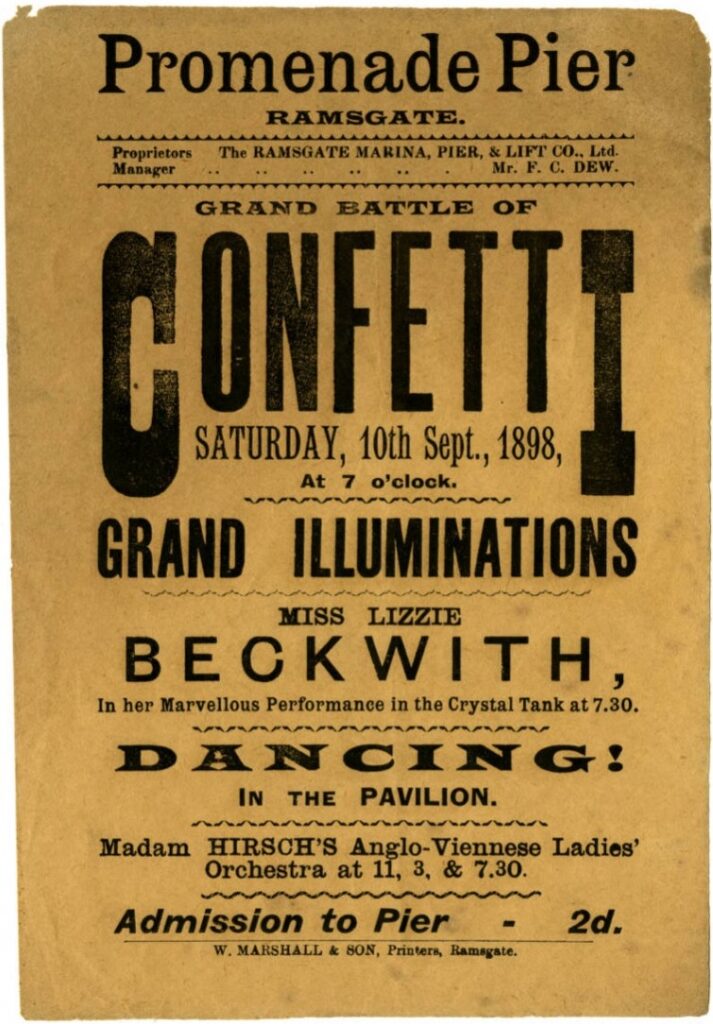
Source. National Fairground and Circus Archive, Electric Modern Printing Company (NFA0196), Variety and Music Hall Posters, c1890 – 1980.
Thomas Attwood
Integrated into the Beckwith shows, particularly in the period between 1869 and 1880, was Thomas Attwood, who was not only Beckwith’s teaching assistant but also regarded as probably the finest tank performer of the Victorian period. ‘Aquarius’ argued that Thomas ‘unquestionably’ took ‘precedence of any other aquatic artiste in the particular line’. While he did not necessarily exhibit anything ‘startling’, what he accomplished was marked with ‘such grace and finish that men of experience gladly admitted the ‘Man Fish’ worthy of being considered facile princeps. He was also one of the very few who could remain for any length of time motionless under water. ‘Aquarius’ had seen him immersed for 2 min 28½ sec in cold water at a time when Thomas was ‘under the depressing influence of something stronger that the last-named liquid’.[10]
In the early 1860s, Thomas competed regularly in swimming events. In October 1863 he won a race over two lengths of Lambeth Baths for youths under 16 and by June 1865 he was being described as ‘winner of the All England Handicap and many other prizes’. At that stage he was working as a teaching assistant to Beckwith at Lambeth and giving ‘great satisfaction by the steady performance of his duties’.[11] In July, Beckwith was willing to back Thomas to swim any ‘lad in England of his own age (under 18) for £10 and upwards’ and in November Thomas won a race open to all England over six lengths of the Lambeth Baths. He subsequently appeared in a great All-England Handicap at the Baths in May 1866.[12]
While he was clearly a successful swimmer in his time, and he had also gained something of a reputation as a swimming teacher, Attwood really made his mark in the aquatic world as a tank performer. Advertising his benefit at Lambeth Baths, 156 Westminster Bridge Road, London, on Monday 17 October in 1881, Bells Life described him as ‘one of the very best performers in the tank in the early days’, noting, in addition, that ‘he was also one of our most graceful swimmers’.[13] An aquatic entertainment at Lambeth Baths promoted by Fred Beckwith in June 1869 included his sons alongside ‘Mr Attwood, the wonderful Man Fish in his extraordinary performance in a monster plate-glass aquarium, as performed nightly by him at Cremorne Gardens’. Attwood went through several feats, eating, smoking, drinking and living the life of a fish, with the facility of a gymnast. During the performance he remained motionless under water for 2 min 6 2-5th seconds as timed using a Benson chronograph. The tank was iilluminated by an oxyhydrogen limelight provided by Professor Wells of the Canterbury Hall and a band was in attendance.[14] In October 1869, Attwood took a benefit at the Lambeth Baths featuring the Professor and his children as well as the ‘wonderful Man Fish in his monster plate-glass aquarium, previous to his leaving London to fulfill his engagements’.[15]
These ‘engagements’ took Attwood far and wide. He appeared as ‘Natator’ in his ‘magnificent Crystal Tank’ at the Pavilion Theatre of Varieties, Whitechapel Road, London, between March and April 1870 in what was billed at the ‘most astounding performance ever witnessed’.[16] On 8 August 1870 the ‘aquatic celebrity known as the man-frog, Natator, and Scott, the diver, gave a series of entertainments at the Victoria Baths, Clifton, similar to those which had taken place at Rennison’s Baths on 6 August.[17] In January 1871, Natator (the great Man-Frog) had a twelve night engagement at the Royal Wear Concert Hall in Sunderland and then commenced performing at the Royal Music Hall in Jarrow for three weeks, from 6 February.[18] In September, Messrs Parravicini and Corbyn, theatrical, musical and general agents, announced that they had obtained an engagement for Mr Attwood, the wonder ‘Man-Fish’ in St. Petersburgh, Russia.[19]
In December 1871, ‘Natator’ sometimes called the ‘Man-frog’ appeared at the London Pavilion accompanied by Master Beckwith. The Morning Advertiser reporter noted that,
The ordinary conditions of respiration do not seem to be binding upon Natator who remains under water an astonishingly long time and performs some really wonderful feats. One great characteristic of this entertainment is its freedom from anything which could suggest the painful or repulsive. There is nothing of the kind in the doings of Natator and his young companion, neither is there the faintest suspicion of danger. The performance is unique and both persons concerned are such perfect masters of the art of swimming that their evolutions are followed with feelings of the most perfect confidence rather than with any degree of apprehension. Natator eats and drinks in the depths of his large glass tank and imitates the fish-like mode of proceeding. He illustrates the mysteries of acrobatism under water by turning somersaults and achieving other things which ordinary bathers would not dream of attempting. Long practice and great care must be necessary to obtain such wonderful results and the success which has followed Natator since he commenced his public career is thoruoghly well deserved. The frequenters of the London Pavilion cannot be called apathetic at any time and they do not forget to applaud the ‘Man-frog’ or ‘Man-fish’, to his heart’s content.[20]
In April 1873, the Man-Fish ‘wonder’ Attwood performed his acrobatic feats in his ‘magnificent glass aquarium’ at the New Colston Hall in Bristol in a turn described as ‘The Greatest Novelty that has ever appeared in this City’.[21] In June he was back in London, at the Crowder’s Music Hall in Greenwich, billed as the ‘Man-Fish’ and appearing alongside Agnes Beckwith, billed as the ‘Mermaid’, in a large glass tank holding three tons of water.[22] He was appearing again with the Beckwiths at the Lambeth Baths in November. Although the swimming pools were closed during the winter Fred Beckwith had converted ithe facility into a gymnasium with an indoor running track and the swimming tank was fitted at the extreme end of the baths with a large glass front and a ladder for access. Willie and Agnes were able to perform their tank feats, a ‘mode of entertainment that has of late years been highly appreciated by the public’, and both young performers demonstrated that they were every bit as well at home in the water as out of it. Some ‘pretty specimens of floating and other branches of the art of swimming’, were given, and they were followed by Mr Attwood, who went through a similar entertainment. He remained for a lengthened time under the water in a reclining posture, during which the band played ‘Sweet Spirit, hear my prayer.’ Upon rising to the surface, he was greatly cheered.[23]
On November 4, 1874, Thomas appeared in a swimming entertainment alongside ‘little Miss Beckwith’ and Willie Beckwith, both of whom were presented with a gold medal after their performances, organised by Fred Beckwith, at Brills Baths in Brighton. During the evening ‘Natator (Attwood) and Professor Beckwith both exhibited their well-known powers and illustrated different style – old and modern’.[24] By 1876, Thomas was also acting as a swimming master at these baths, alongside another Beckwith protégé Richard Giles, both men being credited with doing a ‘great deal towards fostering and encouraging the growing favour and popularity in which the art of swimming is held’. Attwood, surnamed the ‘Man Fish’, performed his unique skills in a glass tank so that all his movements could be ‘closely watched and adequately appreciated’.[25] His performances denoted long practice and much skill in what could be termed ‘acrobatic aquatics’. Unfortunately, the ‘Man Fish’ did not have the mastery over the ‘ills that flesh is heir to’ that he possessed over the water and in September he was taken ill just previous to entering his tank and he had to be replaced.[26]
Thomas Attwood died in Newington Infirmary, London, on 17 June 1893, aged forty-five. Census returns between 1851 and 1891 show that he had remained unmarried and lived all his life on Devonshire Street in Newington. The 1871, 1881, and 1891 censuses record his occupation as a swimming teacher, but his aquatic career was much more complex than that. As a tank performer and professional swimmer known as the man-fish he had built a considerable reputation at home and on the continent, something of an achievement for a man whose years, according to the formal records, had seemingly been restricted to a single location.[27]
Article Copyright of Prof Dave Day
References
[1] “Natator” or the Human Frog. Kentish Chronicle, Saturday, 31 August 1867, 3.
[2] Brett’s St. Leonards and Hastings Gazette, Saturday, 21 September 1867, 6.
[3] Penny Illustrated Paper, 19 June 1869, 7.
[4] Advertisements. The Era, Saturday 30 April 1892, 24.
[5] World’s Fair, Saturday, 18 May 1912, 19; Saturday, 31 March 1917, 18.
[6] The Stage, Thursday, 31 May 1923, 26.
[7] The Stage, Thursday, 12 August 1954, 15.
[8] Birmingham Daily Gazette, Monday, 16 March 1868, 2.
[9] London and Provincial Entr’acte, Saturday, 8 October 1887, 5.
[10] ‘Aquarius’. Swimming. Sporting Life, Saturday, 29 January 1881, 4.
[11] Bells Life in London, 10 October 1863, 7; 3 June 1865, 9.
[12] Bell’s Life in London, Saturday 8 July 1865; Swimming Races at Lambeth Baths. The Era, Sunday 5 November 1865, 5; Bells Life in London, 26 May 1866, 7.
[13] Benefit of Attwood. Bell’s Life in London, Saturday, 8 October 1881, 12.
[14] Bell’s Life in London, Saturday, 26 June 1869, 7; Lambeth Baths – Beckwith Entertainment, The Sporting Gazette, 3 July 1869, 477; The Era, Sunday, 4 July 1869, 3.
[15] The Sportsman, Saturday, 9 October 1869, 3.
[16] Weekly Dispatch (London), Sunday, 27 March 1870, 24; Jewish Record, Friday, 8 April 1870, 12.
[17] Aquatic Entertainment at Victoria Baths. Bristol Times and Mirror, Tuesday, 9 August 1870, 2.
[18] The Era, Sunday, 29 January 1871, 14.
[19] The Era, Sunday, 24 September 1871, 14.
[20] London Pavilion. Morning Advertiser, Friday, 1 December 1871, 3.
[21] Western Daily Press, Saturday, 12 April 1873, 2.
[22] Greenwich and Deptford Chronicle, Saturday, 14 June 1873, 5.
[23] Athletic Sports at the Lambeth Baths. The Era, Sunday 9 November 1873, 3.
[24] Bell’s Life, Saturday 14 November 1874, 8.
[25] Aquatic Entertainments at Brills. Brighton Guardian, Wednesday, 7 June 1876, 5.
[26] Brill’s Baths Aquatic Sports. Brighton Examiner, Tuesday, 19 September 1876, 3.
[27] Modern English Biography, Netherton and Worth, Truro, 1908; London Illustrated News, 12 August 1865, 147; The Era, 24 June 1893.

![“And then we were Boycotted”<br>New Discoveries about the Birth of Women’s Football in Italy [1933] <br> Part 11](https://www.playingpasts.co.uk/wp-content/uploads/2021/07/Boycotted-Marco-Part-11-440x264.jpg)