

To read Part 1 – Click HERE
Inevitably, the success of Thomas Attwood’s aquatic performances led to several imitators over the years from individuals and families keen to capitalise on the obvious popularity of tank exhibitions. One early rival was a Professor Jefferson. In early January 1872, Fred Beckwith, ‘The Old Champion’, wrote to Bells Life on ‘the original Man Fish’ Attwood’s behalf to answer a ‘very boasting challenge’ from Jefferson and to tell him that Attwood was in Berlin where he had been re-engaged for four months so he could not be in England until May. Jefferson showed ‘very bad taste in assuming this acknowledged clever artist’s name but if this second Man Fish really wanted a match’ then he should stake a good deposit of around £30 with signed articles at Bell’s Life and he would ‘not be disappointed’. Attwood would contend in any tank that Jefferson liked and to show that the original Man Fish was prepared for a match he would leave all ‘the preliminaries’ in the hands of Bell’s Life. He had already left two deposits at the office and while his last deposit of £5 was lying uncovered Jefferson had an advertisement in L’ Entr’ Acte stating he would compete against anyone for £200 a side. He had also advertised (‘copied by many’, bad taste again) that he had originated these performances. ‘Natator’ had in fact been the first but the first that Jefferson had seen in a tank was Fred and the real original Man Fish, Attwood, all of whose tricks he attempted. In addition, ‘the first tank he was ever in I sold him after the Man Fish had been using it for two years’.[1]
Jefferson, still styling himself ‘The Great Man-Fish’, clearly took no notice of Beckwith and at the end of January he was appearing at the People’s Hall in Stockport in what he boasted was a second engagement in three months with an ‘increase of salary and benefit, a clear proof of success’.[2] Another advert on the same day announced that,
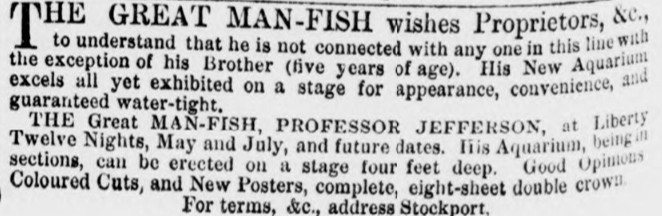
Source: The Era, Sunday, 29 January 1871, 14.
In November that year Jefferson was performing at the Royal Cambridge Music Hall, Commercial Street, Bishopsgate, again billing himself as the ‘great Man-Fish’. He and his brother, featured as ‘Little Willie, the Aquatic Wonder’, performed ‘marvellous feats’ in a glass tank holding 2,000 gallons of water. Jefferson declared that his show was ‘Imitated by many, excelled by none’.[3]
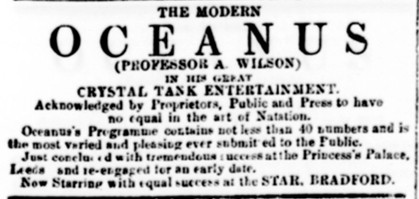
Jefferson was by no means alone in seeing the financial benefits in mimicking Attwood’s performances although some individuals went a little off-piste. The headline act at the Princess’s Palace in Yorkshire in January 1878 was Mr Swann ‘the Man Crocodile in his Crystal Tank’ fighting underwater ‘living serpents, boa constrictors, alligators, tortoises and crocodiles’.[4] A more traditional tank exhibition was being performed at the Princess’s Palace by ‘Oceanus’ in May 1885.[5]
Source: Magnet (Leeds), Saturday May 16, 1885, 7.
Female Natationists
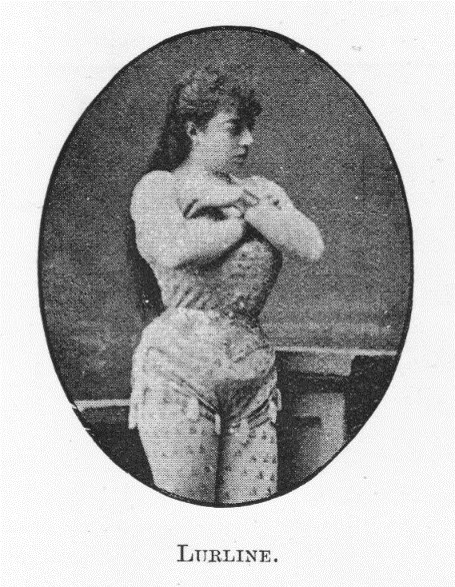
Taking their lead from the example of the Beckwiths several female entrepreneurs developed their own tank performances. On Boxing Day 1881, the Oxford Music Hall presented, for the first time in England, Lurline, the ‘Queen of the Waters’, who had ‘gained world-wide renown on the Continent by her extraordinary feats of natation’. She went through a series of performances at the bottom of her crystal tank and ‘in a serpentine manner’ wound herself between the spokes of a chair fastened at the bottom of the tank’. She was celebrated for the length of time she could remain underwater and for eating and drinking below the surface ‘with the most perfect ease’. The tank was lit by electricity to allow everyone to witness the performance. According to The Stage in April 1882, Lurline’s performances at the Oxford had been extremely successful.[6]
Source. Charles Newman, Swimmers and Swimming, or The Swimmer’s Album (London: Henry Kemshead, 1899), 35.
At the opening of the Bromley Baths in Kent in May 1890, ‘Miss Ada Webb, P.S.A. and F.O.S., Champion Lady High Diver of the World, Winter and Summer off the West Pier, Brighton’, gave her ‘well-known graceful and talented performance in its entirety, the same as given before H.R.H. The Duke of Cambridge’ in her crystal tank. Her underwater feats included gathering shells, eating, drinking, opening and closing eyes and mouth, peeling an apple, answering questions, beating time to waltz, taking snuff, sewing, smoking, writing, singing, the Monte Christo sack act, position of prayer etc.’.[7] Her ‘long and varied entertainment’ lasting 75 minutes was split between the pool and her ‘extra-large crystal tank’ (one specially constructed for Baths and Big Shows) which was met with ‘the greatest enthusiasm, the universal opinion being, here, as elsewhere, that Miss Ada Webb stood alone as a complete, and the only perfected, exponent of every branch of natation’. For ‘vacant dates and full particulars (Specially Constructed tank for stage work, Glass 1½ inches thick)’ enquiries should be directed to F.G. Beckett, Superintendent and Swimming Master, Bromley Swimming Baths, Kent. Writing five years later, Cygnus’ said that he had dropped in to see Ada performing in her crystal tank in Yarmouth and ‘having heard much of her skill’ he had not been surprised by the ‘ease and grace’ with which she accomplished her feats. She reclined underwater for minutes at a time, ‘sewing, writing, peeling apples, and doing many other domestic duties which are not usually associated with such an element’. The tank was not large enough for her to give an exhibition of proper swimming, but he believed she was a ‘perfect mistress of natation’ and an ‘agreeable and experienced instructress of the art’.[8]
Families
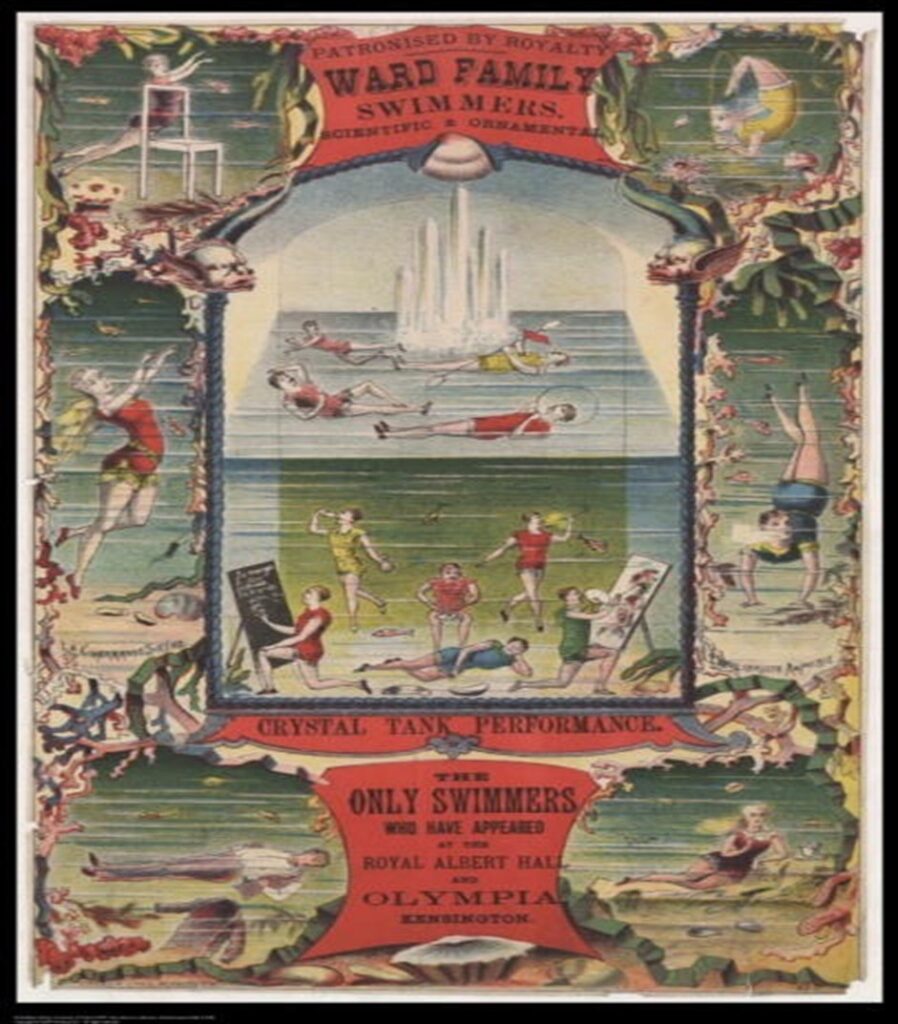
Family members remained an important feature of many natational exhibitions. Professor Cottrell and his sister, who were ‘little short of being amphibious’ did some excellent feats of natation in a glass tank in 1893. The lady peeled a lemon while under water, the gentleman smoked a pipe, turned backward and forward somersaults, and many other surprising feats.[9] Several members of the Ward family exhibited together and separately, and we have them to thank for one of the few illustrations of tank swimming that have survived.
Source: Private collection
In 1889, Miss Ada and Master Ernest appeared in Bournemouth to give their ‘really marvellous entertainment under the water in the crystal tank’. Among the many items of interest were the walking on the hands at the bottom of the tank by Ernest, standing on the head by Ada, ‘waltzing, swimming through a chair, personating writing, sleeping, marching, and the actions of a seal, together with somersaults both backwards and forwards, and double swimming and revolving’. A ‘clever and charming programme of attitudes and actions conceived almost impossible by those seeing them for the first time’.[10]
The Johnsons
With seven daughters, all of whom were involved at one time or another in the family’s aquatic exhibitions, the Johnson family was well placed to take advantage of any opportunities that presented themselves.

Source: Keith Myerscough. Baths and Washhouses Historical Archive. https://www.bathsandwashhouses.co.uk/archive/articles/keith-myerscough/
As with Attwood, the patriarch of the family, Peter Johnson, of Wellington Street Baths in Leeds, had had some issues with Professor Jefferson, noting in January 1872 that he had accepted Jefferson’s challenge on 23 December for £200 a side. Since Jefferson now refused to go ahead with the match Johnson was claiming his sovreign as a forfeit. He would be happy to arrange a fresh match and give Jefferson 30 seconds in duration of time under water.[11] Johnson was obviously confident in his abilities and he and his brother were both later reported as having stayed underwater for four minutes.[12]
On 28 June 1880, accompanied by his daughters Edith and Lizzie, aged eleven and thirteen, Johnson began a week of aquatic performances In Aberdeen in a tank erected on a platform about six feet high. The tank had glass on one side and had the water been a little clearer (the professor made a joke over its ‘brown’ appearance by informing spectators that it was the identical water which supplied the city of Aberdeen) the interesting feats performed by the aquatic trio would have been more appreciated by better seen. The little girls, ‘to whom air seems comparatively an unnatural element’, went through a number of very clever swimming feats while the capacity of their father for remaining long periods below the water (on one occasion he was underneath the surface for 3 minutes and 3 seconds) elicited ‘repeated marks of approbation’. The professor ate a piece of bread and drank ‘a tonic’ and by making a hollow space with his hands round it, smoked a cigar below water.[13] According to G.F. Pardon, Johnson apparently smoked a cigar under water, by putting the lighted end in his mouth and blowing the smoke through his nose.[14]
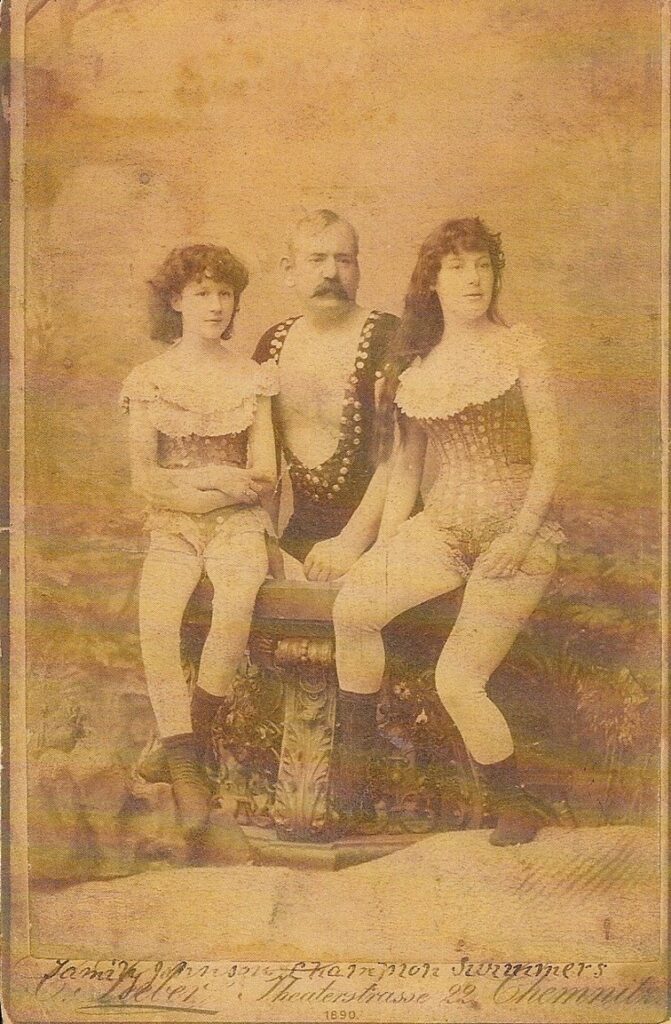
Source: Personal Collection.
In 1882, Johnson and his daughters performed at the Royal Theatre, this time in a large well-lit tank, and the turn was made instructive as well as amusing by the Professor giving a lecture in which he pointed out the utility of each mode of swimming and floating in saving life from drowning. On this occasion Jonson remained underwater for more than three and a half minutes.[15] In July they were appearing in ‘Paget’s Pleasant Pastime’ at The Theatre in Yarmouth giving a performance that was described as ‘really wonderful’. The tank, containing about 500 gallons of water, was placed in the centre of the stage, and after introducing himself and his daughters the professor gave a short practical lecture in which he debunked the common belief that eyes could not be kept open under water as well as giving some useful swimming hints. He also ‘puffed himself up’ by recounting the highlights of his, and his daughters, swimming careers, and he made the most of the fact that after an engagement in Bradford the Princess of Wales had forwarded a small token of appreciation of their performance to daughters Lizzie and Theresa. The act began by picking up porcelain eggs which had been thrown into the tank, one of the daughters diving gracefully to the bottom of the tank and placing the eggs in the basket she was carrying. She was then joined by her sister, and they performed a series of feats, sometimes reclining at the bottom of the tank and another time floating below the surface apparently in animated conversation, smiling at each other and seeming to be as happy and comfortable as though water was their native element. ‘Veritable mermaids they are and their pater a merman’.
The professor then dived into the tank and began a playful and amusing scene between parent and children in which they glided gracefully under and over each other in all kinds of ways without colliding, although in so confined a space. Johnson subsequently went down to the bottom of the tank and wrote with chalk on a slate the name of anyone chosen by the audience and on the other side of the slate ‘kind regards’. While this was being done his daughters submerged and stayed there for a time witnessing his operation. He also smoked a cigar under water, lighting it above the water and keeping it alight somehow in the hollow of his hand. He drank a bottle of milk at the bottom of the tank, and he and his daughters ate solid food under the water, with as much ease and comfort as ‘ordinary mortals at a breakfast table’. The most astounding feat however was that of the professor remaining underwater for three or four minutes and he kept his face close to the glass throughout so that everyone could see that it was genuine. On this particular visit, he remained at the bottom of the tank resting on his elbow with his head in his hand for three minutes and 43 seconds. The scene when his daughters descend and endeavour as it were to wake his out of his sleep was a ‘very pretty one’ and the applause of the audience when the professor rose again to the surface was unbounded. One or two other feats suggested by the audience, who were invited to test the skill of the champion, were also accomplished. The reporter recommended every reader to go and see the entertainment and see the ‘performance of this marvellous family’.[16]
The Finneys
The Finney family, headed by Professor James Finney, was active for over three decades, including an extensive spell in North America. In 1885, James was planning making a tour of the country in company with Miss Alexandria, and was having a circular glass tank constructed for ‘the purposes of his entertainment’.[17] Three years later he was appearing at the Middlesex Music Hall, billed as ‘Champion Swimmer of the World’ and being assisted by Mdlle. Le Grand.
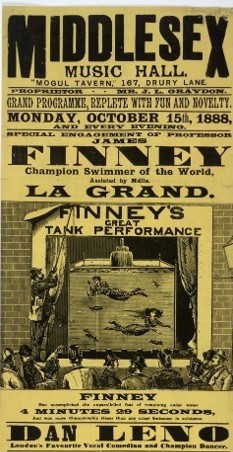
Source: British Library. Evan.1876,
Middlesex Music Hall, London, Holborn.
The following year he was appearing with his sister Marie and other members of the family in the baths and in the sea at Llandudno,
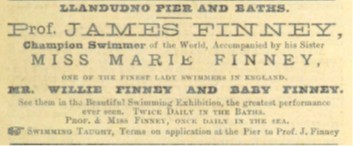
Source: Hartley’s Illustrated Coaching Guide to North Wales, 71. 1889.
and in 1890 he and Marie were performing with Sanger and Sons’ Circus. A large glass tank filled with water was placed in a conspicuous position and these ‘professors of the art of natation’ delighted the audience with a succession of tricks ‘which are uncommon to the dwellers in inland towns’. The performance included gliding over and under each other, eating and drinking underwater, diving for eggs and coins with the swimmers’ hands tied behind their backs; waltzing, floating, and imitating sleep. Professor Finney remained under water for three and a half minutes although his best ever time was 4 minutes 29¼ seconds.[18]
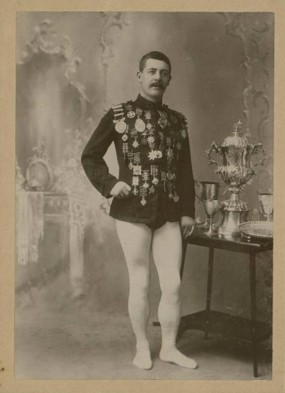
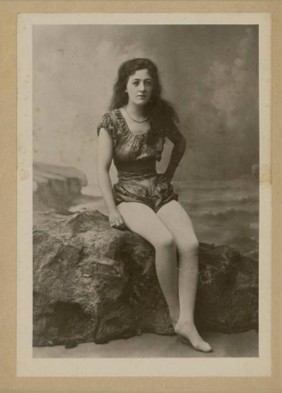
Source: Portraits of James and Marie Finney by Theodore Marceau.
Publication date 13 March 1897 museumofperformanceanddesign, https://archive.org/details/csfpal_000409/mode/2up
Natational feats enjoyed something of a revival in theatres and music halls in the pre-World War I period and ‘some of the most efficient exponents of the art’ the Finney family could be found performing in their crystal tank, at the Holborn Empire in August 1912.[19] In a performance at the Kingston Empire the previous year the Sisters Finney had entered their crystal tank, ‘brilliantly’ lit by limes, and given a ‘graceful exhibition’. Although the tank was only about 6ft long, 5ft high and about 4ft wide they moved about under the water with ‘as much freedom as if they were disporting themselves in a swimming bath’. One sister lay down in the water in a ‘picturesque attitude’ for over two minutes without breathing and also collected about forty coins from the bottom of the tank with her mouth, a feat loudly applauded.[20]
Reflections on the Natational Life
Elite aquatic stars were among the highest-paid novelty performers in Victorian Music Halls. While other performers might be earning between £1 and £3 per week the best aquatic artists functioned as itinerant headliners, booking highly lucrative ‘star-turn’ contracts, and the Beckwith frogs could command up to or over £50 per week. The rarity of aquatic acts meant that theatre proprietors could be confident that a single 15-minute turn featuring leading natationists could fill the theatre night after night, justifying the large salaries. Designing swimwear for nineteenth-century performers, particularly the women, was a balancing act between Victorian modesty conventions, freezing theatre environments, and the physical drag of moving through water. Performers normally relied on specific natural fibres with most professional swimmers wearing form-fitting, machine-knitted worsted wool or dense cotton jersey bodysuits. Wool has natural thermal properties and, even when completely saturated, knitted wool trapped a thin layer of water directly against the performer’s skin, which was warmed by the performer’s body heat, making a primitive wetsuit to resist the chill of the cold water in the tank. However, wool and cotton fabrics were terrible for drag, acting like a sponge and absorbing pounds of excess weight the moment a swimmer dove into the tank. To stay streamlined and prevent the suits from sagging or dragging them to the bottom, costumes were knitted with tight, custom weaves and fitted with built-in canvas stirrups that pulled the fabric taut under the feet.
Breath Holding
In 1882 G.F. Pardon had been a little dismissive of the achievements of tank natationists saying that while ‘Lying at the bottom of a glass tank, and playing various tricks in that position, appears to the uninitiated something very wonderful’, to an accomplished swimmer the feat was not very difficult. The performer fills his lungs with air, sinks his body slowly to the bottom, and there remains for what seems a considerable time, but it is probably not more than a minute or a minute and a half. When the air has been held in the lungs as long as possible, the ‘performer breathes some of it out, and perhaps fills his mouth with water’. The effect of this ‘is to force air from the mouth and throat into the lungs and so relieve them’.[21] In reality, though, Victorian natationists achieved underwater endurance through gruelling, trial-and-error physical routines and they trained their breath-holding ability using several different, but effective, methods.
Performers used traditional, heavy calisthenics to build their chest cavities and heavy wooden Indian clubs to open up the thoracic cage, stretch the intercostal muscles, and maximize their vital lung capacity. Performers took a deep breath and then used their throat muscles to swallow gulps of air into their lungs just before submerging. Victorian swimmers spent hours practicing holding their breath while completely still to push past initial feelings of panic and to train their brains to stop interpreting body spasms as an immediate life-or-death emergency. In addition, elite aquatic artists used meditation training to be able to trigger bradycardia, slowing their heartbeat to extend the lifespan of their body’s stored oxygen supply. The most common, albeit highly dangerous, technique was intentional hyperventilation with performers taking rapid, deep, forceful breaths on stage just before entering the tank. This forcefully flushed carbon dioxide out of their bloodstream allowing them to sit underwater for minutes without physical discomfort, although, because their oxygen levels dropped to zero before the CO2 built up high enough to warn them, performers would occasionally faint underwater and have to be rescued.
To satisfy audiences who wanted to see long breath-holds, performers developed active underwater routines to take their minds off the physical distress and they kept their minds busy by performing tasks like picking up coins from the bottom of the tank, pretending to read an upside-down newspaper, or playing a game of underwater cards.
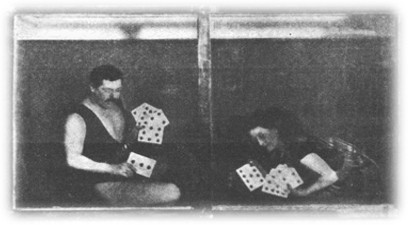
Playing Cards Underwater: Natationists used specially made, oversized, and weighted playing cards.
Tank Performances
Aquatic shows in Victorian music halls and theatres demanded innovation and adaptation since they involved water sanitation, the potential for mechanical failure, and special effects lighting. Maintaining thousands of gallons of water at a suitable temperature in an uninsulated Victorian facility was always a challenge and, in addition, there were no modern filtration systems, chlorine tablets, or automated pumps, with water being filled directly from the local mains or rivers. Because the tanks were often filled with fish and human performers, the water quickly became cloudy from flakes of skin, costume dyes, and organic waste so sand-and-charcoal gravity filters were used to skim the surface between acts and the water had to be completely recycled every few days to keep the water clear enough for the audience to see through the glass. To heat the tank, copper piping from coal-fired basement boilers was directed up to the stage where hot steam or water was circulated through coils placed along the bottom or back plates of the tank, hidden from the audience’s view. The temperature was measured manually with long glass thermometers.
To ensure the audience could clearly track their movements through the thick plate glass and murky water, aquatic stars typically wore custom-designed bodysuits covered in vibrant checkered patterns, horizontal stripes, or shiny metallic sequins that dramatically caught the glare of the theatre’s spotlights. To create a magical, ethereal atmosphere, natationists needed to be illuminated from within or beneath the water and early aquatic acts relied on Limelight (burning oxygen and hydrogen against a cylinder of quicklime) and gas burners. External reflectors and mirrors were placed at precise angles above and to the sides of the tank to bounce beams of light downward through the surface. A major hazard was the intense heat generated by the gas fixtures given that, if a cold splash of water hit a scorching hot glass viewing pane, the thermal shock could instantly shatter the tank. In the late 1880s and 1890s, acts began utilizing early Electric Carbon-Arc lights, positioning these powerful, blinding lights behind the tank’s iron backplates, shining forward through thick glass portholes lined with rubber gaskets. While this made the water glow beautifully, it was still dangerous since wiring insulation was primitive, and a single slow leak through a porthole gasket could electrify the entire iron tank skeleton, threatening to electrocute the performers inside.
The immense pressure of the water combined with the structural limitations of Victorian materials meant that live performances always carried an underlying threat of catastrophe. The most terrifying accident was a glass failure. Shifting weight from diving performers, structural settles in the wooden stage, or a tiny micro-fracture in the glass could cause an immediate, explosive rupture under pressure. When a pane gave way, thousands of gallons of water, heavy shards of thick plate glass, live fish, and the performers themselves were violently projected into the orchestra pit and the front rows of the audience. In one incident at the Westminster Aquarium, scene of many Beckwith performances, where a structural failure in a massive show tank sent a wall of water crashing through the venue. Performers were left gasping on a glass-strewn stage floor while injured musicians and front-row patrons were caught in the flash flood.
Newspaper reports spanning fifty years highlight the range of perils facing the natationist. In 1871, the self-styled ‘Great Man-Fish’, Professor Jefferson, had to take time out after suffering a ‘severe accident’ travelling back from Scotland.[22] Jessamine Lucy Sharp, a 29-year-old professional swimmer touring with the Ray Brothers’ revue ‘Have a Plunge’, which featured trick swimming and diving from a number of female swimmers and divers, died in 1915 after executing a back dive into a tank in Burnley as an encore and hitting her head on the bottom. Music hall artist and swimmer Jack Alert said that for such a dive to be taken safely there needed to between six and eight feet of water in the tank.[23] Four years later Annette Kellerman recalled posing for an alleged underwater fight in a large glass tank, which suddenly broke because the glass was not thick enough. The ‘great rush of water carried her and her male companion through the opening and the ragged edges of the broken glass cut both so seriously that they lay in hospital for nearly four months.[24]
The natational life, then, was not one for work shy or the fainthearted. Touring and performing night after night was demanding physically and danger was ever-present. These were men and women with exceptional skills, entrepreneurial vision, and determination. Hats off to them all.
Article Copyright of Prof Dave Day
References
[1] Letters to the Editors. The Tank Performers. Bell’s Life, Saturday, 6 January 1872, 12.
[2] The Era, Sunday, 29 January 1871, 14.
[3] London and Provincial Entr’acte, Saturday, 18 November 1871, 2.
[4] Yorkshire Post and Leeds Intelligencer, Tuesday, 15 January 1878, 1.
[5] Magnet (Leeds), Saturday May 16, 1885, 7.
[6] Morning Advertiser, Saturday, 24 December 1881, 3; The Stage, Friday, 7 April 1882, 10.
[7] Grand Hall and Swimming Baths, Bromley, Kent. Aquatic Entertainments. Bromley and District Times, Friday, 9 May 1890; The Era, Saturday, 31 May 1890.
[8] Yarmouth Gazette and North Norfolk Constitutionalist, Saturday, 3 August 1895, 7.
[9] Cornishman, Thursday, 8 June 1893, 7.
[10] Bournemouth Times and Directory, Saturday, 19 October 1889, 12.
[11] Letters to the Editors. Bell’s Life, Saturday, 6 January 1872, 12.
[12] ‘Aquarius’. Swimming. Sporting Life, Saturday, 29 January 1881, 4.
[13] Aquatic Perfomances at the Recreation Grounds, Inches. Aberdeen Free Press, Tuesday, 29 June 1880, 4; Aberdeen Press and Journal, Saturday, 3 July 1880, 6.
[14] Pardon, G. F. (‘Captain Crawley’) (1882). Swimming, Skating, and Rinking, London: Ward, Lock, And Co., Warwick House, Salisbury Square E.C., 33-34.
[15] The Stage, Friday, 7 April 1882, 10.
[16] Yarmouth Independent, Saturday, 8 July 1882, 5.
[17] Empire News & The Umpire, Sunday, 25 January 1885, 2.
[18] Sanger and Sons’ Circus. Sheffield Daily Telegraph, Tuesday, 4 February 1890, 3.
[19] The Era, Saturday, 10 August 1912, 18.
[20] The Era, Saturday, 26 August 1911.
[21] Pardon, G. F. (‘Captain Crawley’) (1882). Swimming, Skating, and Rinking, London: Ward, Lock, And Co., Warwick House, Salisbury Square E.C., 33-34.
[22] The Era, Sunday, 29 January 1871, 14.
[23] Music Hall Swimmer Killed at Burnley. Manchester Guardian, 1 July 1915, 12.
[24] Annette Kellerman. Illustrated Sporting and Dramatic News, Saturday, 9 August 1919, 12.