In the seventy years since the death of the ‘legendary cricketer’ Gilbert Laird Jessop, a great deal has been written about the record he set in the 5th Ashes Test at the Oval in1902, which still stands today.
In fact, the Times Journalist Simon Wilde has recently published a fascinating book entitled, ‘Chasing Jessop’, which is devoted to dissecting the record- breaking innings ball by ball, suggesting that the record could be even more impressive than was originally thought.
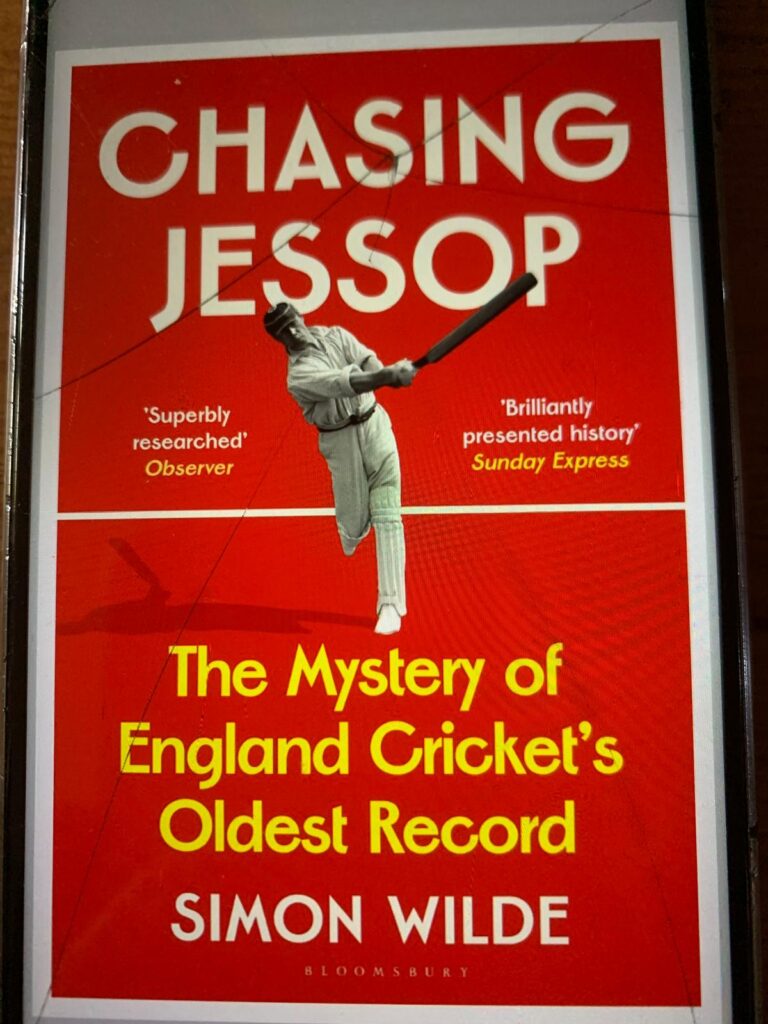
Chasing Jessop
Simon Wilde’s fascinating new book
However, what is perhaps rarely mentioned when discussing Jessop’s career, is the important role played by the most famous of all cricketers, Dr William Gilbert Grace, (known universally as W.G.) who in 1893 first became aware of a young Jessop because he had ‘run out’ his son Bertie in a trial match at Bristol.
‘ The Old Man’
Perhaps it was inevitable that their paths would at some time cross, as despite not being a cricketing family, the Jessops named their eleventh child after the ‘Old Man’ (a term of endearment that Jessop would later use for him), probably due to the fact that he was one of the most famous men of the Victorian era and was the Captain of the Gloucestershire team in 1874, when the young Gilbert was born in Cheltenham.
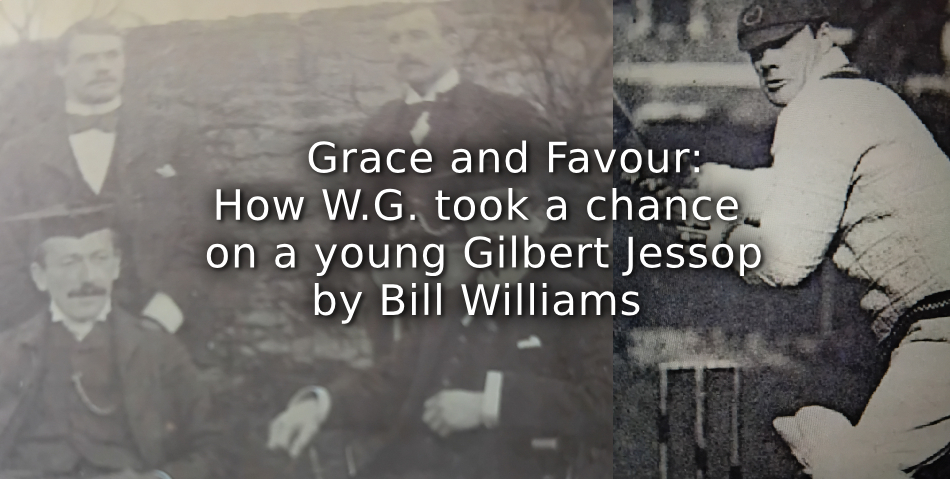
Working as a trainee teacher at Burford Grammar School in Oxfordshire in 1893, the nineteen- year old Jessop having played club cricket to a good standard, turned up in place of his cousin to represent ‘The Rest ‘versus a ‘Public Schools XI’ and greatly impressed WG’s brother Henry ( who was spectating) with his athleticism in the field, prompting him to suggest to his brother that Jessop should play for the county, ’as soon as he was able to next summer.’
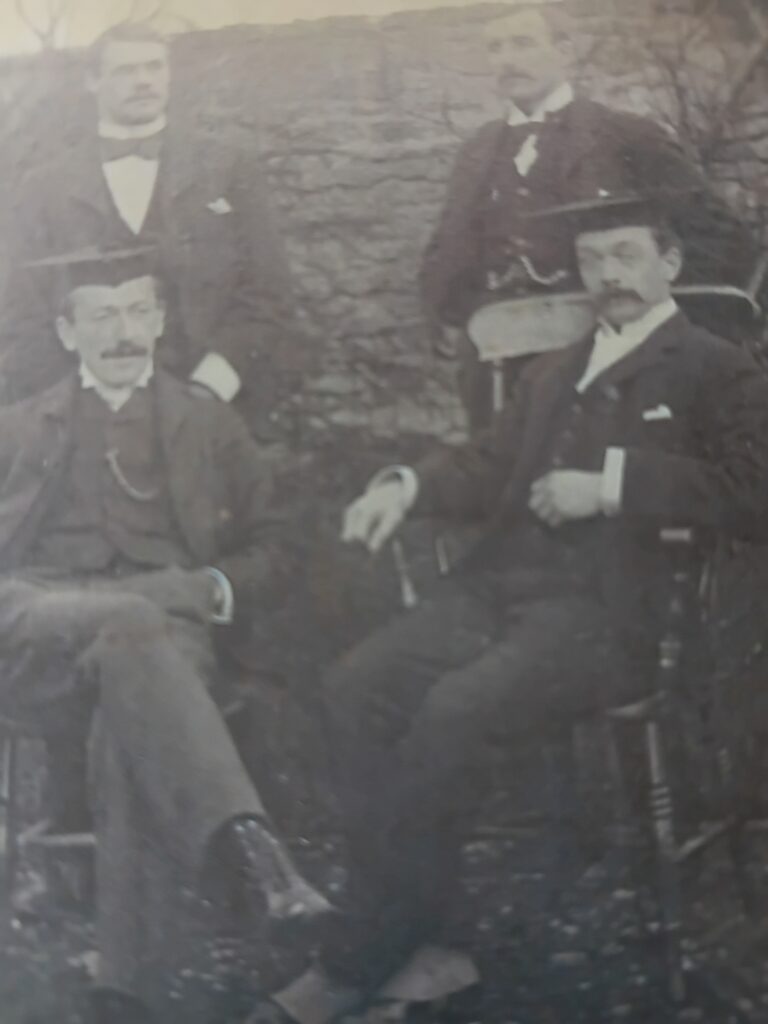
A young Gilbert Jessop (back left) at Burford Grammar School in 1894, posing with senior staff.
True to his word, the invitation came and at twenty years of age, Jessop made his debut against Lancashire at Old Trafford in July 1894 and recalled in his autobiography’ A Cricketer’s Log’, published in 1922
If I were asked at which moment was the most nervous of my career. I should unhesitatingly declare for the one which first found my feet across the threshold of the dressing-room at Old Trafford pavilion. The tremor did not last long- it was not allowed to- it never was when the ‘’Old Man’’ was about- for a kindly nod and a shake from that great ‘’paw’’ soon succeeded in putting me more or less at my ease
To Jessop’s delight, Lancashire chose to bat first, but it proved to be a tough day in the field for the debutant, bowling 29 overs and taking only one wicket for 72 runs, but nevertheless W.G praised his efforts saying, ‘Well bowled, young ‘un, well bowled.’
Jessop batting at six, scored a four off the first ball of his innings, on his way to scoring 29 before being bowled and scored 19 in his second innings, but W.G was happy to champion his talent by announcing ‘Well, we’ve found something this time.’
Clearly, W.G. had seen the potential shown and duly ‘booked’ him for the next three matches, beginning an association with Gloucestershire for Jessop, which would last for the next 21 seasons.
From Burford, Jessop moved to Beccles College in the autumn of 1894 and was again indebted to W.G. the following summer when he wrote to the Headmaster asking permission for his release in order to play at Lord’s against Middlesex, describing Jessop as ‘A good cricketer and someone I should like to have until the end of the season.’
W.G. would score 160 in that match, prompting Jessop later to reflect on his performance by saying:
I never saw him play such another innings. He went for the bowling from the start and he hit it when and where he liked and if he had captured my fancy before, he by this innings enrolled me among his big list of most ardent worshippers.
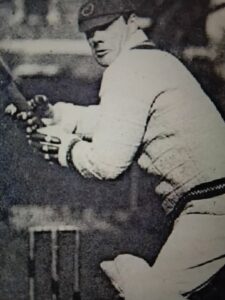
Gilbert Jessop – On the attack
Image Credit – Gloucestershire CCC via https://www.cricketmuseum.wales/gilbert-jessop-in-wales/
W.G’s innings undoubtedly inspired the young Jessop to approach his own style of batting in a similar fashion and its fascinating to wonder if it was this particular innings that became the benchmark for some of the incredible batting performances that he would produce in his twenty- one year career; during the 179 times he passed 50, he scored at a rate of 79 runs per hour, which increased to 83 runs per hour during his 53 centuries.
In 1895, thanks mainly to W.G’s ferocious batting, Gloucestershire rose up the county championship table and Jessop began to establish himself as an ‘all-rounder’, on one occasion taking 16 wickets across two matches and scoring 51 in 18 minutes against Yorkshire; in a rain interrupted match against Sussex, he was selected and trusted by W.G. along with J.J.Ferris , to bat for ten minutes in an attempt to win the match, which they duly did and Jessop was applauded off the field, having also taken 7 wickets for 54 runs including those of the England pair, C.B Fry and K.S Ranjitsinjhi.
At the end of the season Jessop reflected on his arrival in first-class cricket by saying:
To me this season was a sheer delight and I do not honestly think that in respect of personal enjoyment any subsequent year could exceed it. Perhaps this was only natural, as I had begun to find my feet and with such a personality as W.G. in the side, it could scarcely have been otherwise.
Following a stand out season in 1897 while at Cambridge, Jessop toured America with Pelham Warner’s team, but suffered greatly with sea- sickness on the journey home, which turned into an attack of ‘renal colic’, preventing him from returning to university, so he was encouraged to spend time in Cornwall to recuperate. While there he was also forced to become a vegetarian and on returning to Cambridge he suffered a great loss of form, so he decided to consult with W.G. about his health. The ‘Old Man’ was very concerned and prescribed an alternative treatment which meant abandoning the vegetarianism and instead encouraged ‘Champagne drinking’; the treatment led to an improvement, but it did take him over a year to recover.
Jessop also recalled his mindset in the first team observing the example set by W.G. before county matches and when on tour:
W.G believed that cricketing eyes needed as much rest as possible and expected everyone to get to bed early and being a blind worshipper of the ‘Old Man, anything he did was good enough for me and I therefore, followed his example throughout my career.
W.G. centre and Jessop far right sitting in the Gloucestershire team in 1898.
Jessop would first play for England in the summer of 1899 against Australia and there is no question that this was mainly due to the high praise given to him by W.G and it was undoubtedly his strong endorsement as England Captain that secured Jessop’s place in the team for the Ashes series.
His debut was notable for his 51 runs in just 62 minutes and his 3 wickets for 105 runs, which was an indication of what was to come and his first series showcased his potential as a genuine all-rounder.
W.G would leave Gloucestershire in 1899 and in the same year would play his last test for England, due mainly to his declining agility in the field as a result of a significant weight gain. ‘He had been my leader’, recalled Jessop,’ in every class of cricket.’ Jessop took over as captain of the county, but greatly missed his guidance and presence in the dressing room and on the field.
Jessop left with WG and England Captain Archie McLaren right at The Hastings Festival in 1898
Despite W.G.’s migration to London, they continued their friendship and he was a guest at the wedding of Jessop and Millicent Osborne in October of 1902 and often met up for ‘Gentlemen v Players’ fixtures, golf and charity matches at Witney in Oxfordshire, where Jessop had played during his time at Burford Grammar School.
Without doubt, W.G. was crucial to the start of Gilbert Jessop’s career because he noticed his talent, particularly his exceptional fielding and guided him through the early stages, providing him with the opportunity to prove his abilities and develop his all -round game.
W.G. was Jessop’s boyhood hero and an admired figure whom he respected throughout his career and he showed deep respect for the man who would become his mentor, role-model and friend.
Jessop’s finest hour came in the 5th Ashes Test at The Oval in August 1902 and the day has become immortal in the history of cricket for an incredible finish to an incredible match; Jessop launched himself at the Australian attack to reach 100 off 76 balls( although Simon Wilde now believes that it was likely to have been between 72 and 74 balls) and still holds the record for the fastest century by an Englishman in a test match 123 years later, in what will be forever known as ‘Jessop’s Match.’
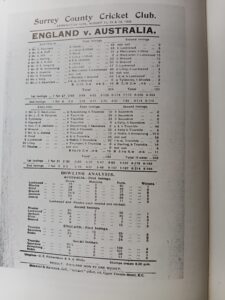
. The scorecard from ‘Jessop’s Match’ August 1902.
Quite simply, it seems certain that without W.G.’s keen eye for talent and his ability to recognise potential in young players and to then nurture them, it is unlikely that Gilbert Jessop would ever have risen to the dizzy heights of August 1902 and as the Ashes series( 2025/26) continues ‘down under’, Jessop’s name will undoubtedly be mentioned if Harry Brook, Joe Root or maybe Ben Stokes gets close to his record, as there is always a chance, but then again, we have been waiting a very long time….
Ben Stokes, Joe Root and Harry Brook will any of them break Jessop’s record?
Article Copyright of Bill Williams