For Part One – Click HERE
Frederick William (‘Bill’) George Thomas, born in Banbury, Oxfordshire, in 1872, was a ‘useful mile runner and cross-country man’ at Herne Hill Harriers Athletic Club (HHH) in the early twentieth century.[1] In the 1902 season, for instance, he finished sixty-seventh out of 125 in the National, twenty-sixth in the Southern, and fifteenth in the South of the Thames events. After the touring Springboks rugby team engaged A.H. Moon, the incumbent HHH trainer, as their trainer, athletic administrator Charles Orway offered Bill the job, even though he had shown ‘no signs of any secret hankering to train or coach’. Bill started coaching in 1906 and remained with HHH until called up into the Royal Flying Corps (RFC) in the 1914 war. Sent to Uxbridge to coach RFC athletes he continued to coach first RFC and then Royal Air Force (RAF) athletes until 1928 and to take RAF men on an individual basis after that.[2] His long coaching career paralleled that of Alec Nelson’s and illustrates the way in which trainers built on the traditional training methods of previous generations by using their own experiences to innovate, and then produce individually unique approaches to training. His career also reflects the difficulty of earning a living as a full-time trainer or coach in Britain in the first half of the twentieth century. In the 1891 census the 18-year-old was working as a ‘Drapers Assistant’ and in 1901 he was described as a ‘Tailor’s Outfitting and Clothing Salesman’ living at 7 Enfield Road, Hackney with his wife, 25-year-old Charlotte, born in Norfolk, and his three-year-old son Victor Vivian, born in Plumstead, Kent. In the 1911 census, the 37-year-old was recorded as ‘Buyer in Athletic Goods’ working for a General Outfitters and living with Charlotte and Victor at 20 Aberdeen Park, Highbury, in London.[3]
While training athletes was evidently not providing enough income to allow him to make this his sole or primary occupation, Bill was consolidating his reputation as a coach and a year later he was engaged by the Amateur Athletic Association (AAA) for £10-£12 and expenses as a marathon trainer prior to the Stockholm Olympics.[4] Commenting on the decision not to allow attendants to accompany marathon competitors at the Games, Bill said that he had always believed that an athlete should be ‘coached and trained to run without feeding so as to get him into that condition in which he can run his race without outside help’. It was not easy to get them to change their strategy and if they had a ‘bad time and do not receive the attention they are used to’ he could see them dropping out. The solution was to exclude attendants from all home races. The Sporting Life reporter observed that Bill was not an ‘armchair critic’ and as an experienced runner he knew the finer points of both cross-country and road running. As a coach, Bill could ‘bring a lame horse home first’ and there was no doubting his judgement.[5]
A Daily Express correspondent observed in 1914 that Bill had made a name for himself as HHH’s track, road, and cross-country trainer. While his speciality was marathon and distance running’ he also knew as much about sprinting and the middle distance as was needed to produce champions. He would ‘take you on one side and expound learnedly and technically on the comparative merits of road and track running. He knows either pretty well inside out and is an authority on leg action’.[6] By this point he had already produced many successful athletes including D.H. Jacobs (the first Jewish athlete to win an Olympic gold medal for Britain as part of the 4x100m relay team in Stockholm in 1912), E.W. Haley (400m semi-finalist, Stockholm), E.J. Webb (silver medallist in the 3,500m walk in London in 1908), Bill Humphreys (cross-country team bronze medal in Stockholm), Joe Deakin (part of the winning 3-miles team race in London), and Harry Green (winner of the Sporting Life marathon in 1911, who set a new world record of 2 hours 38 minutes 16 seconds for the event in May 1913).[7]
Inter-War Coaching
At the time of the 1921 census Bill was still working in the drapery/tailoring business. Now 48 years old, he was employed as a buyer with Billings and Edmonds School Outfitters, but the high regard that he was held in as a trainer/coach meant that he was among a few professional coaches who were invited to give evidence to the Decies Commission on athletics in December 1923. In common with other working-class coaches who were accustomed to being treated as servants by the amateur community, he adopted a subservient approach to the upper-class members of the commission, as reflected by his constant use of ‘Sir’ in his replies. When asked what his response might be to another professional being appointed as a British ‘super-coach’, he replied that ‘if he could teach me anything. I am always ready to learn’. Bill said it was difficult for a professional coach to earn his living by coaching in Britain, and he had to work elsewhere in the evenings after coaching at Uxbridge during the day. In the 1920s, for example, he was also training professional boxers. As to what salary a coach should be paid, Bill thought ‘about £6 or £8 a week, according to his ability, and if a man gave his whole time to it’. [8]
In 1927, when the AAA decided that it would be sensible to have a special trainer for the marathon competitors for Amsterdam they turned again to Bill Thomas,[9] and in October 1928 Oxford University Athletic Club (OUAC) appointed him as their paid coach for £9 a week during the winter term and at the same rate for any period outside full term during which his services might be required.[10] Despite the mixed experience OUAC had had with respect to Alfred Shrubb, their previous professional coach, and the efforts of interim coach, the amateur Evan Hunter, who had used his contacts as honorary secretary at both the Achilles Club and the British Olympic Committee (BOC) to try to stimulate interest in athletics, the committee considered that ‘a larger measure of success may be achieved with the assistance of a paid servant’.[11] This comment reflects the significant social difference that existed between gentleman athletes and men like Bill who, as Jerry Cornes later remarked, ‘was not of our class and class mattered in those days’.[12] Trainers were expected to be deferential, to give help only when asked, and they were ignored if their advice did not meet the athlete’s expectations. As Bannister later observed, ‘The university athlete is first and foremost a human being who runs his sport and does not allow it to run him…He drinks beer…and he listens to coaches when he feels inclined…it has produced…men whose personality and determination were sufficient to enable them to achieve balanced lives and at the same time, to plan successful athletic careers and to stand the strain of first class competition.’[13] As with many upper class amateurs across all sports, Oxford athletes often preferred to be coached by someone from their own social class and, even after Bill’s appointment, the suggestion that a ‘Blue’ should be appointed to look after athletes in each event to encourage ‘young hopefuls’ and give them tips was received favourably at a OUAC committee meeting, after which ‘suitable men’ were allocated.[14]
This master-servant attitude towards employees such as paid trainers and coaches is highlighted constantly in references to Bill in the OUAC minutes, which often recorded instances of club members finding ways to reduce his remuneration. In May 1929, for example, there was debate about him being engaged during the summer term, given that the club could not afford him for the whole time, and he might have to be engaged for some period towards the end of term or for odd days during the term.[15] In May 1930, OUAC members were reminded that Bill was in attendance on Wednesdays and Saturdays in the summer term, but attention was also drawn to the fact that the standard of field events was not as high as at Cambridge probably because Bill was a ‘track man pure and simple’. Guy Butler was suggested for the Easter and summer terms if Bill had no objection but, since no one knew what such a professional’s terms would be, the matter was left undecided.[16] The following month, it was reported that Butler was prepared to attend at Iffley Road in the Michaelmas term once a week, i.e. eight times a term, for £15, and his train fare to and from Bath, which would come to £5. This was considered a reasonable offer given his ‘world-wide’ coaching reputation and it was decided that the £20 could be recouped by not engaging Bill in the summer of 1931, so the committee voted unanimously in favour of engaging Butler for one term.[17] The Times subsequently reported that there ‘is no question that the standard of athletics at Oxford is higher at present than for some considerable time. This term training, under the very capable supervision of W. Thomas, is naturally being concentrated on the events to be run in the Relay Races’, while it also noted that OUAC would have coaching assistance from G.M. Butler, ‘one of the finest runners this country has ever produced’.[18]
At the beginning of 1931, it was still undecided as to whether Bill would attend twice a week in the summer, although a suggestion from F.A.M. Webster that the club should consider a Norwegian coach was rejected given that ‘the club was happy with their present coaches’.[19] In February, Bill attended the first part of the committee meeting but, after ‘various knotty problems’ had been solved, he left the meeting. The committee went on to discuss his engagement in the summer for two days a week, Mondays and Thursdays, for 30 shillings a day plus fares which would come to four guineas a week. His wife Charlotte had just died, and it was proposed that a subscription be raised to help with his costs with the club contributing £20.[20] In 1938, the club accounts show that Bill was still being paid £9 a week and Bill’s visits were reduced in April 1939 because of the club’s financial difficulties.[21] Writing in the Sunday Express in October that year, George Allison described as ‘unpalatable’ the news that Oxford intended to dispense with the ‘services of their old and well-tried coach and advisor, Bill Thomas’. While acknowledging that ‘necessity admits of no sentiment’ he expressed his profound regret that the invaluable work of Bill was to be suspended. It was the popular Bill, ‘shrewd judge of the possibilities of raw talent’, who had discovered and coached men like Cornes, Jack Lovelock, C.F. Stanwood, T.L. Lockton, and Guy Wethered, who had come to prominence in the summer by winning the half mile for Oxford and Cambridge against Harvard and Yale in a record time of 1 minute 52.4 seconds.[22]
Fortunately, for his athletes, for OUAC, and for the sport in general, it seems that Bill was always more interested in his coaching rather than any financial return and he was never well off, although he trained athletes such as Cornes privately at Herne Hill for a small fee,[23] and he supplemented his income by drawing on his previous working experiences to provide sports outfitter services.[24] In October 1934, Lovelock wrote to the New Zealand Olympic Committee about Bill serving as trainer at the Empire Games saying, ‘He is badly off financially and though others whom I know and who he trains pay him privately up to 10 shillings per time, he is not very particular about the cash’. He ‘trains me for the love of the game’ and Lovelock gave him a ‘pound or two’ when he could.[25] Later he arranged for Bill to accompany him, fees and expenses paid, to America for invitation events in 1935 and 1936.[26] When Bill Nankeville, Britain’s best miler before 1950, asked Bill if he would coach him he added that he could not afford to pay him much. ‘Nankeville, my boy,’ Bill replied, ‘I’m not interested in money. You will pay me in results’.[27]
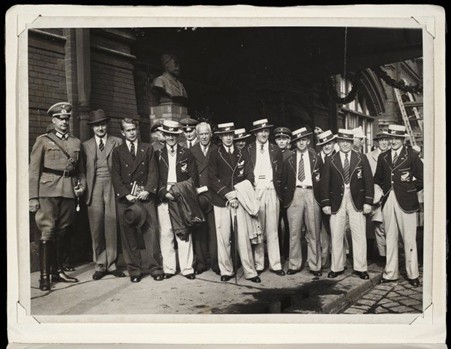
Jack Lovelock and other members of the New Zealand Olympic team after their arrival in Berlin, 28 July 1936.
Lovelock is in the centre holding a while overcoat.
Behind him wearing a suit is Bill Thomas, who had been employed to assist the New Zealand team.
Lovelock, John Edward (Jack), 1910-1949: Papers.
Ref: MSX-2261-005. Alexander Turnbull Library, Wellington, New Zealand. /records/22903807
After winning the southern amateur athletic league in 1933, HHH turned again to Bill, described as ‘one of the finest coaches in the land’ to act as advisor to their members after the intervarsity sports had been decided in 1934.[28] Bill was appointed as coach to the New Zealand team for the 1934 London Empire Games and the 1936 Olympics, prior to which the New Zealand Olympic Games athletes reportedly had an excellent trip to England. The team’s headquarters at Norfolk Court were quiet, comfortable, and central, the food was excellent, and everyone started training the day after arrival. Bill was apparently pleased with the style of athletes Boot and Matthews, but suggested that Boot should carry his arms a trifle higher.[29] At the party organised to congratulate Lovelock on his victory in the 1500 metres in Berlin, Dr A.E. Porritt, himself once a noted athlete, paid tribute to Bill, who had been unable to attend the event.[30] Bill continued to coach for the RAF. In 1937 Cranwell, who lost to Sandhurst despite making a ‘noble effort’, benefitted from coaching from Bill and Flight Lieutenant A.W. Sweeney, the leading British sprinter, but Sandhurst were also well coached, had been able to devote more time to athletics than other colleges, and, importantly, they had larger numbers.[31] In 1939, now aged over 65, Bill was in charge of the Cranwell RAF Cadet College athletic team, which competed against top clubs, including London Athletic Club.[32]
Post-World War II Coaching
Following the Second World War Bill continued actively coaching club, University, and individual athletes. In 1948 he was making his way to Oxford from London on Mondays and Fridays,[33] he was still working with the RAF athletic team at 73 years of age,[34] and he again offered his services to HHH who were struggling to revive and not really in a position to engage a coach of his status. He subsequently received a lucrative offer from one of Britain’s leading clubs but stayed loyal to Herne Hill, often training runners for as little as 1 shilling a session.[35] John De’ath said that he found Bill ‘pleasant and helpful’ when he met him in the 1950s as a member of HHH. He also well remembered his advice to run behind and not alongside opponents in competition.[36] A prominent member of the Pakistan Sports and Social Club hockey team in London was Ali-dul Qayyum, a member of Pakistan’s Olympic hockey team, who had taken up athletics and was being trained by Bill, as was his Olympic colleague, hurdler Mashar-ul-Haq Khan, in 1949.[37] While a woman had never covered a mile in five minutes, there were hopes that Hazel Needham of Cambridge Harriers, Kent, might become the first in 1952. Aged 19 she was studying at Worcester College to become a teacher, and she was being coached by 77-year-old Bill. The previous year Hazel had won the British women’s mile championship at the White City recording 5 minutes 23.4 seconds which compared to the best performance of 5 minutes 15.4 seconds clocked by Miss E Foster in 1939. At that stage, there was no official world record for the event, no place on the Olympic Games programme, and the event was seldom included in a sports meeting programme.[38]
Bill was appointed at the last minute to Olympic duties coaching the marathon team in 1948, where his highest finisher was eighth placed Sam Ferris,[39] who had teamed up with him in 1923 when he rejoined the RAF. Bill induced Sam to join HHH, identified that he had a rolling gate suitable for marathon running, and under his expert guidance Ferris became Britain’s leading marathon runner.[40] A reporter for The News in 1947 observed that a ‘great tribute’ has been paid to HHH by the selection of three of their coaching staff to help prepare athletes for the Olympic Games. One was H.G. Brockman, their president, a second was George Pallett, captain of Surrey’s victorious team at the last intercounty championships, and the third was Bill, whose ‘coaching has produced more Olympic competitors than any other English coach’, including Britain’s outstanding hurdler Donald Findlay.[41] Over the years Bill produced a ‘formidable school of hurdlers’,[42] and Robin Hammond later recalled that Bill used to put a match box on the top of the hurdles on calm days in order to train his athletes to go low over the hurdles. They were supposed either to crush the matchbox or sweep it off with their backsides.[43] His expertise in coaching hurdles was recognised by OUAC in October 1936 when they decided to refuse to change from the 220 yards to 440 yards low hurdles in the varsity sports, because Bill thought it undesirable on grounds of overstrain.[44]
Bill was working right up to 1953, when he was killed after a thunderbolt struck his house.[45] Three years beforehand, James Audsley and George Pallett had reprised his career in the Athletics Weekly, pointing out that elite athletes of the time were still seeking the advice of a man who had been training champions before the First World War. His 44 years of coaching bridged the days of the old Sheffield handicaps and the athlete world of 1950, making him one of the ‘few remaining links’ between to ‘what some people regard as the really great days of running’. Although he was best known as a middle- and long-distance coach Bill trained elite athletes for all distances and he had had a great record with sprinters, such as A.W. Sweeney, the dual Empire sprint champion in 1934. He had also trained J. Armour Milne, later well-known as a leading sportswriter, who, as E.J. ‘Slip’ Saxon, won the 1938 professional Powderhall sprint by 5 yards, the biggest winning margin ever recorded at that stage.[46]
His list of other successful athletes during the 1930s was impressive. Apart from Jack Lovelock (1,500m, seventh in 1932 Olympics, gold medallist and world record, 1936), successful OUAC athletes at the 1932 and 1936 Olympic Games were Jerry Cornes (1,500m silver medallist, 1932) and Tommy Hampson (800m gold medallist, world record, 1 minute 49.7 seconds, and 4x400m silver medallist, 1932). Several other present or former OUAC members featured at the Games, including Hallowell (USA, 1,500m sixth, 1932), Sgt G.T. Harper (110m hurdles, 1932), A.G. Pilbrow (110m hurdles, 1936), H. Sivertsen (Norway, discus 1936), and Pennington (100m and 4x100m, 1936).[47] Additionally, two RAF athletes won medals, Sam Ferris, (marathon silver, 1932), and Donald O. Finlay (110m hurdles bronze, 1932, and silver, 1936), while John Parlett was eighth in the 800m at the 1948 Olympics. Bill was also involved in training the Army runner, Bill Nankeville, who won four AAA mile titles from the late 1940s.[48] Lovelock said of Bill in June 1935, that he had ‘learnt everything I know about running from him’ and he believed that several other elite athletes would say the same thing.[49] In July 1936, Bill had a particularly successful AAA Championships with his ‘stable’ of athletes, while several others had sought out his training advice, which Lovelock concluded had to ‘be a record of championship success for one coach’.[50]
Dave Day, Independent Researcher, djday75@gmail.com, ORCID: 0000-0002-6511-1014.
Read Part 3 HERE
References
[1] Sporting Life, April 23, 1912, 2.
[2] James Audsley and George Pallett, ‘Presenting Bill Thomas’, Athletics Weekly, December 30, 1950, 11.
[3] England and Wales Census. 1891 RG 12/1170; 1901 RG 13/227; 1911 RG 14/978.
[4] AAA Olympic Committee Minutes, June 11, 1912. Birmingham Special Collections AAA/1/2/4/1.
[5] ‘Olympic Games’, Sporting Life, December 6, 1911, 3.
[6] ‘Boy Athletes to Make a Note of’, Daily Express, May 20, 1914, 8.
[7] Sporting Life, April 23, 1912, 2.
[8] British Olympic Association Special Commission, Decies Commission Fifth Day, October 19, 1923; Daily Express, August 26, 1925, 13; Daily Mirror, August 22, 1925, 14; ‘Boxing’, Daily Express, September 8, 1928, 13.
[9] AAA Olympic Committee Minutes, October 10, 1927; February 2, 1928; March 27, 1928; May 23, 1928. Birmingham Special Collections, AAA/1/2/4/2.
[10] OUAC minute book, October 16, 1928; June 19, 1930. OUAC archives.
[11] Athletic News, October 8, 1928, 19.
[12] J. Cornes to McNeish, October 9, 1985, McNeish papers, MS-Papers-7214-27, ATL, cited in David Colquhuon (Ed.), As if Running on Air: The Journals of Jack Lovelock (Nelson: Craig Potton Publishing, 2008).
[13] Laurence Chandy. History of OUAC. https://www.ouac.org/history-club, 89.
[14] OUAC minute book, November 8, 1930. OUAC archives.
[15] OUAC minute book, May 11, 1929. OUAC archives.
[16] OUAC minute book, May 16, 1930. OUAC archives. Winner of four Olympic medals Guy Butler was a sprint specialist who had been at Cambridge during the 1920s.
[17] OUAC minute book, June 19, 1930. OUAC archives.
[18] The Times, October 25, 1930, 7.
[19] OUAC minute book, January 18, 1931. OUAC archives.
[20] OUAC minute book, February 25, 1931. OUAC archives.
[21] OUAC minute book, April 28, 1939. OUAC archives.
[22] George Allison. ‘Profound Regret’, Sunday Express, October 22, 1939, 14.
[23] Daily Express, June 13, 1934, 6.
[24] OUAC minute book, May 11, 1929. OUAC archives.
[25] Lovelock to Amos, 10 October 1934. Heenan papers, quoted in Colquhoun, 86fn.
[26] Centipede. ‘Lovelock, Miler of the Century, Talks of his Last Race Today’, Daily Mirror October 3, 1936, 26; ‘Lovelock Fails to Win U.S.A. “Century Mile”’, Daily Mirror, October 5, 1936, 29.
[27] Bryant, 3:59.4: The Quest to Break the 4 Minute Mile, 138-140.
[28] Achilles. ‘Herne Hill Harriers “Sign” a Famous Coach’. News Chronicle, April 18, 1934, 16.
[29] Evening Post, July 22, 1936, 14.
[30] Evening Post, September 24, 1936, 14.
[31] ‘Sandhurst’s Victory at Cranwell’, The Times, June 7, 1937, 6.
[32] Lincolnshire Echo, May 5, 1939, 11.
[33] OUAC Archives 1948 Hilary Term – Coaching.
[34] Bryant, 3:59.4: The Quest to Break the 4 Minute Mile, 138-140.
[35] Audsley and Pallett, ‘Presenting Bill Thomas’, 11, 12.
[36] John De’ath, OUAC Archivist and Vice-President of Achilles Club – Personal Conversation, April 20, 2011.
[37] Victor Gordon. ‘A London Letter for Pakistan’, The Civil and Military Gazette, September 29, 1949, 2.
[38] Prompter. ‘Athletics. Woman Miler’, The Berwick Journal, January 24, 1952, 2.
[39] Bryant, 3:59.4: The Quest to Break the 4 Minute Mile, 138-140.
[40] The Leader, April 25, 1980, 3; Spiked Shoe. ‘Athletic Notes’, Ireland’s Saturday Night, February 1, 1936, 9.
[41] ‘A Tribute to the Harriers’, The News, November 28, 1947, 2.
[42] J.E. Lovelock. ‘First Varsity Freshmen’s Sports’, Evening News, November 8, 1935, 14.
[43] Achilles Club 1992 Annual Report member of OUAC’s 1932 team, Robin Hammond (H.T. Hammond)
[44] OUAC minute book, OUAC archives, October 15, 1936.
[45] Bryant, 3:59.4: The Quest to Break the 4 Minute Mile, 138-140.
[46] Audsley and Pallett, ‘Presenting Bill Thomas’, 10, 11.
[47] See www.ox.ac.uk/about/oxford-people/Oxford-at-the-Olympics
[48] Bryant, 3:59.4: The Quest to Break the 4 Minute Mile, 138-39.
[49] R.A.H. ‘Centipede’. ‘How I Do It—By Lovelock’, Daily Mirror, June 17, 1935, 27.
[50] J.E. Lovelock. ‘A Rest Before the Games’, Evening News, July 17, 1936, 11.