Abstract
Traditional coaching structures came under pressure in Britain during the late nineteenth century as increasing class differentiation led to a rejection of professional coaches by the middle-class organisers of National Governing Bodies (NGBs). Their social position within the class hierarchy, combined with their attachment to an amateur ethos that rejected specialisation and professionalism, empowered British administrators to develop a culturally specific master-servant relationship with professional coaches that persisted until long after the Second World War. This paper illustrates the essential characteristics of British professional coaching in the first half of the twentieth century through the biography of Bill Thomas, coach to Oxford University in the inter-war period, whose career highlights the subservient role that he played within British athletics, despite the many successes of his athletes. Drawing on a range of sources, combining the traditional use of newspapers, texts, directories, and organisational records, with census data, probates, and other genealogical material, his coaching career is presented in three parts as an exemplar of the working life of an archetypal British professional coach in the first half of the twentieth century.
Keywords: Coaching; Athletics; Bill Thomas; Class; Oxford University; Servant.
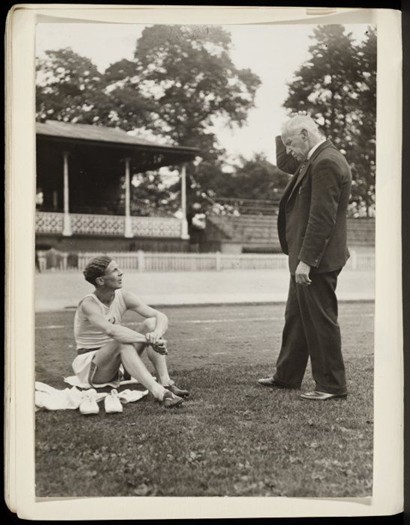
Photograph of Jack Lovelock with trainer Bill Thomas, 15 September 1936
Lovelock, John Edward (Jack), 1910-1949: Papers.
Ref: MSX-2248-088. Alexander Turnbull Library, Wellington, New Zealand. /records/22751293
The photograph was taken after a three-quarter mile time trial just before they set off together for America, and Lovelock’s last race.
Introduction
Interviewed in 2012, Hamilton Smith, National Technical Officer for the Amateur Swimming Association (ASA) from 1963-1967, bemoaned the ‘aristocratic’ attitudes of amateur officials who recognised that they needed to appoint coaches in order to improve international performances but who regarded themselves as the ‘masters’ and treated national coaches ‘as a serf.’ Everything was fine ‘as long as you were positive and respectful’.[1] His comments reflected a coaching legacy that had its origins in the creation of National Governing Bodies (NGBs) of sport, such as the ASA, in the late nineteenth century by middle-class individuals wedded to the ethos of amateurism. In contrast to the American practice of handing complete control to the coach, and even though several elite sportsmen openly acknowledged the effectiveness of the American coaching system,[2] gentlemen amateurs in Britain structured their interactions with coaches by drawing on their traditional social and working experiences to impose a master-servant relationship on the sporting pedagogue.
Slaves or servants have traditionally been an enabling condition of leisured class prosperity[3] and employing a professional coach would inevitably involve undermining their class status for many British amateurs by reversing the master-servant relationship that they were accustomed to in their daily lives. As late as 1921, servants made up 11.6 per cent of the employed population and there were still 1.3 million domestic servants working in 1931. As the nature of industrial organisation evolved, administration and production separated physically and socially, resulting in an increasing bureaucracy that drove the employment of an expanding servant class. The number of males employed in professional occupations and subordinate services grew from 204,000 in 1871 to 348,000 in 1901, and the number of commercial clerks expanded from 212,000 in 1871 to 597,000 in 1901. Elsewhere, the rise of the upper-middle-class professional within the Victorian scientific societies resulted in curators, cataloguers, and veterinary surgeons, being paid a servant’s wage and expected to show deference to their Oxford-educated superiors.[4] Unsurprisingly, then, the idea of an upper-class athlete subverting his social status by allowing himself to be dictated to by a working-class coach was unpalatable to many amateurs and, as early as 1801, a letter to The Times had decried the way that trainer Jacky Smith ordered about the pedestrian Robert Barclay, a gentleman, ‘just as if he had been a spaniel’.[5]
These master-servant attitudes to professionals reflected the residual impact of aristocratic values on the educated middle class. Even today, employment of ‘sporting servants’ or ‘sporting surrogates’ remains ‘a form of overt status display’ by a landed class that has traditionally treated professionals in sports such as prizefighting, horse racing, and cricket, as servants.[6] In prizefighting, individuals drawn from the working class, fought while wealthy patrons gambled on their performances. Racehorses were owned by the ruling class, and they employed professional riders from the lower orders, who were never considered for election to the Jockey Club, just as professional cricket coaches were never made members of the Marylebone Cricket Club.[7] For football administrator Frederick Wall, this was not an issue about ‘class but of control’,[8] although this would probably not have convinced de Coubertin, who believed that amateurism basically reflected a ‘preoccupation with caste’.[9] It is also hard to square with incidents such as objections from British residents about the participation of cyclists Edward Battell and Frank Keeping at the 1896 Athens Games, because they were working as servants at the British Embassy so they could not be considered amateurs since they were not ‘gentlemen’.[10]
Although different classes played together in cricket the landed classes always treated professionals as servants. Eighteenth-century aristocrats not only financed and led the teams but also batted while professional employees bowled, fielded, and ran for them. Cricket subsequently played a prominent role in the Victorian public schools and there were numerous opportunities for retired professionals to obtain employment as coaches, although they always had to know their place. William Attewell had played a dozen times for England and made three Australian tours, but he was addressed by the boys as ‘Attewell’ and he was required not only to coach but to mark out the pitches and perform similar chores. County clubs also developed coaching opportunities and when Surrey Cricket Club advertised for a cricket instructor in 1893 the match committee recommended that the wording ‘an amateur preferred’ be included, although this was subsequently changed by the general committee to read ‘amateur or professional’.[11] Amateurs, officially known as Gentlemen, were given the title ‘Mr’ or ‘Esq.’, and called ‘sir’ by the professionals, who were expected to perform menial duties around the ground as well as teaching skills and bowling for gentlemen batsmen. The standard pay for these ground bowlers was 30~50 shillings a week, and they often had to rely on ‘handsome gratuities’ from members. Because of their extensive practical experience, they fulfilled a servant role in the sport similar to that of a butler in a country house or a regimental sergeant-major, and this was reflected in the way that employers structured the environment in order to keep their distance.[12] Amateurs and professionals used different facilities, dressed in different pavilions, entered the field of play from different gates, travelled in different compartments on trains, and stayed in separate accommodation when playing away or on tour. Teams were always captained by amateurs and when World War I broke out Lord Hawke and Yorkshire County Cricket Club reinforced the subservient status of professionals by telling all members of staff that they were required to join up, making this ‘a strict condition of their continued employment.’[13]
Other upper class sporting retainers included gun-carriers and animal-beaters on safari, chauffeurs in motor racing, and sherpas in mountain climbing. On shooting estates, both workers and animals were expected to ‘behave appropriately, according to the events of the day, the season, or the whims of the sportsman’.[14] The paid yachting hand earned slightly less than cricketers, but he would be allowed to keep his clothes at the end of the season, ‘besides his master’s influence and good wishes during the winter if he has proved satisfactory’.[15] At the rackets and tennis clubs, markers were treated similarly to cricket professionals in that they were always referred to by their surnames. A marker needed ‘patience, decision of character, power of concentrating…a voice clear and audible, but not too obtrusive, and physical strength that will enable him to stand at his post for protracted periods’. He also needed to be thoroughly versed in equipment repair, as well as ‘a competent instructor, and a player of sufficient strength to be able to hold his own with all but the strongest amateurs’.[16] Even in cycling, which ostensibly provided appropriate exercise without involving the need to engage additional servants, some society cyclists employed cycling grooms during the 1890s.[17]
These traditional aristocratic approaches to professionals were replicated by the gentlemen amateurs associated with the emerging NGBs who structured their sport either to exclude teaching professionals or control them through the imposition of a master-servant relationship. Although these upper-middle-class men increasingly administered their sporting organisations through what they knew best, a servant class of clerks and secretaries, and they could also generally agree on a definition of amateur eligibility, there were significant differences between sports as to how these principles were applied. Cricket continued its tradition of employing professionals, while maintaining their servant status, and football legalised professionalism, with the aim of keeping professionals under control, but rugby union officials vehemently opposed any form of professionalism, leading to a split with the Northern Union. Professional coaches were rigorously excluded in rowing and oarsmen generally preferred to be coached by their peers because they considered that professional coaches were incapable of understanding the complexities, or the aesthetics, of the teamwork essential to rowing in an eight.
Some individual sports posed problems for amateur administrators, partly because activities such as athletics, boxing, and swimming, had a long tradition of professional participants and trainers. Swimming provided an early example of how middle-class administrators tried to control coaches and teachers through certification. When the ASA decided in 1899 that professional teachers were essential for increasing participation they instituted a Professional Certificate, although certificates were only granted if officials were ‘satisfied as to the character and antecedents of an applicant as well as to his ability as a professional teacher’.[18] Although the ASA apparently supported the creation of a strong professional association, their decision to exclude professionals from holding any office within the ASA, or its districts, was reaffirmed in 1908.[19] In bowls, full wages might be paid to the greenkeeper for the season, which normally lasted from April-October, with half that amount being paid as a winter retainer, when he was encouraged to make up his wages by offering gardening services and serving at social functions. He could take up learning a trade, as long as it did not interfere with his job, and he could smoke while he worked, but he should not be tipped.[20]
Both golf and lawn tennis were relatively new additions to the middle-class sporting calendar and administrators were able to establish a policy of treating professional coaches as a servant class without having to overcome traditional practices. The golf professional generally achieved a degree of respectability equivalent to that of fencing professors, but, despite the formation of the Professional Golfers Association in 1901, which kept registers of players seeking employment and situations vacant, as well as administering a benevolent fund financed from an annual tournament organised by the News of the World, the average club professional remained essentially a servant. By 1907, golf was providing employment for approximately 80,000 part time caddies and 20,000 full time employees, the most important of which were the greenkeepers, although the greenkeeper and the professional were often the same person at many clubs. Professionals were also expected to fulfil their traditional duties of repairing clubs, playing rounds with members, and teaching. For many professionals their most profitable income source was their shop, which became highly profitable as club memberships expanded, but, while some professionals were reputed to be earning £300 a year or more, which might well exceed the remuneration of many club secretaries, this did not put them in the same social class. There are some examples of admiration being shown for club professionals, but this reflected their status as accomplished butlers rather than gentlemen.[21]
In 1903 one lawn tennis player rued the fact that while cricket, real tennis, rackets, football, and billiards, all had a large professional contingent who could be pressed into service as officials, no such class existed in lawn tennis.[22] Although professional coaches did emerge over the next twenty years they did not always distinguish themselves and one amateur, writing in 1927, described them as a ‘wholly incompetent class of self-styled instructors whose only concern in life is to take money from beginners while giving an entirely inadequate return’.[23] Their servant status was embedded into the structure of the sport. Club professionals were separated spatially from the club members with their own, often inferior, changing and catering facilities while social distinctions were reinforced through an established etiquette, which often required poorly paid professionals to call club members ‘sir’ and ‘madam’ and to run baths, serve tea, and fold clothes.[24] In 1928, Dan Maskell, whose coaching ability and unwavering respect for authority made him acceptable to the amateur establishment, became the All England Lawn Tennis Club’s first professional, which enabled him to coach elite players in preparation for the Davis Cup,[25] although when he was appointed to train the squad in 1933 he was booked into separate hotel accommodation from the team.[26]
The English middle class was not a unified entity, and the entrepreneurial sector was often much closer than the professional middle classes to the sportsmen they backed and controlled. They regularly dealt with professional coaches, especially if they were relying on the efforts of their athletes and teams to bring financial return or some measure of local prestige. These businessmen recognised that the physical conditioning, psychological preparation, and tactical development of individuals, in professional boxing, pedestrianism, and sculling, demanded an expertise that was traditionally working class in origin. Distance between middle-class organisers and working-class contestants needed to be maintained so hired servants, in the form of trainers, were engaged to provide a buffer between administrators and participants. Although the boxing professors hired by the gentlemen’s clubs of the 1880s were gradually replaced by men like W. Childs, the 1908-9 amateur middleweight champion who became Cambridge University’s coach, boxing at local levels continued to rely on professional trainers such as Bat Mullins and Bill Natty.[27] Natty also trained the South London Harriers and the Catford Cycling Club, members of Guy’s Hospital, and Volunteer Battalions, including the London Rifle Brigade and the London Scottish Rifles.[28] For entrepreneur Bill Price at the Hackney Wick ground, close contests between well-prepared athletes were essential in attracting paying spectators so coaches, who often also acted as an athlete’s manager, were important intermediaries. Similarly, in professional sports like Northern Union rugby and association football individuals such as Manchester United trainer Fred Bacon were employed to maintain discipline and to prepare players, although they were always closely monitored by the amateurs who sat on the clubs’ boards.[29]
The Artisan Coach
The increasing demands of performance sport ensured that opportunities continued to present themselves for professional coaches, even after the formation of amateur NGBs,[30] although they had to accept their allotted place in the sporting hierarchy. Looking down from their lofty and secure class positions some amateurs recognised that professional trainers included men ‘steady, observant and capable of forming clear and sound conclusions’,[31] and, just as some English workingmen could be considered worthy and respectable, many professional coaches could become ‘respectable icons of hard work and prudence, thereby reinforcing amateur-like qualities’.[32] This was especially the case if they were constantly exposed to the example set by their social superiors. One observer in 1861 remarked that a ‘more respectable or a better class of tradesmen do not exist than the majority of English (horseracing) trainers’ because their interactions with gentlemen enabled them to ‘imbibe liberal ideas and prove themselves worthy of the highest trust and responsibility’.[33]
By the early twentieth century, most professional coaches had adapted to the new sporting environment and several individuals achieved artisan status, mainly because professional coaching remained a highly skilled and specialised activity.[34] Tennis player and coach Peter Latham clearly impressed one writer who left a meeting with him in 1902 ‘with a feeling of interest in and respect for a professional athlete which is a rare sensation to an essentially amateur sportsman’.[35] R.H. Lyttleton subsequently argued that the professional, though still drawn from the shop, the factory, the pit and the slum, was a prosperous individual whose dress and deportment made it hard for spectators to tell him from the amateur,[36] and Wilding described the tennis professional as ‘an excellent type of man, capable, intelligent and courteous’ in 1912.[37] The following year, the professional golfer was described as a ‘man of good class and education who has mastered not only the practice but the theory of the game and has a thorough knowledge of club-making and business generally’,[38] and The Times referred to professionals in golf, cricket, rackets, tennis and ‘practically every other form of sport’ as ‘deservedly one of the most respected classes in the community’.[39]
This increasingly positive perspective was reflected in the way that major Olympic sports gradually accommodated them when preparing for the Games. Among those accompanying the British swimming team to the 1912 Olympic Games was professional coach Walter Brickett, who had also attended to the team at the 1908 Games and whose involvement with lifesaving and teaching, together with the social networks that he created with leading amateurs, had consolidated his status as a respectable artisan. As long as he maintained a degree of subservience to amateur administrators and displayed a suitably deferential attitude he was an acceptable choice for the controlling elite of the ASA.[40] Similarly, while they had reservations about the potential negative influence that professional coaches might be able to exert, there was a recognition of their potential value within the amateur track and field community. Spencer (Sam) Wisdom, for example, who was trainer to professional sprinter Henry Hutchens and 1908 Olympic champion, Reggie Walker, had a long career as a professional coach and achieved artisan status even though he was never allowed to have any administrative influence within the Amateur Athletic Association (AAA).[41]
Bill Thomas: The Archetypal Servant Coach
The expertise of men like Wisdom was widely appreciated by elite competitors within the athletics community and there were suggestions during the 1890s, even from prominent amateur administrators, that the Universities and leading clubs might benefit from engaging ‘professional instructors who could supervise practice and give dietary advice’.[42] Even so, and although suitable men, such as Harry Andrews, were regularly engaged by amateurs from several sports over the next twenty years, it was only following the 1908 Olympic Games in London and in Stockholm in 1912, both of which showcased the strength of American track and field, that this practice really gained momentum. Between the two World Wars, athletes from Cambridge University, coached by Alec Nelson, and Oxford University, coached by Bill Thomas, won over 100 events at national level and 31 Olympic medals, almost a third of which were in middle distance events. While a recent biography by Ian Stone has exhaustively explored Alec Nelson’s life and coaching career,[43] Bill Thomas has not received anything like the same attention, despite a successful coaching career that spanned over fifty years. Roger Bannister’s somewhat disparaging description of Thomas as belonging to a school of athletic coaches, ‘developed from the old handyman-masseur trainer at the end of last century’, one of the ‘bath attendant coaches who gradually picked up “tips” by their acute observation’,[44] was not a view shared by the many elite athletes he coached, nor by his coaching contemporaries.
Dave Day, Independent Researcher, djday75@gmail.com, ORCID: 0000-0002-6511-1014.
To read Part 2 – Click HERE
References
[1] Tegan Carpenter, ‘Uneasy Bedfellows: Amateurism and Coaching Traditions in Twentieth Century British Sport.’ PhD diss., Manchester Metropolitan University (2012), 127, 156-157.
[2] Montague Shearman, ‘International Athletics’, The Badminton Magazine December (1895), 585-590.
[3] Alfred H. Lloyd, ‘Ages of Leisure’, The American Journal of Sociology, 28 no.2, (1922), 166.
[4] Richard Holt, Sport and The British. A Modern History (Oxford: Oxford University Press,1992), 132; Lloyd, ‘Ages of Leisure’, 166; Robert Taylor, ‘How the Weekend was Won’, BBC History Magazine, August 2004, 40-41; Eric Dunning, and Ken Sheard, The Class Structure and Professionalization of British Sport, Centre for Research into Sport and Society, University of Leicester (1988); Adrian Desmond, ‘Redefining the X Axis: “Professionals,” “Amateurs” and the Making of Mid-Victorian Biology – A Progress Report’, Journal of the History of Biology 34, (2001), 14-17.
[5] The Times, November 14, 1801, 4.
[6] Douglas Booth and John Loy, ‘Sport, Status, and Style’, Sport History Review 30, (1999), 1-26.
[7] Mike Huggins, ‘Culture, Class and Respectability: Racing and the English Middle Classes in the Nineteenth Century’, in J. A. Mangan, ed., A Sport-Loving Society: Victorian and Edwardian Middle-Class England at Play (London: Routledge, 2006), 231.
[8] Frederick. J. Wall, Fifty Years in Football (London: Cassell, 1935), 120.
[9] John Hoberman, The Olympic Crisis: Sport, Politics and the New Moral Order (New York: New Rochelle, 1986), 11, 87.
[10] Eve Langford, ‘Top 10 Olympic Cycling Team GB moments’, British cycling.org.uk August 1, 2016 https://www.britishcycling.org.uk/article/20160729-gb-cyclingteam-Top-10-Olympic-cycling-moments-0#:~:text=A%20servant%20who%20worked%20at,could%20not%20be%20considered%20amateurs
[11] Derek Birley, Playing the Game: Sport and British Society, 1910-45 (Manchester: Manchester University Press, 1995), 21; Tony Money, Manly and Muscular Diversions: Public Schools and the Nineteenth-Century Sporting Revival (London: Duckworth, 1997); Keith Booth, The Father of Modern Sport: The Life and Times of Charles W. Alcock (Manchester: The Parrs Wood Press, 2002), 208.
[12] Derek Birley, ‘The Primrose Path: The Sports Pages Lecture 1995’, The Sports Historian 16, (1996); John Lowerson, Sport and the English Middle Classes, 1870-1914 (Manchester: Manchester University Press, 1993), 170, 193.
[13] Keith A. Sandiford, Professionalism and Amateurism in Modern Cricket Centre for Research into Sport and Society, University of Leicester (1998); Derek Birley, ‘Sportsmen and the Deadly Game’, British Journal of Sports History, 3 no. 3, (1986), 297.
[14] Steven A. Riess, ‘From Pitch to Putt: Sport and Class in Anglo-American Sport’, Journal of Sport History 21 no. 2, (1994), 179-180; Booth and Loy, ‘Sport, Status, and Style’, 1-26; Hayden Lorimer, ‘Guns, Game and the Grandee: The Cultural Politics of Deerstalking in the Scottish Highlands’, Ecumene 7 no. 4, (2000), 415.
[15] Lowerson, Sport and the English Middle Classes, 194.
[16] Alfred E.T. Watson and The Eighth Duke of Beaufort, The Badminton Library: Tennis, Lawn Tennis, Rackets, Fives, 1903. Republished 1987 (Gosport: Ashford Press Publishing). Tennis by John Moyer Heathcote, 3-123.
[17] David Rubinstein, ‘Cycling in the 1890s’, Victorian Studies, 21, (1977),58-59.
[18] ASA Committee Minutes April 29, 1899; September 2, 1899; ASA Committee Report 1899. ASA Archives, Loughborough.
[19] ASA Committee Minutes, September 21, 1894; ASA Annual General Meeting Minutes, April 14, 1894; March 30, 1895; March 7, 1908; March 6, 1909. ASA Archives, Loughborough.
[20] Lowerson, Sport and the English Middle Classes, 194.
[21] Dennis Brailsford, British Sport: A Social History (Cambridge: The Lutterworth Press, 1992), 104; Birley, Playing the Game: Sport and British Society, 35; Birley, ‘The Primrose Path’, 1-15; Richard Holt, ‘Golf and the English Suburb: Class and Gender in a London Club, c.1890-c.1960’, The Sports Historian 18 no. 1, (1998), 76-89; John Lowerson, ‘Golf’, In Tony Mason, (Ed.) Sport in Britain: A Social History (Cambridge: Cambridge University Press, 1989), 187-214; Brian Dobbs, Edwardians at Play: Sport 1890-1914 (London: Pelham Books, 1973), 165; Geoffrey Cousins, ‘Golf’, In James Rivers, (Ed.) The Sports Book: Britain’s Prospects in the Olympic Games and in Sport Generally (London: Macdonald and Co., 1948), 185-201; Lowerson, Sport and the English Middle Classes, 194-197; Wray Vamplew, ‘Successful Workers or Exploited Labour? Golf Professionals and Professional Golfers in Britain 1888–1914.’ Sport in Society 19, no. 3 (2016), 400-424.
[22] Watson and Beaufort, The Badminton Library. Lawn Tennis by Charles Gilbert Heathcote, 333.
[23] Lawn Tennis and Badminton, January 15, 1927, 989.
[24] Robert J. Lake, ‘Stigmatized, Marginalized, Celebrated: Developments in Lawn Tennis Coaching, 1870–1939’, Sport in History, 30 no. 1 (2010), 82-103.
[25] Robert J. Lake, Dave Day, and Simon J. Eaves. ‘Coaching and Training in British Tennis: A History of Competing Ideals’, In Routledge Handbook of Tennis (London: Routledge, 2019), 39-49.
[26] Lake, ‘Stigmatized, Marginalized, Celebrated’, 93-95.
[27] Derek Birley, Land of Sport and Glory: Sport and British Society, 1887-1910 (Manchester: Manchester University Press, 1995), 213.
[28] Stan Shipley, ‘Tom Causer of Bermondsey: A Boxer Hero of the 1890s,’ History Workshop Journal 15 no. 1 (1983), 28-58.
[29] Pierre Lanfranchi, ‘Mister Garbutt: The First European Manager’, The Sports Historian 22 (2002), 44-59.
[30] Wray Vamplew, Pay Up and Play the Game (Cambridge: Cambridge University Press, 1988), 198-199.
[31] Henry Hoole (M.D.), The Science and Art of Training; A Handbook for Athletes (London: Trübner and Co., 1888), 7.
[32] Rob Light, ‘Ten Drunks and a Parson’?: The Victorian Professional Cricketer Reconsidered, Sport in History 25 no. 1 (2005), 71-73.
[33] The Hon. Admiral Rous, ‘On the Roman Bath as Applicable to Training Racehorses’, Baily’s Monthly Magazine II no. 14, April 1861.
[34] Edward Palmer Thompson. The Making of the English Working Class (London: Gollancz, 1980), 259-262.
[35] Manchester Guardian, April 12, 1902, 5.
[36] Birley, ‘The Primrose Path’, 1-15.
[37] Anthony F. Wilding, On the Court and Off (London: Methuen and Co., Ltd, 1912), 41.
[38] Agenda Club, ‘The Rough and the Fairway’ (1913), 37, cited in Lowerson, Sport and the English Middle Classes, 178.
[39] The Times, September 13, 1913, 7.
[40] Dave Day, ‘Walter Brickett. A Respectable Professor’, in Bob Snape and Helen Pussard (eds), Recording Leisure Lives: Sports, Games and Pastimes in 20th Century Britain (LSA Publication No. 107, 2010), 193-214.
[41] England and Wales Census. 1871(RG10/10/32/55); 1881(RG11/6/34/36); 1901(RG13/1218/113/11); 1911(RG14PN59RG78PN2).
[42] Shearman, ‘International Athletics’, 585-590.
[43] Ian Stone, Alec Nelson and British Athletics Prior to World War II (Newcastle Upon Tyne: Cambridge Scholars Publishing, 2023).
[44] John Bryant, 3:59.4: The Quest to Break the 4 Minute Mile (London: Arrow, 2005), 227; Roger Bannister, First Four Minutes (London: Putnam, 1955), 58.