
The British and Irish Lions are considering the possibility of a tour to Argentina to expand their ‘commercial value’ and increase ‘fan engagement’ beyond the traditional rotation of South Africa, New Zealand and Australia.
Argentina is seen by the ‘Lions’ as a ‘premier, high-growth’ rugby nation, deserving of a potential visit for a historic 16-year cycle and ‘The Pumas’, who are currently ranked 5th in the world, would strongly welcome the ‘Lions’ viewing it as a ‘massive deserving honour for their rugby development.’
The Lions Captain Maro Itoje in action against The Pumas in Dublin prior to the tour to Australia in 2025. Could the Lions be heading back to South America for the first time in 90 years?
However, it may surprise many to learn that back in the early years of the last century, Argentina was toured on no less than three occasions by British touring teams between 1910 and 1936 (now collectively known as ‘The Forgotten Tours,’) and provided the impetus for the formation of the Argentine Rugby Union.
Rugby had established itself in Argentina in the late 19th century, with the first recorded match taking place in 1873. Introduced by the British, it was initially played exclusively within the ex-pat community mainly in Buenos Aries, before spreading to the Spanish-speaking population.
‘The River Plate Rugby Union’ (which would become ‘The Argentine Rugby Union or UAR in 1951), was founded in 1899 and is recognised as one of the oldest rugby unions in the world and the oldest in South America.
The first ‘British Isles’ touring team consisting of 17 Englishmen and 3 Scots ventured to South America in June 1910, confirming Argentina as a potentially important part of the developing rugby world and played in the ‘first international rugby match in the history of Argentina’; with caps awarded the British, led by the Belgian born John Raphael, won 28-3 against an Argentinian side that consisted entirely of British-born players.
In contrast the next visit, which had to wait until 1927, was much more representative of the home nations and included many established internationals such as Captain David MacMyn, Carl Aarvold and Jimmy Farrell, from Scotland, England and Ireland respectively.
The ‘Lions’ made a clean-sweep of the series with comfortable wins in all four tests, conceding just nine points across nine matches played on the tour, but the game was now no longer the preserve of the ‘English-speaking elite’, with over half the team playing in the tests from Spanish backgrounds, which included their captain Arturo Rodriguez, who would also go on to win the gold medal in the heavyweight boxing competition at the Olympics in Amsterdam the following year.
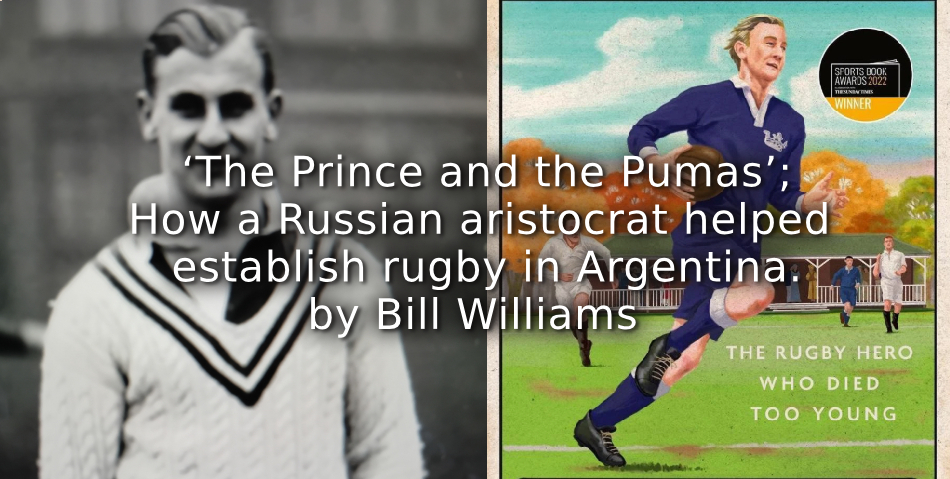
However, the inclusion of Prince Alexander Obolensky on the 1936 tour would prove to be ‘highly significant’ in the growth of Argentine rugby, serving as a major ‘box-office’ attraction that increased the sport’s popularity and provided a high-standard example of attacking rugby.
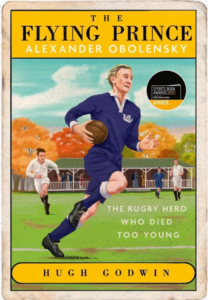
The Flying Prince by Hugh Godwin
Known as the ‘Flying Prince’, Obolensky was the ‘superstar’ of the tour, scoring twelve tries in six matches and his speed and flair offered Argentine players and fans a first-hand look at top-tier international talent, providing what would become ‘a benchmark’ for skill and pace in the country and fostering the long-term growth of the sport.
Alexander Obolensky was born in Petrograd modern day St Petersburg in 1916, the son of Prince Sergei Obolensky an officer in the Tsar’s Imperial Horse Guards.
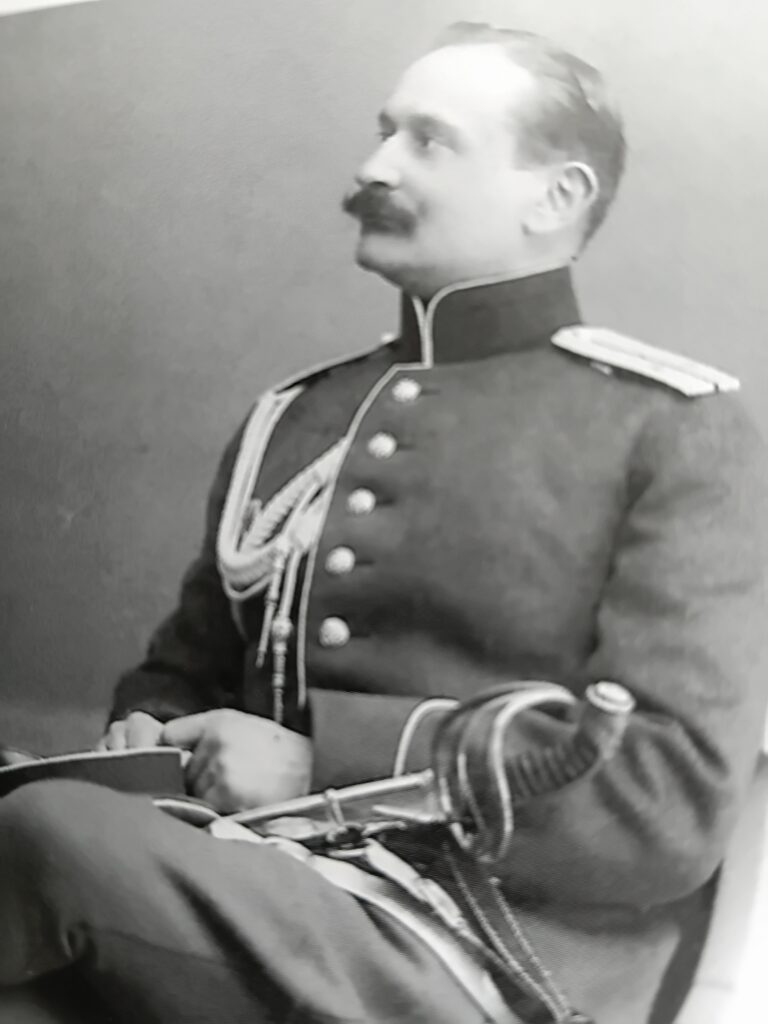
Alex’s father Prince Sergei Alexandrovich Obolensky was a mounted captain in the Tzar’s Russian Imperial Guard before fleeing the country in 1917.
Image in the public domain
The family fled Russia after the Bolshevik revolution in 1917 and settled in London, but it was decided that the young Alexander would board at Trent College in Derbyshire where he excelled at sport, particularly rugby, becoming part of a ‘famous’ unbeaten 1932 1st XV.
Two years later he entered Brasenose College in Oxford, where he won two ‘rugby blues’ as a wing three quarter, but his selection for England in 1936 initially put into question his nationality, despite scoring two tries on his debut in a 13-0 victory over The All Blacks ( the first time England had beaten New Zealand) at Twickenham.
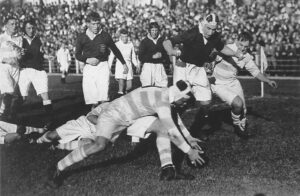
Argentina v. British and Irish Lions, rugby union match played at GEBA, Buenos Aires, 1936
Image in the Public Domain
He would be naturalised as British in March of that year, thus making him available for the impending British Lions tour in the summer.
While there had been significant widespread opposition to his inclusion in the England team, opposition to his selection for The British Isles tour to Argentina however, was virtually non-existent and his selection solidified his standing as a prominent British sports personality, rather than an outsider.
Sailing from Tilbury, the 20-day journey included a stop off in Santos in Brazil, where a ‘Test’ was played against a representative Brazilian team and is famous for Obolensky’s performance in the 82-0 victory where he scored a ‘record-setting’ 17 tries.
He would make his first appearance in Argentina in the third match of the tour, where he scored two tries against the ‘Olvios ‘club, but it appeared that the locals already knew his name and a cartoon in a national newspaper carried the caption; ‘The Prince, despite being only 20, has established himself as one of the best rugby players in England.’
The Oxford University Rugby XV, three days before taking on Cambridge at Twickenham, 4th December 1937.
From left to right (back row), I. H. Watts, F. M. M. Forster, D. G. Coles, F. K. Mayhew, R. G. P. Almond, P. Cooke; (middle row) W. N. Renwick, C. T. Bloxham, H. D. Freakes, J. A. Brett, M. M. Walford, Prince Alexander Obolensky (1916 – 1940), R. M. Marshall; (front row) H. Pennington and R. A. Cooper
As the star of the 10-match tour, Obolensky provided an inspiring example of pace, skill and in some cases unorthodoxy, on dry Argentinian pitches and gave the tour immense prestige and though the tourists won the Test match 23-0, his thrilling performances on tour contributed greatly to the growing popularity and standard of rugby in Argentina.
Back in Oxford, he wrote in the ISIS magazine ( a student publication at the University) that ‘Argentina might also become supreme in the ‘rugger world’ and if they take advantage of the lessons we endeavoured to teach them, then the tour will have accomplished its purpose. I felt ‘a spirit of progress’ in the time I spent in the country.’
However, despite being the ‘star’ of the tour, surprisingly he was not considered a ‘consistent choice’ by the RFU selectors and combined with a series of injuries (and a notable incident involving being bitten by a dog while attempting to rescue it from a crashed car), after gaining only four caps, he never played for England again.
In 1938, he joined the Royal Air Force Volunteer Reserve and was called up for service when war broke out a year later, effectively ending his rugby career.
Alexander Obolensky tragically died at the controls of a ‘Hawker Hurricane’ in March 1940, during a training exercise at Martelsham Heath in Suffolk, when he overshot the runway- he was 24 and such was the affection for him, that banner headlines of shock and grief were seen the length and breadth of the country.
Today his legacy is celebrated by the annual ‘Obolensky Lecture’ at Twickenham.
Following WW2, Argentina’s political landscape, including the regime of Juan Peron, made touring in South America less appealing to the British Lions management who decided to prioritise the traditional tours to South Africa and New Zealand and later Australia.
So, a proposed British and Irish Lions tour to Argentina would break the current 12- year cycle and while it could potentially re vitalise the brand, it is likely that it would spark a ‘negative reaction’ from the traditional partners who rely heavily on the income generated by the tours, resulting in a ‘backlash’ and a possible refusal to tour Britain and Ireland during the Nations Championship series.
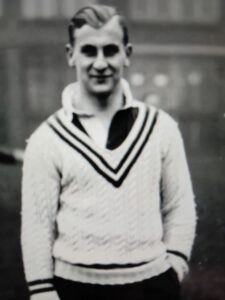
Prince Alexander Sergeevitch Obolensky ( 1916-1940)
Image in the Public Domain
Article copyright of Bill Williams


![Playing Football with the Chorus Girls: <br>Vaudeville Women’s Football in Naples [1931]](https://www.playingpasts.co.uk/wp-content/uploads/2020/06/PP-banner-maker-440x264.jpg)
