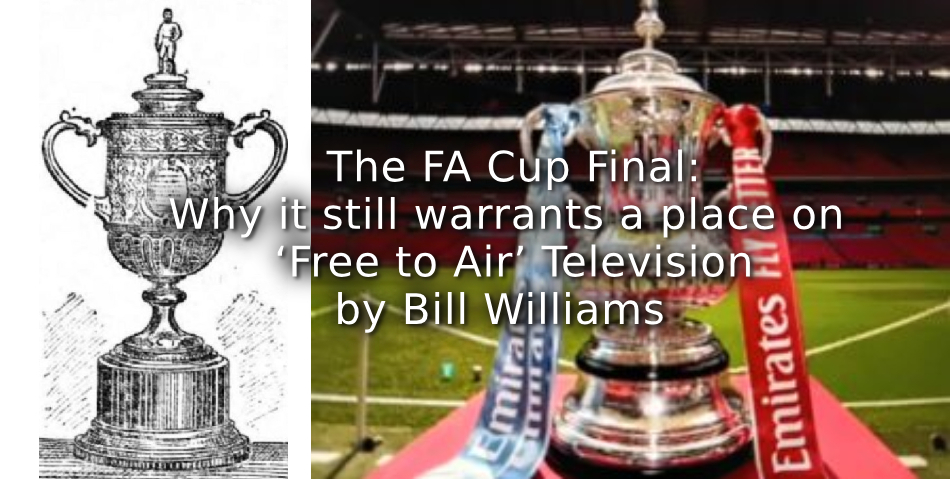
BBC sport under a new partnership with TNT Sports, has become the sole ‘free to air’ broadcaster of an institution that first appeared over 150 years ago and is recognised as ‘the oldest domestic football competition in the world’.
The Football Association Cup was the first national football tournament providing structure where previously only ‘friendly’ matches existed and pre- dates the English Football League by 17 years.
In July 1871, the Football Association decided that a ‘Challenge Cup’, should be introduced into English football and in November the first matches got underway involving 15 teams, with the final taking place in March 1872 between two amateur teams; Wanderers and The Royal Engineers.
The FA Secretary Charles Alcock envisaged a competition that mirrored the inter house matches of his schooldays at Harrow copying a format of halving the number of teams each round via a knockout.
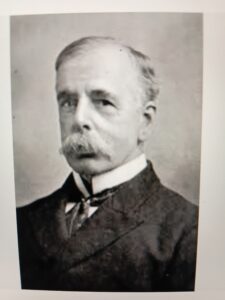
FA Secretary Charles Alcock, envisaged a competition that mirrored the inter-house matches of his school days at Harrow
https://www.streathamsociety.org.uk/ Image c/o
The match took place at The Kennington Oval in London, with Wanderers winning 1-0 and was attended by 2,000 fans, paying a shilling each; by 1884 over 100 teams had entered with 12,000 spectators at the final.
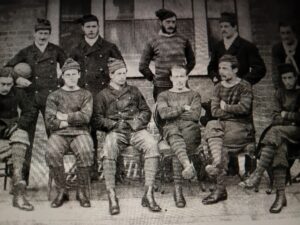
Wanderers FC won the first final against The Royal Engineers 1-0 at The Kennington Oval
Image in the public domain
Women would have to wait until 1970 for the inaugural Women’s FA Cup competition, which began as ‘The Mitre Trophy’. It involved 71 teams, which included clubs from Scotland and Wales and was won by Southampton; for the 2025/26 Competition over 500 teams have entered what is now called ‘The Adobe Women’s FA Cup’.
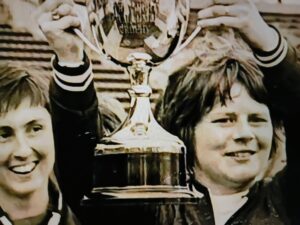
Southampton Ladies hold aloft The Mitre cup in 1970
Image Credit The National Football Museum
Codified in 1863, ‘Association Football’ coincided with the onset of Industrialisation and the development of the railways, which paved the way for teams to play matches all over the country and the campaign for half-day closing on Saturdays, plus ‘Sundays off’ began to gather pace and by the turn of the century, was rapidly becoming a reality. Historian Brian Beard believes that, ‘Fan bases then grew because people now had leisure time knowing that if they didn’t play they could watch.’
In pre-industrialised Britain, sports and pastimes had been very localised and often violent and the concept of ‘Popular Recreation’ had been characterised by poor transport and communication and an illiterate working class who worked seven days a week, mainly on the land.
There were many examples of what was often referred to as ‘Mob Football’ that was played across the length and breadth of the country, usually at Shrovetide, which was played to a set of rules that were specific to that part of the UK.
For example, in Alnwick Northumberland, ‘Scoring the Hales’ was a large Shrovetide football match, first played in 1762 and differed greatly from the ‘Atherstone Ball Game’, which had been played in Warwickshire since 1199.
‘Rational Recreation’ replaced this and emerged in industrial Britain as a means of promoting leisure activities, such as ‘Association Football’ and the FA Cup, which was to be played nationally and on an annual basis to an agreed set of rules that were codified and standardised across the whole country; alongside Football, other sports such as Rugby, Tennis and Hockey were codified around the same time.
That Wanderers and The Royal Engineers along with The Old Etonians and Oxford University contested every one of the first seven finals, showing the dominance of the public schools and universities and the amateur code, in the early years of the competition, but football was quickly being adopted by the new emerging urban working classes and within a decade, Blackburn Olympic were beating The Old Etonians in the final, so beginning the dominance of the professional clubs.
Professionalism was effectively made legal in 1882, when the FA accepted that clubs could pay ‘expenses’ to compensate for a loss of earnings when playing football and so the professional age began.
Press publicity first made the FA Cup significant in national sporting terms and Mike Huggins in ‘The Victorians and Sport’ (2004) believes that, ‘The media were active in constructing the very meaning of sports, since what people understood of them was largely shaped by the way they were represented’. The popular press played a very important part in the emergence of football as a spectator sport and Huggins recognised their importance to the growth of the sport and the FA Cup:
Readers were drawn into this imagined sporting community, becoming part of a larger passive or active body of supporters and the free publicity provided informed readers what was on and where.
The growth of a specialised sporting press had a very close relationship with the spread of sporting participation and spectatorship and publications like Bell’s Life, The Sporting Telegraph, The Sportsman and Sporting Times, began to target the ‘masses’ by the end of the century.
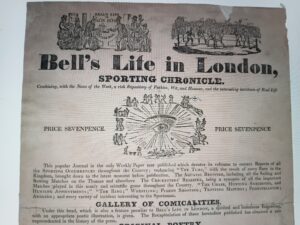
Publications like Bell’s Life and Sporting Chronicle reported on the early FA Cup matches
Sometimes referred to as ‘The Khaki Final’, due to the huge number of military personnel at the 1915 Cup final between Sheffield United and Chelsea played at Old Trafford in Manchester, it is surprising that the match was allowed to go ahead, (although there was a belief amongst many that the war would be over by Christmas) bearing in mind that Britain had been at war with Germany since August 1914.
‘The Khaki Final’
According to Dr Alex Jackson, curator at The Football Museum, ‘ The Government decided that a decision about whether to continue or not was to be left to the individual organisations, so the FA along with the other national football associations decided that it would be better for the war effort to continue.’
There was criticism and understandably, no one was in the mood to celebrate the result ( a 3-0 win for Sheffield United) of a match that would turn out to be the last final to be staged before competitive football was halted due to the war.
Much of the opposition to professional football continuing during WWI was due to the concern that many men would prefer to play and watch games rather than join up, however football alongside cricket and rugby was seen as a useful recruiting tool and many professional players served in the forces often representing their regiments and the newly formed ‘Sportsman’s Battalions’.
In the summer of 1915, the FA decided that for the next season, football would be reorganised to suit wartime demands, so the FA Cup was cancelled and leagues were only to go ahead if they did not involve excessive travel and on Saturday afternoons only.
The competition resumed in the 1919/ 20 season and its status took a huge step forward in 1923 when the final was held at ‘The Empire Stadium’ in Wembley, which had only been completed four days earlier before the Bolton Wanderers v West Ham United match.
The match is remembered for the huge crowd; some believe that it was over 200,000, when spectators spilled onto the pitch and were eventually removed by the mounted police and in particular, George Storry and his horse, ‘Billy’. The ‘White-horse’ final as it would become known, is one of the most iconic moments in FA Cup history.
The ‘White-horse’ Final
In 1927 Cardiff City became the first and to date the only club to take the cup out of England, when they beat Arsenal 1-0 in the first final to be transmitted live on national radio.
Images from the 1927 Final
However it would take until 1938 for Television to arrive with the BBC’s broadcast of the Preston North End versus Huddersfield Town match shown in its entirety, despite the fact that only 20,000 households actually had a television.
The 1938 Final, footage from Pathe News
The declaration of war in 1939 meant that both the Football League and the FA Cup were suspended for a second time and to fill the void left, a special ‘War Cup’ was set up to ‘boost morale’ and to keep the game going. Matthew Taylor in ‘The Association Game’(2008) believes that, ‘the continuation had a positive impact on society as a whole and that it was during the so called ‘’people’s war’’, that the idea that football had a central role in British social and cultural life first took root’.
The 1953 final was the first to reach a mass TV audience and was intertwined with the idea of modernity and tradition that ran through British culture in the early 1950’s with Stanley Matthews, the national hero, finally gaining a winner’s medal at the age of 38.
The new Queen Elizabeth who was at the game represented optimism in the future, which was closely linked with technological progress epitomised by the television coverage and the strong British traditions of monarchy and sport, were being actively promoted by the BBC.
Stanley Matthews held aloft and Queen Elizabeth II presenting the FA Cup
What makes the competition unique is the fact that is open to all affiliated clubs down to level nine of the English Football League (EFL) system and the last to join are the top two leagues ( The Championship and The Premier League), who join in the third round proper.
This creates a special focus and epitomises the ‘romantic’ nature of the FA Cup, where a lowly non-league team can be drawn against one of the ‘big clubs’, with a chance of achieving ‘giant-killing’ status; in the modern era the only non-league club to reach the quarter final ( the last eight) was Lincoln City in 2017.
Matthew Taylor (2008) explored the growing role of football as television entertainment and cited Iain Colley and Gill Davies’ research on the 1981 Cup final, where the authors, ‘offer a detailed examination of the way in which the football match was contextualised and in their own words, ‘’recombined’’ by both the BBC and ITV as a major television event.’
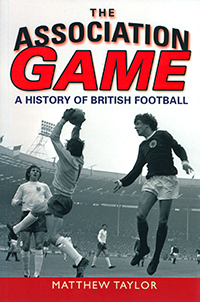
The Association Game: A History of British Football by Matthew Taylor Longman 2008
The FA Cup final coverage probably reached its peak in the 1980’s as a cultural force as the whole family gathered around the TV and ‘made a day of it’, with coverage starting in the morning focusing on the build -up through to live coverage ( on both channels simultaneously) of the match itself
Sadly, since the inception of The English Premier League(EPL) in 1992, the value of the FA Cup has been diminished and has unfortunately become a devalued prize, as many of the top teams in England are now totally focused on qualifying for The European Champions League,(ECL) also established in its current format in 1992.
To put things into perspective financially, in 2025, Liverpool earned £174 million for winning the EPL, Paris Saint-Germain won £168 million for winning the ECL and Crystal Palace earned a mere £2.1 million for winning the FA Cup.
In July 2023, an MP warned that the FA was risking ‘diminishing the value’ of the Cup if a controversial TV deal was struck with the EPL.
Clive Efford, who sat on The Culture, Media and Sport parliamentary committee, believed that if the FA struck a long -term arrangement with the EPL to sell the international rights of this historic competition, ‘it will be bundled alongside its own TV package.’
However, in April 2024 the FA and the EPL reached a new six -year agreement which was designed to strengthen the Emirates FA Cup format, which included:
- All rounds to be played on weekends
- Fourth, fifth and quarter finals weekends exclusive of EPL fixtures
- No replays from first round proper
- Cup final weekend exclusive of EPL fixtures
- EPL to increase funding to football pyramid
The Chief Executive of the FA Mark Bullingham commented:
The Emirates FA Cup is our biggest asset and generates over 60% of our revenue to invest into the game, so it is critical to secure a strong format for the future, ensuring that the magic of the cup is protected and enhanced.

Mark Bullingham, CEO, The Football Association
Credit: https://www.thefa.com/
However, under this new four-year agreement for the 2025-26 season, the BBC has become the sole ‘free to air’ broadcaster in partnership with TNT Sports and has secured live coverage of 14 games per season co-exclusively, which includes the final , ring fenced under the Broadcasting Act of 1996, which states that live coverage of the final must be made available to all; surprisingly, ITV has completely relinquished its broadcasting rights to the competition.
The FA Cup was crucial to British sport in the 19th century, establishing a knock out format, fostering professionalism, uniting fans through local identity and becoming a global spectacle in the television age ( over 500 million people world- wide watched the final in 2022) that showcases the drama and tradition of English football, bridging the gap between amateur and professional eras and driving the games ’growth.
So, the FA Cup final will continue to be shown on free to air television for everyone at least for the foreseeable future and due to its rich history, rightly deserves to be ring-fenced for the nation, solidifying its ‘exclusive slot’ alongside the Olympics, Wimbledon, World Cup finals, The Grand National, The Rugby World Cup finals and the Six Nations and the hope is that the historical status of this unique competition in the British sporting calendar that influenced football globally, will be preserved for at least another 150 years.
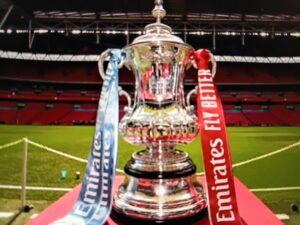
The Football Association Cup ( 1872- present)
Image Credit: https://www.thefa.com/
Article copyright of Bill Williams