A team of tradesmen and farmers from Staffordshire has recently ( March 2026) won the gold medal at The Tug of War indoor world championships in Taiwan.
The Sheen farmers Tug of War Club representing England, celebrated victory in the 560KG weight division against The Basque Region and recorded their first win since 2006; it comes after a bid by The Tug of War International Federation (TWIF), asking for the sport to be included in the 2032 Olympics in Brisbane.
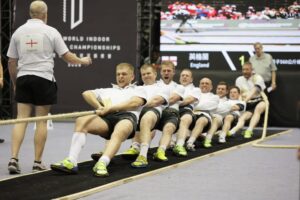
The Sheen Farmers Tug of War team, take the strain as they pull to victory in Taiwan
Credit: Sheen Farmers Tug of War team Facebook page
https://www.facebook.com/p/Sheen-Farmers-Tug-of-War-61558552682037/
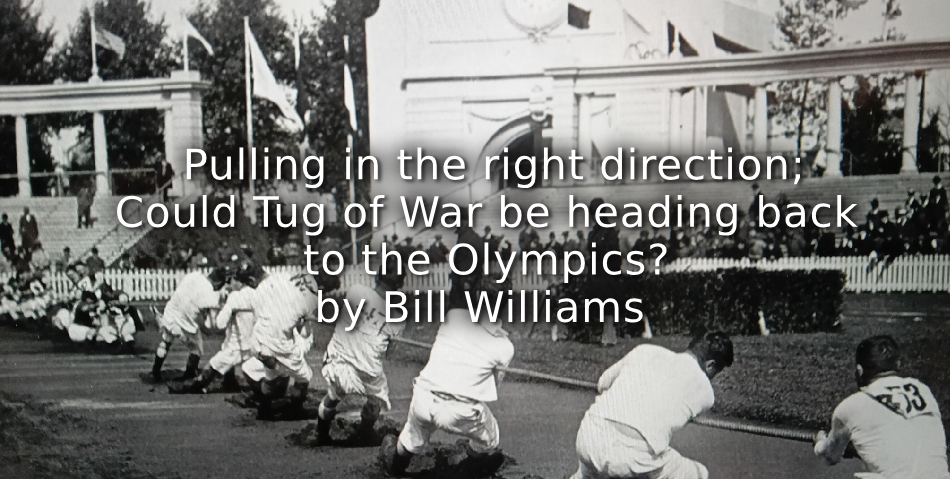
The modern revival of the ancient Greek Olympics in 1896 included a tug of war competition, with teams consisting of five or six pulling members and at the 1900 games in Paris, many of the teams featured athletes who were competing in other events, with the gold medal going to a combined team from Sweden and Denmark.
The team of six defeated the French team which included Constantin Henriquez de Zubiera (who would also go on to win gold as part of the French rugby team) becoming the first black athlete to win a medal at an Olympic Games.
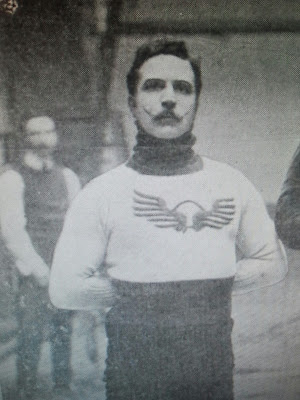
Constantin Henriquez de Zuberia who competed in the 1900 competition
becoming the first blackman to win a medal at an Olympic games
Image in the Public Domain vai Wiki Commons
It is believed that the sport originated as part of military training across Egypt, Greece , China and India, with roots dating back to 2000-2500 BC.
Known in ancient China as hook pulling, it was used to train warriors and test strength, later evolving as a competitive sport and a Royal pastime before becoming an Olympic event and was included because it was considered a legitimate high-level test of strength, endurance and team co-ordination.
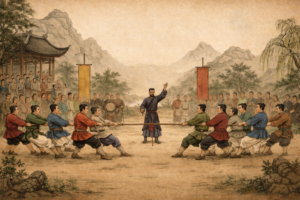
Known in ancient China as ‘hook pulling’
Image credited by AI
As part of the Olympic track and field programme in the early 1900s, it was viewed as a prestigious sport rooted in ancient tradition, something the games founder Pierre de Coubertin believed was very important and would feature in five consecutive summer games from 1900 to 1920.
Interestingly, the competition was entered by clubs, which allowed countries like Great Britain (GB) to enter several teams because the competition was originally treated as a contest between athletic clubs, not solely national teams, allowing them to potentially win multiple medals in one event; this practice was allowed until the structure of the games matured and national representation was formalised, leading to its removal in 1920.
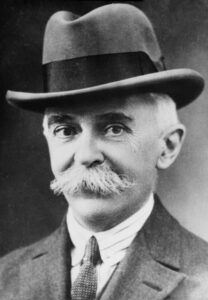
Pierre de Coubertin welcomed events like Tug of War
Image in the Public Domain via Wiki Commons
Having failed to win a medal at the two previous Olympic games, GB swept the board in London in 1908, with The City of London Police, winning the gold, The Metropolitan Police the silver and The City of Liverpool Police the bronze.
The sport seemed to provide an ideal pool of disciplined, physically large and uniformly strong men from the police, often utilising specialised training and sometimes controversially, heavy regulation boots; at the 1908 games, the Liverpool police caused a major upset by wearing regulation police boots, which were equipped with heavy steel cleats for added traction, sparking protests from the Americans.
The strength of the teams was deemed crucial for public spectacles and maintaining the prestige of the force and teams who won national-level amateur police competitions were treated as the elite de facto national teams for Great Britain due to consistent strength and performance.
It was very common for clubs, universities, and organisations to represent GB at those early Olympic games and it was also not unusual to have mixed teams from different nations, as in the Tug of War competition of 1900 which was won by a combination of Swedish and Danish athletes.
By 1908, The British Olympic Association (formed in1905) began formally selecting national teams, forcing many National Governing Bodies to send representative teams rather than clubs, like for example The Devon and Somerset Wanderers Cricket team (who won gold in 1900),who were just keen to take part.
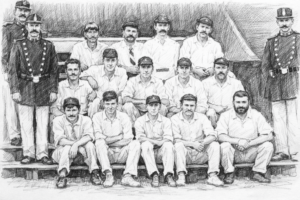
The Devon and Somerset Wanderers cricket team won the Gold medal in 1900
Pencil sketch
The introduction of formal selection significantly shaped Tug of War in GB, transforming it from a loosely organised pastime into a specialised police-dominated sport, capitalising on the fact that they had the major advantage of being able to train together on a regular basis, created a highly specialised, almost professional approach to what was an amateur competition.
After the 1920 games in Antwerp, where GB again secured gold (the team made up entirely of The City of London police officers) however, the International Olympic Committee (IOC) decided to streamline the Olympic programme and remove the sports that they felt had limited global participation and the specialised club-focused nature of the sport in Britain ultimately contributed to its downfall and the sport was dropped.
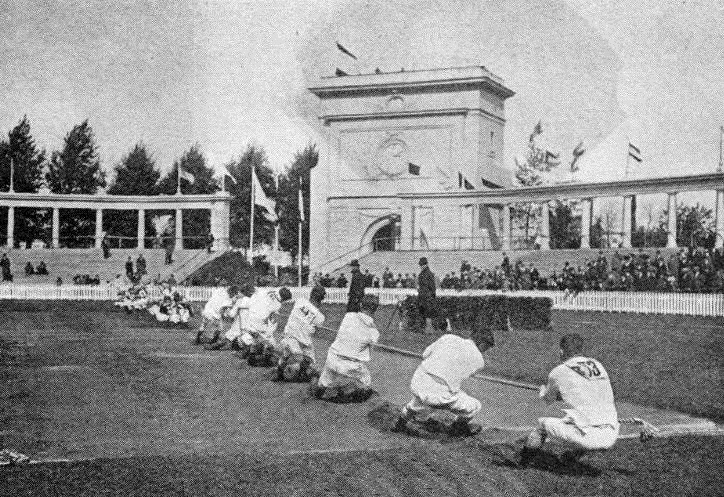
The Great Britain Tug of War Team- Gold medalists in 1920 and the ‘Reigning Olympic Champions!’
Credit:La Vie au Grand Air, Public domain, via Wikimedia Commons
Following its removal, the sport in Britain shifted away from police domination with The Amateur Athletic Association (AAA) overseeing it until 1958, before the establishment of specialised associations in England, Scotland and Wales and modern British Tug of War is now structured around strict weight classes for men, women and youths.
Despite its removal from the Olympics, GB has remained a strong force in the sport, with English and Scottish teams regularly performing well at The World Games and TWIF (formed in 1960) competitions.
Reintroducing the sport at the Brisbane games in 2032 would be monumental for Tug of War in GB and as reigning Olympic Champions, its return would be viewed as a homecoming, validating the sports history and potential to boost Team GB s medal tally and the Tug of War Association remains highly optimistic about this prospect.
Article copyright of Bill Williams