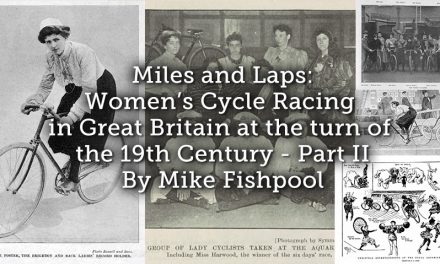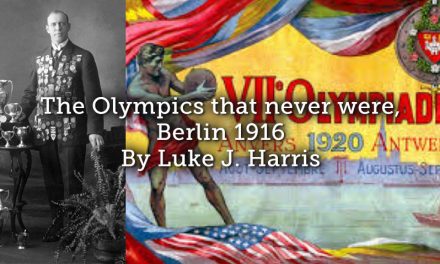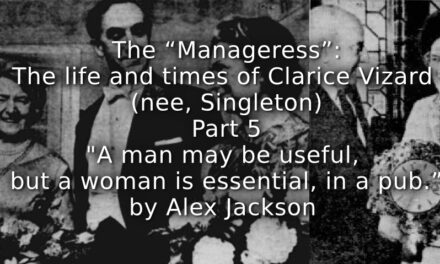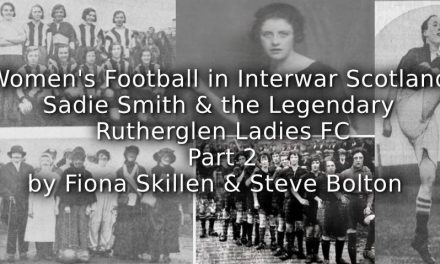

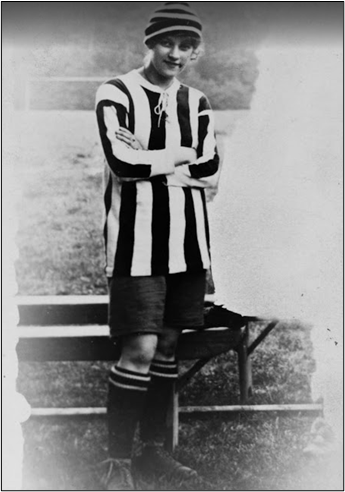
Alice Kell Looking Magnificent in June 1919
“Not a woman who happened to be a footballer, rather a footballer who happened to be a woman” – Steve Bolton Feb 2026
Source: Public Domain Image
Legendary Leader of the Original Dick Kerr Ladies FC
Alice was the leader of the Dick Kerr Ladies for their first 130 games, starting at age 19 on Tuesday 25 December 1917. Confident, articulate, skilful and born to the roll, Alice was the original football legend, worshipped by her teammates. After Britain came close to civil war in 1926, a lot of the Dick Kerr Ladies moved from employment at the Dick, Kerr & Co Factory in Preston to the Whittingham County Mental Hospital, about 8 miles/ 13 km away in the rural village of Goosnargh. Technically they changed their name to the Preston Ladies and they lost their manager, the inspirational Alfred Frankland. Frankland eventually came back in 1931, but in the interim Alice served as manager and chaperone for the few high profile games managed in the late-twenties. In this short article, I intend to provide some of the significant amount of evidence which backs up my claim that Alice Kell is the greatest woman footballer of all time.
April 1920 – Vive La France – ‘Les midinettes sont arrivées’
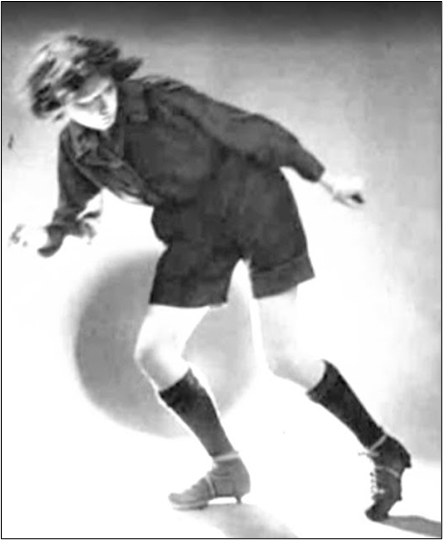
Madeleine ‘Mado’ Bracquemond
Captain of France from 1920 – 1935
France’s Greatest Woman Footballer
Original Image from the #SteveBoltonCollection
Source: Steve Bolton Collection
April 1920 – Fame Comes to the Dick Kerr Ladies
At 4.45pm on Friday 7th May 1920 when Alice Kell and her Dick Kerr Ladies were waved off at Euston station, London, on the train back to Preston by the French National side, led by Madeleine ‘Mado’ Bracquemond, history had been made. A series of four games played by the Dick Kerr Ladies against the visiting French women had catapulted them to national and international stardom. These games effectively started the ‘second golden era’ of women’s football. The 1919-1920 season had started rather inauspiciously for the Dick Kerr Ladies, who had only managed 5 games in the entire season from February to April 1920, playing just against the re-constituted Liverpool Munitionettes team, such was the lack of opposition after the war. Even worse, the DKL lost two of these games which did not give manager and public relations genius Alfred Frankland much chance to brand them the ‘undefeated lady champions’ of football.
May 1920 – Stamford Bridge, Chelsea
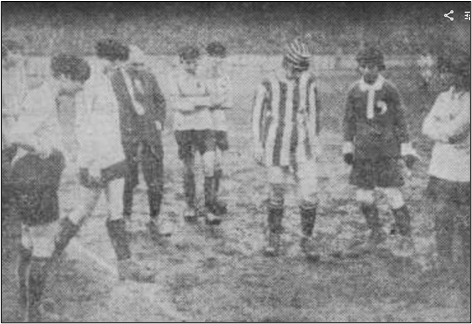
Captains ‘Mado’ + Alice Kell at Stamford Bridge Coin Toss
Source: BNA Leeds Mercury Saturday 8 May 1920 p16
Captain in the Groundbreaking 1919-1920 Season May French Tour
Alice Kell is pictured above in the Leeds Mercury with the French captain Madeleine ‘Mado’ Bracquemond inspecting the coin on the pitch at Stamford Bridge. This was her 39th game as captain and unfortunately it was another loss, this time 2 v 1. This was the fourth and final game of the tour:
Game 1 – Deepdale, Preston – Friday 30 April 1920
DKL 2 v 0 France Crowd 22,000
Game 2 – Stockport – Saturday 1 May 1920
DKL 5 v 2 France Crowd 15,000
Game 3 – Hyde Road, Manchester City – Wednesday 5 May 1920
DKL 1 v 1 France Crowd 12,000
Game 4 – Stamford Bridge, Chelsea – Thursday 6 May 1920
DKL 1 v 2 France Crowd 10,000
The tour of the confident and exuberant, Parisian, middle class women footballers around a dull, dour England, broken after the tribulations of a global war, caused a sensation. The Liverpool Echo reported that the French Lady footballers have: “refused further invitations to play matches at Newcastle-on-Tyne, Lancaster, Blackburn, Burnley, Bristol, London Lyons Tea Girls and Wigan”. Pioneer of women’s sport and French team manager Alice Milliat was quoted in the Leeds Mercury after the 2 v 1 defeat at Preston:
The girls consider that the opposing backs (Miss Kell and Miss Hume) are marvellous and feel that if the backs hadn’t been so good we might have arrived at a better result.
The Preston Invincibles of 1888-1889
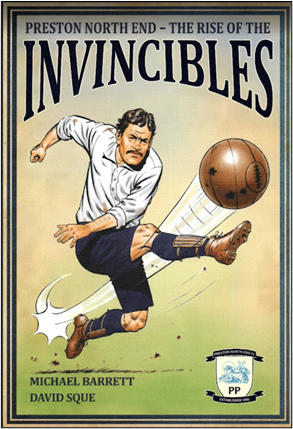
“Preston North End – The Rise of the Invincibles”
Graphic Book by Michael Barrett + David Sque
Source: Steve Bolton Collection
Preston, Lancashire – “Football Town”
The sumptuous book above is a signed personal gift from my good friend, Michael Barrett. Michael wrote the book and David Sque illustrated. David is a famous artist who worked on Roy of the Rovers, star of the fictional Melchester Rovers. At the heart of the book is the 1888-1889 double-winning team, the ‘Preston Invincibles’. If you look carefully at the front cover above you can see the Preston Civic Crest which adorns everything in Preston. Below the Paschal Lamb (a tribute to St. Wilfrid, the Patron Saint of Preston), are the letters “PP”. My non-footballing Nan frequently told me on my visits in my formative years that it stood for “Proud Preston”. It actually stands for Princeps Pacis, which is Latin for Prince of Peace and a reference to St. Wilfrid. Like most Prestonians (technically I was born in Chorley Hospital but my family are all Preston) I prefer ‘Proud Preston’.
When Scottish businessmen and engineers William Bruce Dick and John Kerr decided to expand into the exponentially growing market of tram manufacture by opening the Dick, Kerr and Co. factory on Strand Road next to Preston Docks in 1893 little did they know the legacy they would leave in Preston. The factory soon developed a formidable male football team which competed in the Lancashire Combination, which effectively was a ‘feeder’ league for the local professional teams. The close symbiotic relationship between Preston North End and the Dick Kerr’s men’s team eventually led to censure by the English FA in the 1920s. The firm also gave rise to the greatest women’s football team of all time, the Dick Kerr Ladies FC.
A Very Personal Story
The factory doesn’t now dominate the town like it once did, but the huge West Strand building still remains on Strand Road. For many years the factory remained shut but it is now a going concern, with Granite House Kitchen Worktops having their manufacturing and showroom on the premises. In 1923 when my footballing Granny Lizzy Ashcroft joined the Dick Kerr Ladies, (after her team St Helens had thrashed the DKL 5 v 1) she moved to Preston and was given a job at the factory. Later on my other grandfather, ‘Pop’ Singleton, who was a metalworking turner, also worked at the Dick, Kerr Factory. Like a lot of Preston folk, the place is in my DNA.
Michael Barrett, who gifted me the lovely book above, is the Heritage Coordinator for the Preston North End Community and Education Trust. I would like to take the opportunity in this article to highlight the amazing work done by this Trust, run by the Football Club. One of the inspiring events that they run is the Sporting Memories meeting every Tuesday to support dementia and loneliness. This is augmented by speakers, trips and visits and is just a small part of what they do.
A couple of years ago I joined the online session which the Community Association had put on, because a group of my old friends from my cricketing days with the Whittingham County Mental Hospital were present, some sadly in need of dementia support. I did one of the silliest things that I have done in a long while – I tried to show off that I had met the famous Lily Parr, which in some circles is a bit like saying ‘I once met Pele’. After a short silence it started: “Eh, Frank, didn’t your Ada work wi’ Lily?”. Several contributors carried on with the same theme. Of all the forums in the world where I could have chosen to make this silly statement, I had chosen the wrong one. Half the gathering had spent many years with Lily. I think the moral, engage brain before opening mouth applies to this story!
The WW1 Media Superstars – The “Dagenham Invincibles”
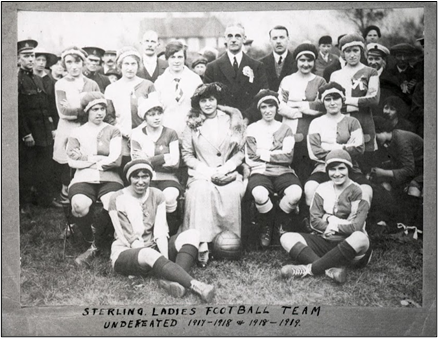
STERLING LADIES FOOTBALL TEAM
UNDEFEATED 1917-1918 & 1918-1919
Source: Courtesy Valence House Archives
WW1 – 250 Teams Play Over 1,000 Games in the First Golden Era
The long ‘hangover’ of the Victorian era and its attitudes to class and gender reached long down the last century and it could be argued still has a significant impact on society today. British society was not ‘ready’ for widespread women’s football until post the 1966 men’s world cup. This is when we start to see, albeit with huge challenges and barriers, the widespread formation of women’s football leagues, particularly in the Midlands. This poses the question: how did we have two golden eras, fifty or so years earlier? The main reason is that British Society faced a total war. If it was a necessity for men to sacrifice their lives in the trenches then it became acceptable (temporarily) for women to engage in the male, impact sport of association football, wearing skimpy outfits and potentially damaging their fertility and ‘readiness’ for marriage. Women were encouraged into roles previously only acceptable for men and the factory workers became known as munitionettes. Football was seen as a positive way of them spending their breaks and this was generally regarded as a good outlet to make them fitter and assuage worries about morality, a lot of young women living and working hundreds of miles away from their families. It was soon realised that high profile charity matches between ‘munitionettes’ teams was great for morale and a very good way to raise funds for the war effort. The unique media superstars of this first golden era for women’s football were a team based at the Sterling Telephone and Electrical Co. factory in rural Dagenham. Four of their games featured on Pathe news, including their very first game in September 1917. It is tantalising to think that the Preston women at the Dick, Kerr and Co. factory may have seen them in the local cinema and been inspired to form their own team when asked to help raise funds by the Matron at the local VAD (Voluntary Aided Despatch) Hospital on Moor Park.
The Dick Kerr Ladies Record in the First Golden Era of WW1
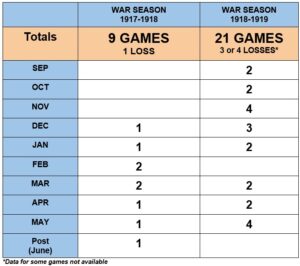
Dick Kerr Ladies – Late Starters to the Game
The Dick Kerr Ladies had their first game on Christmas Day 1917. On the very same day the North East women’s football scene was having its 115th game. This game was an ‘international’. A select eleven had been chosen to represent ‘England’ in a match against ‘Ireland’ in Belfast. There were active football scenes all over the country in all the major industrial areas. Teams played football in London, Glasgow, Cardiff, Belfast and although most games were local, due to travel restrictions, some interesting matches took place. For instance, midland legends the Humber Ladies travelled south for a hugely significant game against the mighty undefeated Vickers Crayford Ladies FC.
As can be seen from the table above the Dick Kerr Ladies faced some stiff northern competition, most notably St Helens, Bolton, Whitehaven and Lancaster.
Alice Kell – Recognition in the Preston Newspaper
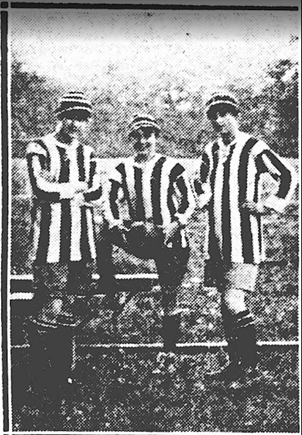
ALICE KELL + JENNY HARRIS + FLORRIE REDFORD
“STARS OF DICK, KERR’S TEAM”
Source: BNA Lancashire Evening Post Saturday 28 June 1919 p5
Alice Kell – “Able to Play Any Position with almost a Man’s Skill”
Preston newspaper, the Lancashire Evening Post published the above photograph just after the end of the Dick Kerr Ladies war odyssey. The short article starts with the headline: “GIRL FOOTBALLERS – “STARS” OF THE DICK, KERR’S TEAM.” The article then continues:
The record of Dick, Kerr’s ladies’ team in general, during the last two years, and of the three members whose photograph we give – Alice Kell, Jennie Harris and Florrie Redford – is a striking refutation of the contention that girls cannot take part in youths’ field games with aptitude and success.
The team, splendidly handled and run, has raised large sums for war charities, and at the same time has provided enjoyable sport for thousands of people. The standard of skill reached has varied, but the three girls pictured above are probably unsurpassed, certainly as a trio, in the kingdom. Kell and Redford have been members of the side from its inception, while Harris, along with Walmsley, centre half, of the three at least learnt to play the game with their brothers, and all display almost a man’s skill and knowledge, Kell and Redford being able to fill any position on the field.
Season 1917-1918 – 1st Major War Season
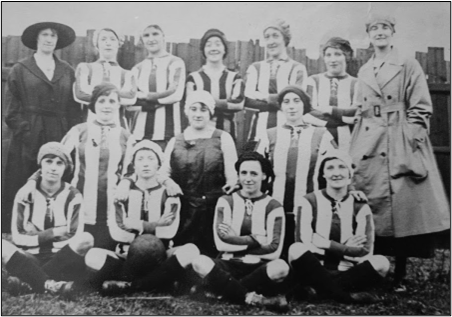
First Known Photograph of the Dick Kerr Ladies
Source: Courtesy Dave Coulton
1917-1918 Season – Alice Kell – A Dominant Centre Half
On Saturday 2nd February the Lancashire Evening Post had this to say about the performance of Alice Kell in the Dick Kerr Ladies second ever game, a narrow 2 v 1 win over arch rivals National Projectile Factory Lancaster, with their star centre forward Jenny Harris:
Miss Kell, Dick, Kerr’s ladies’ centre half, played a brilliant game at Lancaster on Saturday, so much so that I am told Joe McCall never dominated a match more completely.
This is quite some compliment. Joe McCall had been the Preston North End centre half since breaking into the team in 1906. He was a great organiser and leader and was made up to captain. He was so good that he was selected for international duty but unfortunately the war then interrupted a potentially brilliant career.
Game number six was a challenging home game at Deepdale against Mrs Vizard’s Bolton Munitionettes XI. The LEP had this to say about Alice Kell’s opening goal for the DKL in the narrow 3 v 2 win in front of 7,000 spectators:
... which Miss Kell worked for with a skill that no professional player could have excelled.
Similarly, the Preston Herald stated: “Miss Kell, however, quickly equalised with an individual effort which would have done credit to a professional footballer.” After the final game of the season at New Brighton against the mighty Aintree Filling Factory Ladies the Liverpool Echo has this to say:
The visiting centre half, Miss Kell, is probably the best lady exponent in the land.
Season 1918-1919 – 2nd War Season
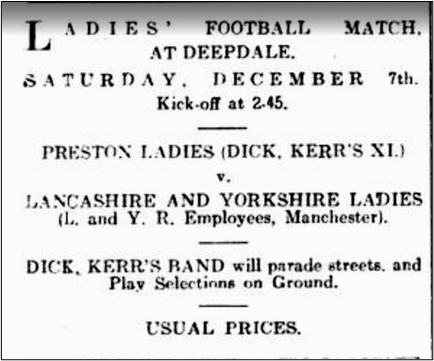
dvert for Game – Saturday 7th December 1918
Source: BNA Preston Herald Saturday 30 November 1918 p1
1918-1919 – Alice Kell Frequently Mentioned in Despatches
The LEP had this to say about the December 4 v 0 win against the Lancashire and Yorkshire Railway workers from the British Westinghouse Works, Manchester: “The latter were no match for their opponents, who were both cleverer, faster, and possessed of better idea, especially with the skill of Kell and Redford in defence.” In the Christmas day 2 v 2 draw with Bolton at Deepdale the LEP stated that Kell, Harris and Nixon were the ‘pick of the home side’. By January 1919 some big changes had taken place at the DKL with an influx of the best players from Lancaster: Harris, Walmsley and Hastie. The preamble to the 25th January game points out that Kell was ‘fit to play again’ and the teamlist has her now playing at right back and listed as captain. The DKL, together with the Sterling Ladies FC are notable for managing to complete a full set of fixtures in the 1918-1919 season. Towards the end of the season the DKL combined with Bolton Ladies to take on a North East representative team called ‘Newcastle’, with both home and away fixtures at Deepdale. Two very close games against the likes of Winnie McKenna, Mary Lyons and Minnie Seed resulted in 1 v 0 win at Deepdale and a 0 v 0 draw at St James Park. The St James Park game on Tuesday 22 April attracted a crowd of 30,000 which is the largest credible figure for a crowd during this first golden era. One of the last games of the season pitted captain Alice Kell against future DKL teammate Alice Woods on Saturday 17 May at Springfield Park in Wigan. The LEP described their opponents:
… when they will be opposed by St Helens, the solitary undefeated ladies’ team in Lancashire.
The final score has yet to be verified, but it helps to show that in the first golden era of women’s football the Dick Kerr Ladies were just one side in a much bigger picture, facing some strong local opposition. They did not ‘pioneer’ women’s football in this era and they were not unbeaten.
1919-1920 Season – Le Glamour Français est Arrivé
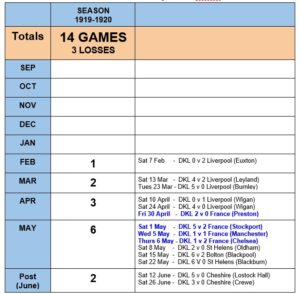
1919-1920 – A Difficult Season Post War Season
The vast majority of the 250+ teams who had played during WW1 had ceased to exist.
This had nothing to do with the actions of the English FA.
The Dick, Kerr & Co factory had, unlike a lot of other factories, not laid off its women workers and most of the team had not married and they were very keen to start up again. A dreary season playing the town teams made from ex-munitionettes was lifted to another level by the visit of the glamorous French team – and the French team were very good footballers.
1919-1920 Alice Kell – Captain and Right Back
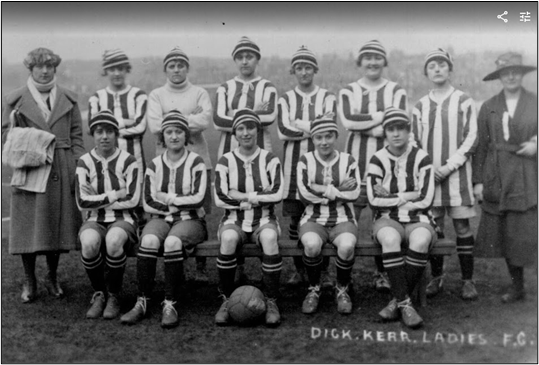
L-R:Alice Norris, Alice Kell, Annie Hastie, Annie Crozier, Jessie Dickinson, Jessie Walmsley, Lily Jones, Lily Lee
Seated: Molly Walker, Emily Jones, Nellie Mitchell, Jenny Harris, Florrie Redford
Dick Kerr Ladies FC at Turf Moor – Tuesday 23 March 1920
Original Postcard from the #SteveBoltonCollection
Source: Steve Bolton Collection
Alice Kell – “Plays Really Good Football”
A lengthy report in the Burnley News about the 5 v 0 win for the DKL at Turf Moor had a mixed report about the game. £450 was raised from the gate money for the Discharged Soldiers and Sailors’ Association. The News had this to say:
The game provided both interest and fun, some of the efforts of the ladies being somewhat laughable, but individually in both sides there were some who could play really good football and showed both ball control, speed and stamina. Especially was this so as regarded Misses Kell, Walmsley, Jones and Redford of Dick, Kerr’s and Miss Swift of the Liverpool Ladies.
The paper then went on to point out that the DKL got three offside goals before Jenny Harris completed the fourth and fifth from individual runs, finishing with a hat trick.
May 1920 – Mado’ and Alice Kell – Front Page of the Daily Mirror
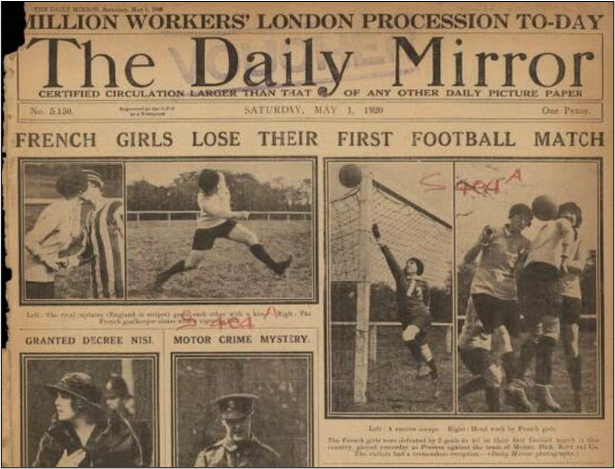
FRENCH GIRLS LOSE THEIR FIRST FOOTBALL MATCH
Front Page of the Daily Mirror
Source: BNA Daily Mirror Saturday 1 May 1920 p1
Alice Kell – First Woman Football Captain to feature on Major Front Page
History was made as Alice Kell, together with Madeleine ‘Mado’ Bracquemond were featured on the front page of a major English Daily Newspaper. This was nearly 100 years before the Lionesses. This tour caught the public and press imaginations and I have enough material for a book from just these four games. The wheels had been set in motion for the second golden era of women’s football. The paper had this to say underneath the first picture:
Left: The rival captains (England in stripes) greet each other with a kiss. – Right the French goalkeeper clears with a vigorous kick
Left: A narrow escape. Right: Headwork by French girls
It is interesting to note that these pictures are not actual action shots of a game. They were publicity stills taken before the Deepdale game at Lively Polly Corner on Ashton Park, which was the sports facility for the Dick, Kerr and Co. Employees. Alfred Frankland, the manager of the Dick Kerr Ladies was a public relations genius. This set of photographs was almost certainly down to him.
May 1920 – ‘Mado’ and Alice Kell – Le Miroir Des Sports
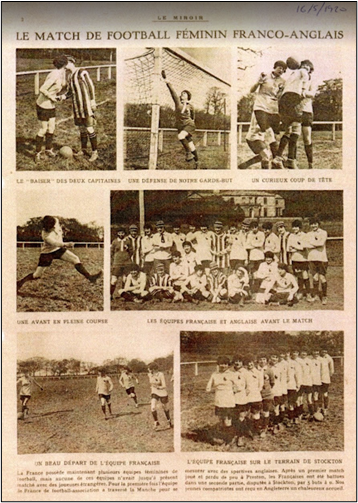
MATCH DE FOOTBALL FÉMININ FRANCO-ANGLAIS
Original Magazine from the #SteveBoltonCollection
Source: Steve Bolton Collection
‘English’ Football Captain Alice Kell Featuring in French Sports Magazines
These photographs quite clearly show the white building in the background, proving that they were taken at Ashton Park. Ashton Park was the sports facility for the Dick, Kerr and Co. Factory. To Prestonians it was always known as ‘Lively Polly’ corner because for many, many years the huge wooden fence facing onto Blackpool Road carried an advert for Lively Polly Soap. The Pathe clips of the Dick Kerr Ladies training were usually filmed here. There is now an information board in their honour sited in the Park.
1920-1921 Captain of the Greatest Team of All Time
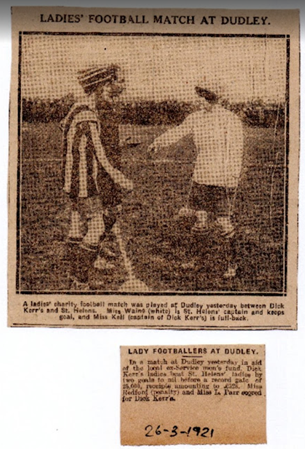
Alice Kell Greets Edith Waine
Original Newspaper Clipping from the #SteveBoltonCollection
Source: Steve Bolton Collection
Captain During the “Second Golden Era” – Season 1920-1921
From Saturday 21 August 1920 to Saturday 4th June 1921 the Dick Kerr Ladies played 52 games with Alice Kell as captain. They won 51 games and drew the other. The draw was against the French National side in Paris where a very partisan crowd of 20,000 at the vast Pershing Stadium cheered on the home side. I cannot begin to do justice to this season in this short article. Forming their opposition for 13 of these games was the second best team in the country, St Helens Ladies. This is also the season, where in April 1921 my granny Lizzy Ashcroft made her debut for St Helens at the age of 16 in front of 30,000 at St Andrews, home of Birmingham City FC. One of the more remarkable items in my collection is the original piece of newspaper (picture above) showing my granny’s first two captains: Edith Waine of St Helens and Alice of the Dick Kerr Ladies. Edith Waine was widely regarded as the best goalkeeper in the country.
September 1920 – 15 Year old Lily Parr Joins DKL
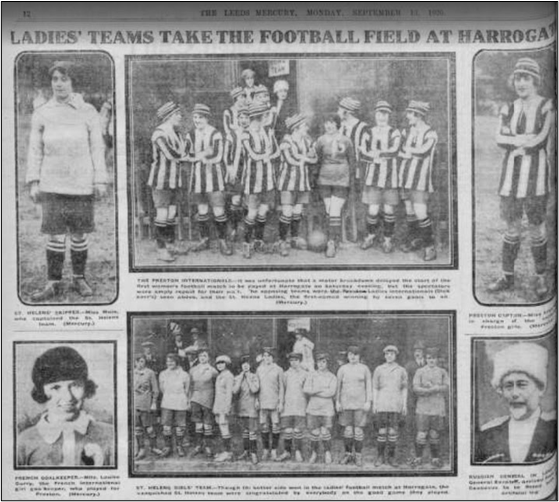
Edith Waine + Alice Kell Featuring on the Leeds Mercury Back Page
Source: BNA Leeds Mercury Monday 13 September 1920 p12
Alice Kell Uses Her Leadership Skills with Lily Parr in September 1920
AFTER the French tour during the previous season the Dick Kerr Ladies had thrashed St Helens Ladies by 6 v 0 at Ewood Park, Blackburn. One St Helens player was singled out as being an amazing defensive talent, the young Lily Parr. This was her one and only known game for St Helens. She was persuaded over to Preston from her native St Helens but this presented a problem for Alfred Frankland, what to do with the precocious but undisciplined young talent, as he had a team of superstars, especially in the front line. So, at the start of the 1920-1921 season he placed her at left back, under the watchful eye of the most respected woman footballer of the era, Alice Kell. This obviously worked, because half-way through the season Parr got an opportunity to play up front and had a barnstormer of a game. She then owned the position of left wing for the Dick Kerr Ladies, and for a while they became unbeatable.
The LEP had this to say about the first game of the season, a 3 v 0 win over Mid-Cheshire:
The Preston players reproduced all their last season’s skill, and showed all-round superiority, especially in their footwork, which pleased the crowd. Kell and Parr came in for special recognition for their clearances. Harris, Redford and Haslam were the pick of the Preston forwards.
1921-1922 The ‘Ban’ Season
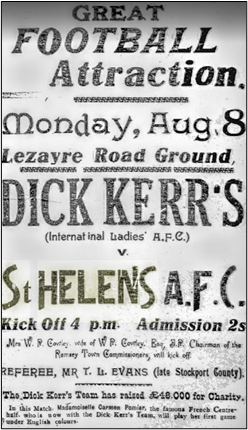
Isle of Man Tour Advertisement – Ramsey
Source: IOM Archive Ramsey Courier Friday 5 August 1921
Tour to Isle of Man
The 1921-1922 season started early with a tour to the Isle of Man during Preston holiday week with St Helens Ladies FC. The Dick Kerr Ladies took with them their new signing, legendary French footballer Carmen Pomies. The Dick Kerr Ladies sailed from Fleetwood and St Helens sailed from Liverpool. My granny was just 16 and she must have been starstruck to go on tour to the exotic (in 1921) Isle of Man with the superstars of the Dick Kerr Ladies. The exotic Isle of Man turned out to be very wet and so crowds of 5,000, 6,000 and 2,000 watched the DKL run out 5 v 3 winners in Ramsey, 3 v 0 winners in Port Erin and 4 v 0 winners in Douglas. These three games were the first of 35 games played, despite the English FA prohibitions of October and December 1921 which brought an effective end to the second golden era.
The sword of Damocles had fallen, and it remained for an unconscionable 50 years.
March 1922 ‘Olympique de Paris’ Tour of England
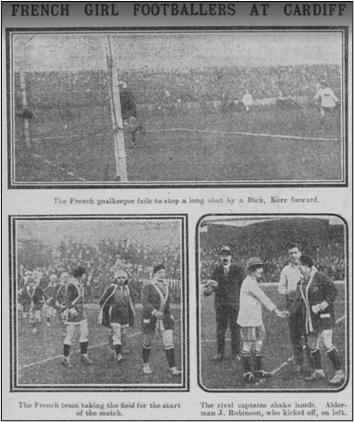
Alice Kell greets Violette Gourard-Morris
Crowd of 15,000 at Cardiff Arms Park
Source: BNA Daily Mirror Friday 24 March 1922 p5
March 1922 – ‘England’ Captain Alice Kell Features in Daily Mirror
Despite the FA ban, the Dick Kerr Ladies managed a very full season. Apart from one game in July the season finished with a triumphal set of four wins over the visiting French side which styled themselves Olympique de Paris. The most controversial footballer in the history of women’s football, captain of Olympique, *Veronique Gourard-Morris was welcomed to the cenotaph and Mansion House. Hey’s Brewery Bradford, together with Stoke, had now assumed St Helens role as the second best teams in the country and Hey’s were accorded a game in Bradford, which they duly won 2 v 0. The game had to be moved to a neutral pitch because the northern rugby league committee had passed a resolution banning women’s football from their grounds.
*Veronique Gourard-Morris caused no end of trouble all through the long golden age of French women’s football. Her increasingly outrageous and licentious behaviour caused scandal even in the Paris of les années folles. Her arrest for murder on her houseboat and her eventual assasination by the maquis at the end of WW2 for collaboration make her easily the most controversial woman footballer of all time.
1922-1923 Season – Alice Kell “Captain America”
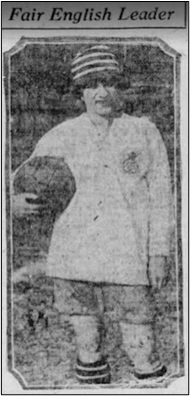
FAIR ENGLISH LEADER
Source: Newspapers.com
September 1922 – Alice Kell Features in the American Newspapers
The Philadelphia Enquirer had this to say:
THIS is Alice Kell. She is the fair captain of the English soccer lasses who reached here last night. The British maids are to play the local Phil Kickers Saturday in this city and the fair Alice is said to be one of the star players of the invaders.
This was a very long, exhausting and fabulous trip for the young women of the Dick Kerr Ladies. As well as her leadership on the football pitch, Alice would have needed all of her skills and prowess as the senior female group leader and Alfred Frankland would have relied upon his ‘rock’. Success was rescued from the jaws of disaster as fixtures were rearranged during the trip. After a week long voyage on board the USS Montclare they arrived in Quebec only to find that the Dominion Football Association would not allow them to play in Canada. They ended up playing 9 games against men’s teams in the USA. Their 7th game was in Massachusetts on Sunday 15th October, followed one week later with a game in Baltimore. Their 9th and final game wasn’t until Saturday 14th November and was in Philadelphia. They had departed on 15 September and did not return until 17 November. This was an extremely long and challenging tour. The tour group were on the boat for seven days and a lot of ‘tall’ stories came back from the tour.
1923 – St Helens hand the Dick Kerr Ladies their Greatest Ever Defeat in their Final Game
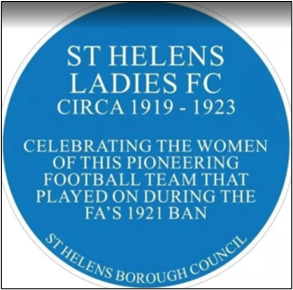
St Helens Ladies FC Blue Plaque
Courtesy: St Helens Borough Council
Saturday 31 March 1923 – St Helens 5 v 1 Dick Kerr Ladies
The 1922 US tour had temporarily protected the Dick Kerr Ladies from the ramifications of the English FA ban of December 1921. However, not only was decent opposition on a decent ground getting very challenging, they had big changes in personnel with retirements and players moving on. In particular they lost superstars Carmen Pomies, Florrie Redford and Jessie Walmsley. It was a somewhat different team that travelled the short distance to the Queens Park in central St Helens for a game against friends and arch-rivals St Helens Ladies FC, also apparently without talismanic captain, Alice Kell.
The Queens Park is a small urban park in the centre of St Helens and for the game was sealed off and entry charged. The Liverpool Daily Post had this to say about the game:
In connection with the Mayor’s Easter effort on behalf of local charities, a ladies’ football match was played on Saturday at the Queen’s Recreation Ground. The bad weather spoiled the attendance. Play was most interesting. St Helens won by 5 goals to 1. S. Chorley, the St Helens centre forward, showed remarkable form, and scored four goals, Hilda Parkinson putting in the other. For Dick Kerr’s team, L. Parr, who hails from St Helens, scored from a penalty.
Teams:-
St Helens – S. Fairclough; P Scott and Mitchell; L. Martin, L. Ashcroft and J. Collinson; L. Ackers, A Jones, S. Chorley, H. Parkinson, and E. Roden.
Dick Kerr’s – M. Rainford; L. Lee and D. Clayton; A. Norris, M. Walker, M. Shaw, E. Frankland, A. Mills, J. Harris, A. Docherty and L. Parr.
Referee, Mr T. W. Coulson.
The St Helens Reporter gave the crowd at 2,000 and had this to say about Susie Chorley:
Sue Chorley, the Saints’ centre, was the outstanding player. The way she got possession of the ball and ran down the field delighted the spectators. Besides being nippy and elusive, she was a powerful kicker, and easily beat Miss Rainford, the visitors’ goalkeeper.
1923-1924 Season – An Annus Horribilis for Dick Kerr Ladies
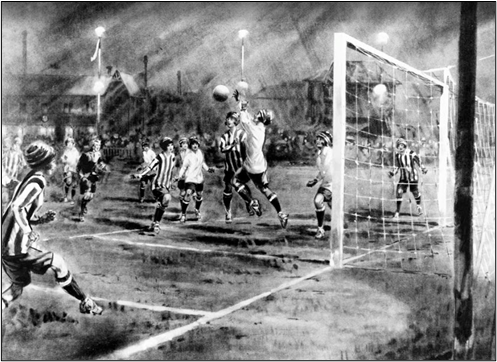
1923 World Record Floodlit Games in Burnley
Dick Kerr Ladies (stripes) v Hey’s Brewery Bradford (white)
Source: Steve Bolton Collection
21 + 31 December 1923 – Alice Kell in World Record Floodlit Games
This was an awful year for the Dick Kerr Ladies. After the debacle of the 5 v 1 defeat, three of the St Helens Ladies had been hastily recruited: Lizzy Ashcroft, Lydia Ackers and Susie Chorley. Polly Scott and Hilda Parkinson also became significant DKL players. The season started with some easy thrashings of the much weaker Dumfries ladies but then came the female ‘Scottish Professors’ with their modern passing game, the Rutherglen Ladies who outclassed the DKL by 2 v 0 on Shawfield Park in Rutherglen. Rutherglen were led by the leading Scottish footballer of the time, Sadie Smith, whose granddaughter is folk singer Eddi Reader. Just as St Helens defeated the DKL in their last ever game, so too did Stoke Ladies on 22 September in their last ever game, albeit by the much closer margin of 1 v 0. On Colne Cricket pitch the great Daisy Bates sprinted half the length of the pitch, probably being chased by my granny, and banged one in. The season ended on August 2 with a 2 v 2 draw against Hey’s Brewery Bradford Ladies.
Alice Kell’s Playing Career Comes To An End
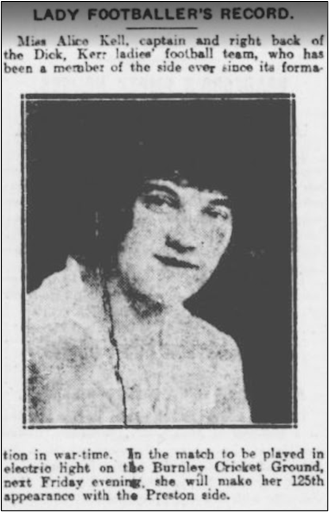
LADY FOOTBALLERS RECORD
Source: BNA LEP Saturday 15 December 1923 p6
1923-1924 Season – A Legend Bows Out from Playing
This season marks the end of high profile women’s charity football being a winter game. The innovative, world record floodlit games took place at Burnley Cricket Club using industrial lighting, seven years before a similar male game. Unfortunately, the wintry moors weather and high cost of the technology made the games a financial disaster for the Dick Kerr Ladies.
Alice Kell had other things to do in her life and this season marked her departure from playing the game after 7 spectacular years, achieving what no other woman footballer had, or will ever do.
May 1925 – Life Without Alice Kell for Dick Kerr Ladies
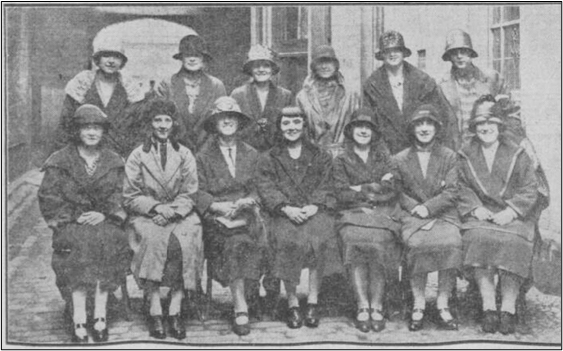
Dick Kerr Ladies Posing in the Courtyard of Bull & Royal Hotel
L-R: Annie Crozier, Lily Martin, Lily Lee, Florrie Redford, Lizzy Ashcroft, Lily Parr
Maggie Shaw, Polly Scott, Lily Buxton, Jenny Harris, Lydia Ackers, Hilda Parkinson, Jenny Lancaster
Source: BNA LEP Saturday 16 May 1925 p6
May 1925 – Captaincy Passes to the Legendary Florrie Redford
The gruelling 10 day tour in May 1925 against the French touring side, taking in London, Lancashire, Scotland, Belfast and then back to London over 18 days was too much for the nearly 27 year old Alice. The mantle of leadership passed to her great friend and another original Dick Kerr Lady, the supremely talented Florrie Redford. Here are the Preston team posing in their cloche hats, perhaps trying to match their French visitors who posed for a similar picture. The cobbled courtyard in the entrance to the Bull and Royal has not changed much in 100 years, but it is no longer used as the stable entrance for Preston’s poshest hotel.
1920 Alice Kell – The Writer
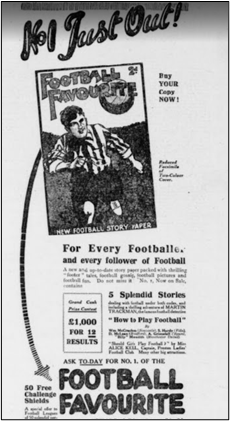
Football Favourite Magazine – Edition No 1 – September 1920
“Should Girls Play Football?” by Alice Kell
Source: BNA Athletic News Monday 6 September 1920
September 1920 “Should Girls Play Football?”
Football Favourite was a very popular football magazine, first issued in September 1920, which together with its rebrand as Football and Sports Favourite ran until 1929, with 483 issues. Alice Kell was featured in the very first issue with the following:
Why not? Asks Miss Alice Kell, the Popular Captain of the Famous Preston Ladies’ Team.
There are few cleverer Soccer players than Miss Alice Kell, the captain of Dick Kerr’s famous team of girl footballers. She is equally at home either at centre-forward, centre-half, or right-full-back. Her cool tackling, powerful kicking and deadly shooting have called forth admiration and surprise amongst the large crowds gathered together in the cause of charity by the attractive play of the Preston munition workers.
There follows a lengthy and articulate exposition of women’s football by Alice. She confirms: “Not a single player has received any pecuniary benefit from playing football. All of us play solely for the love of the game.” Alice also wrote for William Appleton’s ‘The Democrat’ in 1921 and was frequently quoted in the newspapers of the era.
1927 – Alice Kell – Manager and Chaperone
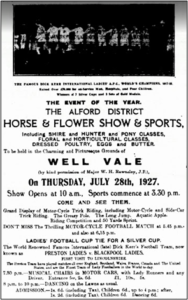
Alford District Horse & Flower Show & Sports
Well Vale House, Lincolnshire Wolds
Source: BNA Friday 22 July 1927 p2
1927 – Two Innovative Games – Post 1926 General Strike
On Monday 3rd May 1926 Britain came close to civil war as for 9 days the country was paralysed and the military were used to maintain food supplies. One of the more remarkable items in the #SteveBoltonCollection is a two page version of the Lancashire Daily Post from the second day of the strike. Two warships were used to deliver food to Liverpool. Also detailed is the number of employees on strike from Leyland Motors and Dick, Kerr and Co, the two big employers in the area. Women’s football was not immune from this. The Dick Kerr Ladies were forced to change their name to Preston Ladies and Alfred Frankland no longer ran the team. He was not to return until 1931. “Pea Soup” football became popular in mining communities, but the high profile charity model championed by the Dick Kerr Ladies ceased to exist, except for two innovative games in 1927 with Alice Kell in charge.
The first of these games took place on Thursday 28 July 1927. Situated on the edge of the Lincolnshire Wolds is the Grade II listed 17th Century Mansion, Well Vale Hall which was owned by Major Walter Hugh Rawnsley, a prominent local landowner, horse breeder who acted as Lord of the Manor. 1927 saw the fifth annual Horse show taking place in the grounds of the hall and it was decided to introduce a number of attractions, including a high profile women’s football match. The advert above includes the ‘WORLD’S CHAMPIONS’ postcard (featuring my Granny and Lily Parr) with the following
Show Opens at 10am., Sports commence at 3.30pm
COME AND SEE THEM.
Grand display of Motor-cycle trick riding, including Motor-Cycle and Side-Car Trick Riding. The Greasy Pole. The Long Jump. Aquatic Apple.
Riding Competition and 50 Yards Sprint.
DON’T MISS The Thrilling MOTOR-CYCLE FOOTBALL MATCH at 5.45 p.m.,
and also at 6.15 .p.m.
LADIES’ FOOTBALL CUP TIE FOR A SILVER CUP.
The World Renowned Famous International (late) Dick Kerr’s Football Team, now known as
PRESTON LADIES V BLACKPOOL LADIES
FIRST VISIT TO LINCOLNSHIRE
The Preston Team have played matches all over England, Scotland, Wales, France, Canada and the United States, and are the Finest Team of Lady Footballers in the World to-day.
The football match was described as ‘the outstanding’ attraction. It is important to note that there was no Blackpool Ladies football team. This was really a marketing ploy for a DKL A v DKL B game. A saloon charabanc was chartered to leave from Blackpool at 7.30am and pick up at Preston en route, with Alice Kell described as Chaperone and ‘looking after’ both teams. Florrie Redford returned from her job coaching the F.S.F.S.F. (Fédération des sociétés féminines sportives de France) to captain ‘Preston’ with Alice Kell acting as a reserve player. The charabanc broke down and was one hour late so Major Rawnsley kicked off at 7pm and presented the silver cup to Florrie Redford as Preston ran out winners at 9 v 2. Unfortunately, unsettled weather contributed to a heavy ground but the ladies were commended for ‘a clever exhibition of ball control and team work’. It was also noted that they were ‘not afraid to charge’.
The use of an agricultural show for a high profile women’s football match was very innovative and was used by Alfred Frankland in 1932, 1933 and 1934 with the high profile ‘international’ matches at the Royal Lancashire Agricultural Shows. Although the attendance doubled from 1,500 the previous year to 3,000 this 1927 show was the last one referred to as the ‘Alford Horse Show’.
1927 – Alice Kell – Manager and Chaperone Again
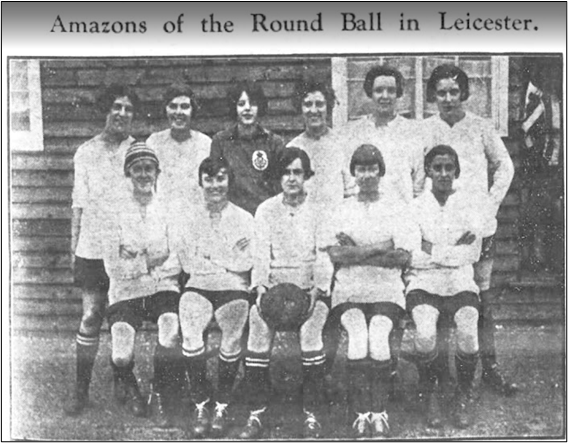
Amazons of the Round Ball in Leicester
Top Right Lizzy Ashcroft and Lily Parr
Source: BNA Leicester Daily Mercury Friday 9 September 1927 p17
1927 Leicester Agricultural Show
A similarly innovative football match took place on Thursday 8 September 1927 at the Leicestershire Agricultural Show. Again the teams were styled Preston v Blackpool with Preston running out 11 v 2 winners and again the charabanc broke down briefly en route. Innovations this time were the advertisement for local ‘athletic ladies’ to join one of the teams and for the glamorous French footballer Carmen Pomies to play. Unfortunately she was taken ill en route to the game from London and had to be taken to hospital. Miss Emma Snow of Blaby played for the ‘Blackpool Ladies’. Three professional footballers from Leicester City acted as officials for the game. The crowd for this game was reported as 1,000.
In a slightly jarring note, in a post match interview, the referee Kenny Campbell, Leicester’s goalkeeper and ex-Scottish International, was quoted in the Leicester Evening Mail as saying “it is against the laws of nature”. This seems a little surprising given the goodwill before the game. My thoughts are that he was probably pressured to say this.
The next high profile charity match involving the Dick Kerr Ladies was in Ilkeston in Derbyshire nearly four years later on Wednesday 15 April 1931. Alice Kell’s active roll in women’s football came to an end in style as manager, chaperone and innovator.
In 1927 Alice Kell married and became Mrs Alice Cook.
English National Football Museum, Manchester
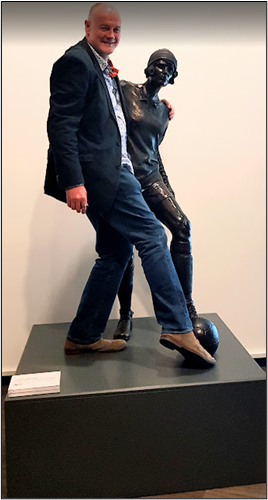
With Granny’s Old Friend: Lily Parr
Source: Author
English National Football Museum Hall of Fame
Lily Parr and Joan Whalley are in the Hall of Fame.
Alice Kell is not in the hall of fame…
Conclusion
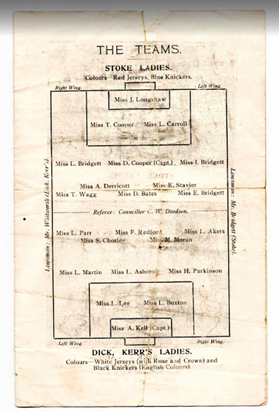
Stoke v DKL 1923 – Kell in Goals, Lizzy at Centre Half
My Original Match Programme
Alice Kell – The Greatest Woman Footballer of All Time
I do not make the above statement lightly. In the 1923 match programme above captain Alice Kell is operating as goalkeeper with my granny at centre half. The mighty Stoke Ladies won this match 1 v 0 in their last ever game thanks to a goal from the great Daisy Bates. Daisy nearly scored a second from a last minute penalty but for this report from the Lancashire Evening Post about Alice Kell in goals:
Alice Kell (the captain) played brilliantly, and towards the close saved a penalty.
Gail Newsham, in her groundbreaking book ‘In a League of Their Own’ about the Dick Kerr Ladies describes my granny Lizzy Ashcroft thus:
She was a tall and skilful player and rated the best defender at the club since Alice Kell.
In my book that is some compliment. I am so glad that my granny got to experience playing with the legend that was Alice Kell, both as her captain and as her manager.
In my view, Alice Kell should not only be in the Hall of Fame, it should be named after her…
Steve Bolton
February 2026