Read Part 1 HERE and Part 2 HERE
In 1935, a Daily Mirror reporter observed that Bill Thomas had been the greatest influence on the ‘small select batch of world’s first-class athletes belonging to Britain’ yet ‘the public does not know him and the A.A.A. have not invited him to teach at their Summer School’.[1] Bill’s traditional training methods and philosophy probably militated against him being invited to the Loughborough Summer School. While there was an increasing tendency ‘to treat athletics as a science’ and several scientific instructional articles were published in the post-War period, Bill thought this approach was being over-emphasised. The place for the coach was on the track, and the trainer’s real job was to bring the athlete to his event really fit. Although the 1939 Register records Bill’s occupation as that of an ‘Athletic Coach’,[2] he apparently refused to use the word ‘coach’, regarding himself simply as a trainer, although his advice to his athletes clearly went far beyond merely getting them fit. Writing in 1953, Pallett observed that there had always been ‘so-called coaches in British Athletics’ and he thought Bill, then nearly 80, the best of them. He was still appearing regularly at the track as a freelance professional and was supposedly,’ by his own confession, not a coach but a trainer. ‘I make em work!’ is his motto’.[3] During his time at Oxford, Bill practiced what he preached and several times a week he changed into running gear and ran miles around the University track. He marked his sixty-second birthday by running a mile in 6 minutes 2 seconds at Iffley Road on December 13, 1935, which was reported as being just 7 seconds short of the record for a veteran, and in 1937 the 64-year-old ran five miles in 34 minutes 28 seconds, beating his previous record by 10 seconds, the last mile being run in 6 minutes 48 seconds.[4] He always insisted that his athletes take a cold shower after training, and even in his seventies he would finish off his weekly five mile run by dousing himself in ice-cold water.[5]
Bill believed that a body could be brought to a peak only once or twice a season and that style mattered above all.[6] Parlett credited Bill with helping him to refine his running style through training schedules that were ‘very personal and geared to you as an individual’. These largely consisted of timed repetitive routines, of varying distances, with frequent 600-yard time trials. At the end of each run, Bill would look at his stopwatch and say either ‘that was good’, or ‘do it again’.[7] Lovelock was very positive about the contribution of Bill to his running.[8] In 1932, he stated that Bill expected him to run the mile in 4 minutes 8 seconds,[9] and in 1933, when he defeated Bill Bonthron to set a world record running for Oxford and Cambridge, he planned to do the four laps in 61, 62, 63, and 62 seconds respectively. His times for the first three laps were a little slow, but as he entered the finishing straight, he made up the time by following Bill’s advice to ‘more or less collect yourself physically and mentally for a last great effort, change the arm action higher, quicken and raise the leg action to as near a sprinter’s as possible’.[10] Lovelock particularly appreciated the coach’s ‘calming influence’ at the approach of a big race. Prior to the annual elite mile at Princeton on June 15, 1935, Bill spent the two weeks up to the race looking after the stressed Lovelock. His ministrations were said by the runner to have ‘saved’ him, ‘physically and mentally’, and enabled him to win a classic tactical race. Before Lovelock ran his last race at Princeton in October 1936, he said that he had ‘been secretly working to a new training schedule with ‘my wonderful coach, Bill Thomas’, who had accompanied him.[11]
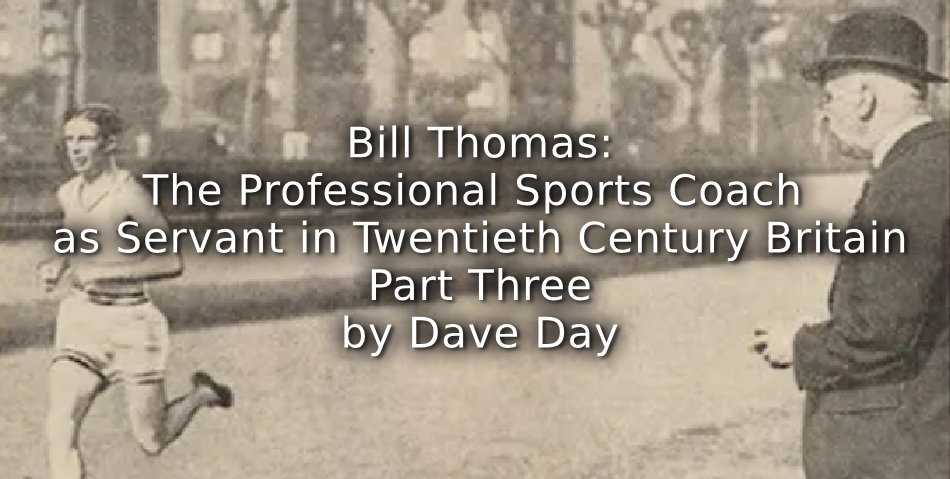
Bill was a distinctive figure, his bulky frame standing silently observing his athletes with stopwatch in hand, quiet but gruff, always dressed in a dark double-breasted suit, tie neatly knotted and always wearing a bowler hat,[12] interestingly mimicking the commonplace uniform of Oxford college servants such as porters and scouts. His most striking asset was said to be his acutely developed ‘coach’s eye’, that quality, acquired through their experience by only a few elite coaches, of accurately estimating an athlete’s potential and of identifying any fault which might be holding him back. This ability to spot a man’s capabilities, plus the training watch, enabled Bill to tell athletes exactly what they were capable of doing and the athletes, finding that they could do just that, acquired confidence in themselves and in the coach. Bill’s judgement was not infallible, of course, and in 1937 he was prepared to give a hundred to one against a four-minute mile being done in his lifetime.[13]
Bill did not agree with varying his manner to suit individual athletes and his approach was the same for everyone. He was always bluntly outspoken and, in common with the leading American coaches of the day, he insisted that his instructions be carried out to the letter. On several occasions he had refused to continue coaching outstanding athletes who ‘showed a tendency to argue points, and who seemed to think they knew as much as he did’.[14] When Bannister went to see Bill, ‘he stood by the track, bowler-hatted, watching me run round. He grunted continuously but said little. Though the comments he made were probably extremely shrewd, he seemed upset when I asked him why he said this or that.’[15] Bill said little but listened much and thought much. Athletes, and others, could find him brusque and somewhat unsocial, but he was a ‘character, not an ordinary man, and ‘in an age of mass production, with even human beings seeming to show fewer strikingly individualistic qualities than they used to, he might even be called eccentric’. The surest guide to his character was the tendency of athletes and officials, who had known him for a long time and who admired not only his vast knowledge, but his forthrightness and integrity, to ‘speak of him almost entirely in superlatives’.[16]
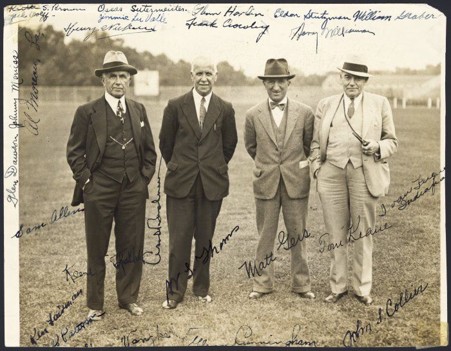
Photograph of Keane Fitzpatrick, Bill Thomas, Matt Geiss and Tom Keane at Princeton, June 1935.
A photograph from Jack Lovelock’s scrapbook showing Bill Thomas, with three leading American coaches.
From left they are Keane Fitzpatrick, just retired as Princeton track coach, Thomas, Matt Geiss of Princeton and the coach of Bill Bonthron, and Tom Keane of Syracuse Uni.
The photograph has been autographed by the four men, and other athletes.
Source/Credit: Lovelock, John Edward (Jack), 1910-1949: Papers. Ref: MSX-2254-024. Alexander Turnbull Library, Wellington, New Zealand. /records/23063491
Audsley and Pallett concluded that Bill could not be ‘blind to the fact that he is less widely known than is his due’, and that he was aware that, had he gone to America, he would have been at least the equal of Lawson Robertson and Dean Cromwell, who were ‘national figures enjoying a commensurate financial reward’. He also knew that, in certain cases where he had not been an athlete’s only coach but had been called in to get results when these were not forthcoming, he had not always received his fair share of credit. Apparently, these things did not seem to worry him. If he had not received much publicity, he had never sought it, and he was, in fact, extremely antagonistic to the idea of it. He was quite content to be simply Bill Thomas, trainer to Herne Hill Harriers.[17] The regard with which he was held by the club is reflected by the inclusion of a special invitation 1500 metres event for the ‘Bill Thomas’ trophy in the programme of an athletic meeting arranged by HHH in August 1955.[18]
The Legacy
At a personal level, Bill Thomas left a coaching legacy through his athletes. Johnny Johnston, an amateur coach who revolutionised the British approach to marathon running as a coach in the 1950s, had received advice from Bill in the 1920s as a member of Herne Hill Harriers and his ideas greatly influenced Johnston’s coaching.[19] On a broader level, even though the nature of the coaching community was undergoing a transformation, the legacy of the master-servant relationship continued to impact on the development of British elite sport in the post-war period. Bill’s successor at Oxford was John Jeffery, a physical education lecturer at the Loughborough Training College and a product of Geoffrey Dyson and the AAA’s national Coaching Scheme. He typified the new group of coaches, who worked hard to raise the standard of British athletic achievement, particularly in field events, where standards had been so much lower than in Europe and America.[20] Bannister observed that Oxford had taken the ‘revolutionary step of appointing a highly qualified professional coach, quite different from the old masseur, handyman trainer and bath attendant coach’ and that athletes were beginning to use cine camera to aid their training, as well as taking advantage of technical advice from the AAA professional coaches. He went on to say, however, that ‘Never, though, will our universities become so coach conscious and coach dominated as are university sports in the USA.’[21]
The widespread reluctance to reproduce the coach-centred system adopted in America was connected both to the amateur ideology and to a broader nationalism. The rapidity and overwhelming nature of American sporting prowess in the first half of the twentieth century entrenched amateur resistance to professional coaches in Britain, at a time when most of Europe was enthusiastically adopting American approaches to training and coaching. Many amateur administrators recognised that engaging professional help could improve international performances and a team of professional trainers was engaged to accompany the British Olympic team to Stockholm in 1912, mainly for their skills in massage or in specialist areas such as maintaining bikes, although their knowledge and experience also proved valuable in coaching the amateur participants.[22] These appointments highlight the increasing opportunities afforded to British professional coaches by the creation and expansion of formal international competitions, but the final decision about whether or not their skills were to be employed remained firmly within the control of their amateur masters. Amateur unease with the engagement of professional coaches was only mollified by reproducing the master-servant relationship characteristic of upper-middle-class life, with any man selected being prepared to ‘know his place’. As a result, the status of professional coaches across most sports ‘differed little from that of a servant or labourer’.[23] Alec Nelson and Bill Thomas both had successful careers at Oxbridge in the inter war period, but archival material always highlights the influence of patronage and the ongoing master-servant relationship that existed between university athletes and their coaches. Professional coaches, irrespective of their level of expertise, were treated paternalistically by employers,[24] they were never allowed to have any administrative input, and their servant status was reinforced by the lack of formal association or opportunities for appropriate training.[25]
There were some dissenting voices to be heard in the late 1940s. In 1947, there were calls to address the standards of coaching and the support given to coaches through the provision of a ‘College for Coaches’. It was argued that, despite having some first-class coaches in cricket, football, athletics, and swimming, Britain still needed ‘an abundance of first-class coaches’ and it was proposed that a body of knowledgeable ‘all round’ coaches, who could call for assistance from an elite specialist coach when required, should be developed. A British College of Sport, a national centre for training sports coaches, could offer a three-year course with students learning the origin and development of various sports, first aid, psychology, massage, modern methods of coaching, correct interpretation of sporting rules, and the organisation of sport.[26] A year after the 1948 Olympics teachers were calling for the introduction of a teaching certificate in athletics,[27] and writing in the Daily Express in 1949 Frank Butler observed that it was a pity that ‘in spite of the lessons we keep learning from the Americans we are not 100 per cent coach conscious. The American athletic coaches are among the highest paid in sport and why shouldn’t they be? Their dominance at the Olympics is due to coaches as much as to the athletes’.[28]
However, these perspectives were very much in the minority and Oxbridge members of the Achilles Club, the traditional backbone of international athletics teams, remained somewhat ambivalent about coaching, despite many of them being Honorary AAA coaches. Although they agreed that coaches were necessary in technical events it was also argued that runners could ‘acquire a good technique without ever being coached’, and that the rigid application of a coaching system could ‘ruin a man of great natural gifts.’[29] In 1953, the AAA secretary, E.H.L. Clynes, observed that:
The association is, however, not only concerned with champions but with the average young man who wishes merely to participate in a healthy outdoors recreation, to build up a fit body and mind, in the friendly company of other athletes. Too much emphasis cannot be given to the fact that amateur athletics is primarily and always a recreation. This is the foundation on which the association has been built, and the sole reason why thousands of old athletes are prepared to give voluntary service to the active members as honorary coaches, honorary administrators or club officials. Without this unpaid service amateur athletics could not exist.[30]
Even after NGBs such as the AAA began to employ professionals as national coaches, one British athletics team manager, Les Truelove, often referred to coaching as ’90 per cent kidology’ and outwardly expressed the view that he did ‘not believe in coaching’.[31] This was a common attitude of amateur administrators and one that caused frequent disagreements between them and their national coaches. Many officials felt that the role of national coach did not confer any special status, and they made no attempt to mediate their approach.[32] The AAA national coach Geoff Dyson believed that the ‘average British person wouldn’t be able to explain the difference between a trainer and a coach’ and even those who did understand the coaching role, still felt that it was ‘unimportant’ and considered the coach ‘a sort of hanger-on.’[33] It was unsurprising, therefore, that administrators were not willing to take direction from the coaches. When Dyson suggested to Roland Harper, the Chair of the AAA Coaching Committee, that he should be referred to as the ‘Director of Coaching’ because that was essentially the job he was doing, Harper replied, ‘Oh, the Coaching Committee would never agree to that, for we cannot be directed by anyone.’[34]
The imposition of this master-servant relationship on the sporting pedagogue, left a legacy that permeated nearly all aspects of twentieth-century British sport. Disagreements between Dyson and amateur administrators had reached such a pitch by 1961 that he felt that he had to resign. He was subsequently offered him a five-year contract as the Director of the Royal Canadian Legion Sports Training Plan leading observers to argue that ‘Britain’s loss is Canada’s gain – apparently they place far greater importance on athletics coaching in Canada than we do’.[35] For Tom McNab, AAA National Coach from 1963-1977, the legacy of the intangible heritage of amateurism was that it had left a ‘vacuum’ that would inevitably impact on any future coaching developments.[36] The strength of the amateur ideal and the embedding of voluntarism as a practice became so entrenched in the British sporting psyche that most sports coaches still work part-time in a voluntary capacity and the number of men and women coaching professionally full time remains very small in comparison.
Dave Day, Independent Researcher, djday75@gmail.com, ORCID: 0000-0002-6511-1014.
References
[1] R.A.H. ‘Centipede’. ‘How I Do It—By Lovelock’, Daily Mirror, June 17, 1935, 27.
[2] 1939 Register 22/4/192, 63 Water Lane, Lambeth, William G. Thomas, Widow, born 24 December 1873, Athletic Coach.
[3] George Pallett. ‘Rise of Coaching in England’. The Straits Times, February 27, 1953, 13.
[4] Daily Express, April 12, 1937, 17.
[5] Bryant, 3:59.4: The Quest to Break the 4 Minute Mile, 138-140.
[6] Bryant, 3:59.4: The Quest to Break the 4 Minute Mile, 91-93.
[7] Matt Rogan and Martin Rogan, Britain and the Olympic Games–Past, Present, Legacy (Leicester: Matador, 2010), 91.
[8] ‘Biographies, John Edward Lovelock’, Te Aro, The Encyclopaedia of NZ.
[9] Evening Post, June 22, 1932, 9.
[10] ‘World Record Run. The Great Race’, Evening Post, September 16, 1933, 7.
[11] ‘Centipede’. ‘Lovelock, Miler of the Century, Talks of his Last Race Today’, Daily Mirror October 3, 1936, 26; ‘Lovelock Fails to Win U.S.A. “Century Mile”’, Daily Mirror, October 5, 1936, 29.
[12] Daily Mail, December 14, 1935,14; December 20, 1935, 15.
[13] Sunday Express, June 27, 1937, 27.
[14] Audsley and Pallett, ‘Presenting Bill Thomas’, 11, 12.
[15] Bryant, 3:59.4: The Quest to Break the 4 Minute Mile, 227; Bannister, First Four Minutes, 58.
[16] Audsley and Pallett, ‘Presenting Bill Thomas’, 12.
[17] Audsley and Pallett, ‘Presenting Bill Thomas’, 12.
[18] ‘Evening Meeting at Tooting Bec’, The News, August 12, 1955, 5.
[19] Neil Allen, ‘Mr. Johnny Johnston. Marathon Runners’ Coach’, The Times, 6 April 1967, 16.
[20] Bannister, First Four Minutes, 59-60.
[21] Chandy, History of OUAC – Of coaches and coaching. https://www.ouac.org/history-club
[22] Dave Day, ‘Massaging the Amateur Ethos: Professional Coaches at Stockholm in 1912’, Sport in History 32, no. 2 (2012): 157-182.
[23] Neil L. Tranter, Sport, Economy and Society in Britain 1750-1914 (Cambridge: Cambridge University Press, 1998), 71.
[24] Riess, ‘From Pitch to Putt’, 179-180.
[25] Norman Baker, Whose Hegemony? The Origins of the Amateur Ethos in Nineteenth Century English Society Sport in History 24 no. 1 (2004),12-13.
[26] Hedley Trembath, British Sport (London: Skelton Robinson British Yearbooks, 1947), 17-18.
[27] R.A. Sparling, ‘Coaching the Coaches’. The Weekly Telegraph, August 6, 1949, 14.
[28] Frank Butler, ‘Use the Ex-Star as Coaches’, Daily Express May 6, 1949, 6.
[29] Harold Albert Meyer, ed., Athletics (London: J. M. Dent, 1955), 3-4, 293.
[30] AAA Annual Report, 1953.
[31] Christopher Brasher, “The Path to Rome: Smoothing the Way”, Observer, October 4, 1959, 31.
[32] Tony Ward, ‘Echoes of Infamy’, Running Magazine, April 1987, File HA Box 3, AAA Collection, Birmingham.
[33] Geoff Dyson, interview by Tom McNab, 1970.
[34] Carpenter, ‘Uneasy Bedfellows’, 127, 156-157.
[35] ‘Exports’, Athletics Weekly, April 25, 1964.
[36] Carpenter, ‘Uneasy Bedfellows’, 167.